

The secret behind North Korea's 'piggy bank'
Despite its economic isolation, North Korea has found numerous loopholes to acquire substantial amounts of foreign currency.
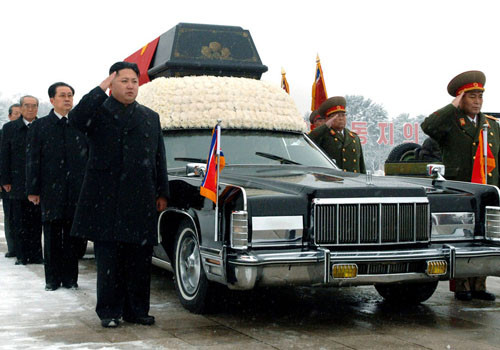 |
North Korean leader Kim Jong-un (left) stands next to a Lincoln Continental carrying the coffin of the late leader Kim Jong-il. Photo: AP. |
When leader Kim Jong-un appeared in public in a sleek black Mercedes Benz worth an estimated $2 million, the world couldn't help but wonder who sold those luxury cars to North Korea?
In addition to luxury limousines, North Korean leader Kim Jong-un also owns a $6 million yacht and the $35 million Masikryong ski resort, CNN reported, citing an international organization that monitors North Korea's economic activities.
Since 2006, the United Nations has tightened sanctions on North Korea over its controversial nuclear program. For years, the US and its allies have sought to cut off the North Korean government's money supply, including freezing all of North Korea's transactions in the global banking system.
However, according to a 2014 United Nations report, in 2012, the North Korean government spent $645.8 million on luxury goods, equivalent to 19% of the country's total spending of $3.47 billion in 2015.
Excluding China, North Korea's largest trading partner—where approximately 75% of its exports go to its neighbor—the value of North Korea's luxury goods imports exceeds the total value of all other goods imported combined, according to an analysis of international trade data by the Observatory of Economic Complexity.
Foreign exchange supply
The US Central Intelligence Agency (CIA) assesses North Korea as one of the least "open" countries in the world.
"Heavy military spending has depleted resources needed for investment and consumption. Industrial and energy production has stagnated for years. Crop failures due to weather have further exacerbated the food shortage," the agency said.
So where does the foreign currency flowing into North Korea come from? CNN, citing experts, suggests that the government has many ways to circumvent the law and bring foreign currency back into the country. Besides coal exports and illegal labor, North Korea is accused of conducting cyberattacks targeting banks worldwide, smuggling weapons, producing counterfeit money, and even trading in endangered species. A 2008 US congressional study estimated that Pyongyang earns between $500 million and $1 billion annually from these illegal activities.
"North Korea would be willing to sell anything it can sell to anyone as long as it's a 'cash for goods' deal," Anthony Ruggiero, a former U.S. Treasury Secretary, said at a forum on democracies in June.
This supply of foreign currency not only helps North Korea develop its weapons and nuclear programs, consolidating the power and position of leader Kim Jong-un, but also assists Pyongyang in neutralizing pressure from the US and its allies.
"Foreign currency goes directly into the bank accounts of North Korean leaders," said Professor Sheena Greitens of the University of Missouri, who has been tracking North Korea's financial activities for the past 10-15 years.
Economic stick
Analysts believe that only by tracking and blocking the secret flows of foreign currency into North Korea can US President Donald Trump exert enough pressure to force the North Korean leader to agree to sit down at the negotiating table.
In theory, it sounds easy, but in reality, cutting off Pyongyang's foreign currency earnings is not simple. North Korea will always find new ways to transfer money back into the country.
"(Pyongyang) is really good at finding new ways to circumvent the law, very creative with measures to generate foreign currency, sometimes, this involves changing the geographical location of illegal activities," Professor Greitens said, adding that it is necessary to control North Korea's ability to adapt.
"North Korea has built an overseas system capable of withstanding pressure from any international sanctions, primarily through its skillful concealment and disguise of illicit trade activities under the guise of legitimate ones," according to John Park, a North Korea expert from Harvard University.
To counter Pyongyang's unpredictable maneuvering, US Secretary of State Rex Tillerson said the US is prepared to sanction third parties that help North Korea circumvent the law.
Although Secretary of State Tillerson did not specify how the U.S. would punish countries engaging in clandestine trade with Pyongyang, the immediate priority is for those countries to scale back diplomatic relations with North Korea.
"What we are doing is asking countries to reconsider their diplomatic relations with North Korea," said W. Patrick Murphy, Deputy Assistant Secretary of State for Southeast Asian Affairs. Murphy also emphasized that the U.S. is putting pressure on Southeast Asian nations.
However, the effectiveness of this measure remains an unanswered question.
"Southeast Asian countries maintain ties with North Korea in many areas—diplomatic, cultural, and economic. And they have demonstrated that they want to maintain these relationships... They will decide for themselves how they will deal with North Korea," according to The Diplomat magazine.
The China factor
"If you want to cut off all of Pyongyang's revenue streams... Ultimately, you still have to come back to the question of what you'll do with China," former U.S. Treasury official Ruggiero concluded.
As North Korea becomes increasingly isolated, it is becoming more dependent on China, its closest ally, largest supplier, and most influential partner. According to UN figures, approximately 85% of North Korea's exports go to China, and 76% of its imports also come from China.
Experts say the U.S. will need China's support to contain North Korea.
Last November, Beijing agreed to take a tougher stance on UN sanctions against North Korea. One of North Korea's biggest sources of foreign exchange comes from selling millions of tons of coal to China each year, accounting for about one-third of North Korea's official export output in 2015. Therefore, effective February 19th, China decided to halt coal imports from North Korea.
However, China has never tightened its trade and economic grip on its East Asian neighbor because North Korea remains a crucial economic and political buffer zone for Beijing to counter South Korea, a key US ally, former CIA director David Cohen observed.
John Park, director of the Korea Working Group at Harvard Kennedy School, believes that Pyongyang is holding "very large sums of money" in Chinese banks.
According to CNN, investigations by the United Nations and the US government have also found evidence that North Korea is using a network of shell companies to conduct transactions through banks globally. Anthony Ruggiero warned that the US would intervene to prevent Chinese banks from continuing to assist Pyongyang.
"Ultimately, you'll still have to follow the trail of Chinese banks and companies colluding with Pyongyang to evade international sanctions," Ruggiero said.
According to VNE
| RELATED NEWS |
|---|