

In six months, only 6 enterprises completed their equitization process.
The slow pace of equitization means that the number of units to be completed this year has reached 40, still 5 fewer than planned.
On July 11th, Deputy Prime Minister Vuong Dinh Hue, Head of the Steering Committee for Enterprise Reform and Development, chaired a meeting to review the work of the first six months of the year on the equitization and divestment of state-owned enterprises.
Assessing the restructuring, equitization, and divestment of state capital in enterprises during the first half of the year, Deputy Prime Minister Vuong Dinh Hue pointed out the cautious attitude and fear stemming from previous inspections and audits, leading to a reluctance to make decisions on matters within the authority of ministries and localities, instead opting to seek the Government's opinion for safety. This is also partly why the process is sluggish and failing to meet requirements and objectives.
"Experience shows that ministries that are decisive see positive changes, while those where leaders are not decisive experience stagnation and very limited results," the Deputy Prime Minister emphasized.
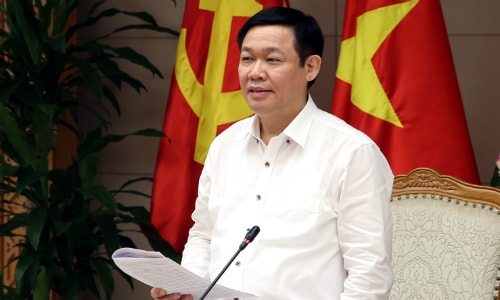 |
Deputy Prime Minister Vuong Dinh Hue stated that any unit whose leadership does not decisively direct the equitization of enterprises will achieve very limited results. (Photo: VGP) |
Reporting at the meeting, Deputy Head of the Government Office Le Manh Ha - Deputy Head of the Steering Committee - stated that only 6 enterprises had completed equitization in the first 6 months of the year, and 14 enterprises were developing plans to submit to competent authorities for approval. Among them...There are businesses with very large equity capital, such as three member companies of the Vietnam Oil and Gas Group (PetroVietnam) with a total equity value of nearly 90,000 billion VND, or a unit of the Vietnam Electricity Group (EVN) with equity capital of 24,000 billion VND. "We will complete the equitization of 40 businesses throughout the year, 5 fewer than planned," said Mr. Le Manh Ha.
Regarding the divestment of state capital, divestment has been completed in 22 enterprises with a total book value of over 666 billion VND and revenue exceeding 11,589 billion VND. Six of these units divested below par value.
The Deputy Prime Minister stated that if a large enterprise is successfully privatized between now and the end of the year, the percentage of capital transferred to new ownership will be very large, leading to better governance.Therefore, he insisted that the equitization and divestment plan for 2017 must be completed.
Government leaders urged ministries and localities to "act in accordance with the law, ensuring transparency and openness. If the law is inadequate, it must be amended, but while it is still in effect, it cannot be violated; it must not follow established practices and must safeguard national interests."
In addition,The government will review the responsibility of leaders of ministries, departments, localities, corporations, and general companies who are遅延 (delayed) or fail to complete the tasks of reforming and restructuring enterprises, privatizing, and divesting.
To address institutional shortcomings, the Head of the Steering Committee for Enterprise Reform requested the Ministry of Finance to submit to the Prime Minister in July a draft decree amending Decree No. 59 on converting 100% state-owned enterprises into joint-stock companies; and to complete the amendment and supplementation of Decree 91 on state capital investment and management of state capital assets in enterprises in August.
Also in August, the Ministry of Planning and Investment submitted to the Prime Minister for signing a Decision on the list of state-owned enterprises to be divested during the 2017-2020 period...
Corporations and state-owned enterprises must submit their equitization plans no later than July for the Prime Minister's approval in August 2017.
According to VNE