

What are effective solutions for downsizing the workforce?
Without restructuring the organization and the civil servant workforce, it is impossible to reduce the number of civil servants.
No mechanical reduction
Implementing Resolution No. 39 of the Politburo on downsizing the workforce, Hanoi aims to reduce it by at least 10% by 2020, completing the goal one year ahead of schedule. The ultimate objective is to streamline the workforce while simultaneously improving the quality of public service delivery. To date, agencies and units have basically completed organizational restructuring and consolidation; and are continuing to finalize job position plans as a basis for workforce reduction...
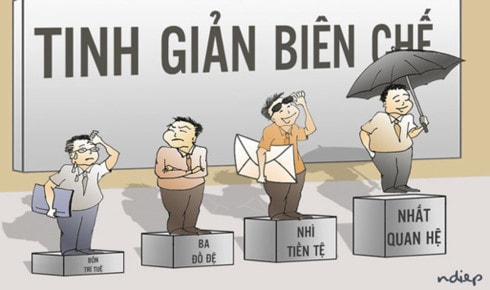 |
| Illustrative image. |
Accordingly, the Hanoi City Party Committee merged two Party Committees: the Business and Tourism sectors; seven districts no longer have Farmers' Associations; 20 Party and mass organization units were restructured; and the number of project management boards from the city to the district level was reduced from 69 to 27…
Following the restructuring and consolidation, Hanoi city has reduced 59 departments and divisions; 39 heads of departments and divisions and 143 deputy heads of departments and divisions; 130 affiliated public service units under the Departments, 27 project management boards, and 2 funds, resulting in a corresponding reduction of 30 head positions and 69 deputy positions. It is expected that upon completion, an additional 128 units will be eliminated at the district level.
Mr. Vu Duc Bao, Head of the Hanoi City Party Committee's Organization Department, stated that Hanoi's experience shows that instead of mechanically reducing staff, it's about eliminating surpluses and those with weak capabilities, merging units with similar functions and tasks, and increasing staff in areas with shortages based on approved job position frameworks. Simultaneously, it supports the transition of public service units to a self-governing and self-responsible mechanism. In practice, these units have proven highly effective, achieving financial autonomy, budget autonomy, and staffing autonomy, eliminating the need for state subsidies.
“Based on this experience, in 2017 Hanoi decided to expand the scope of subsidized units and sectors. The spirit will be to resolutely focus on subsidizing only administrative and state management units, while for units that can be socialized and become self-reliant, we will resolutely focus on directing efforts to ensure that this is the key to downsizing the workforce, and the number of civil servants and public employees reduced in this area will be large, rapid, and effective,” said Mr. Vu Duc Bao.
The practice and approach in Hanoi show that downsizing the workforce must be linked to streamlining the number of administrative units. The workforce of officials, civil servants, and public employees must be restructured, not simply reduced in number. In conjunction with workforce reduction, ministries, sectors, and localities must develop workforce reduction plans from now until 2021, and each year must have a specific plan with a roadmap for downsizing.
Based on this, units and localities that have not yet met the prescribed downsizing rate must increase the downsizing rate by 1.5-2% each year, so that by 2021, the downsizing rate across the entire political system must reach at least 10%. This will avoid the situation where 86.25% of those subject to downsizing are officials with only 2-3 years left before retirement, leading to the downsizing policy targeting the wrong people.
National Assembly representative Pham Khanh Phong Lan, from the Ho Chi Minh City delegation, stated that downsizing the workforce is a sensitive issue, affecting the responsibilities and rights of over 3,574,000 current civil servants and public employees. For this process to be effective, it requires coordinated efforts from all levels and sectors, creating motivation in the workplace. This process cannot be achieved without the impartiality, responsibility, and exemplary conduct of the heads and leaders of agencies in evaluating and assessing staff.
According to delegate Pham Khanh Phong Lan, due to quota issues, there is a phenomenon of "grabbing whatever is available," with everyone who retires being counted as part of the downsizing process. Therefore, it is necessary to redefine tasks and work efficiency, strengthen job performance-based compensation to increase income, and allow civil servants and public employees to balance their finances. At the same time, downsizing should start from the top down to set an example, and boldly implement the job position scheme.
In fact, the number of staff in public service units increased by 165,000 from 2011 to 2016. However, during the implementation of Resolution 39, some local public service units were reorganized to streamline operations. The workforce of the public service system was strengthened in terms of quantity, especially in education, training, vocational training, and healthcare.
The staff of public service units basically meet the requirements and professional tasks assigned and are gradually improving; public service units are autonomous in paying salaries and income, thereby attracting a highly qualified workforce. Therefore, a long-term solution is to promote socialization, reduce the number of people receiving salaries from the state budget, and create more jobs for the workforce, which should be encouraged.
Staff reduction must be linked to a reduction in the number of administrative units.
Minister of Home Affairs Le Vinh Tan said that the Ministry is submitting to the Prime Minister a plan to reform the management and financial mechanisms and reorganize the system of public non-business units.
This includes promoting decentralization in management and finance; proposing a shift from fees to prices to enable public service units to be financially autonomous; gradually researching the elimination of subsidies for public service units; and ensuring equal treatment between public and private service units to encourage competition. Simultaneously, there should be a development plan for public service units, focusing on standards and conditions for development, and gradually reducing state funding for public service units, moving towards socialization and granting autonomy to these units.
Recently, while working with the Ministry of Interior on this project, Deputy Prime Minister Vuong Dinh Hue requested that the restructuring of the public service system should avoid dispersion, fragmentation, and overlap in order to significantly reduce the number of administrative units, decrease the workforce, and link the right to recruit with the right to employ.
“The perspective on reforming the operations of public service units must follow market principles, with the leading role of the state; thoroughly implementing the Party's guidelines and resolutions. Socialization should be encouraged, with clear distinction between public and private sectors. Decentralization and delegation of authority should be strengthened. Along with that, inspection, supervision, and post-auditing should be intensified. The overall goal is to improve the quality of public services while also improving the living standards of civil servants and workers in the public sector, restructuring budget revenue and expenditure to create resources for salary reform,” Deputy Prime Minister Vuong Dinh Hue emphasized.
Therefore, downsizing the workforce must be linked to reducing the number of administrative units. Without restructuring the organization and the civil servant workforce, workforce reduction is impossible. The policy of reforming management mechanisms, financial mechanisms, and reorganizing the system of public service units is crucial. Alongside this, it is also important to encourage socialization and grant autonomy to public service units.
In addition to such fundamental solutions, it is necessary to emphasize the role and responsibility of leaders in streamlining staffing and utilizing personnel; in other words, the effective use of human resources should be considered a particularly important solution.
Leaders need to be given more authority in recruitment, and also be held more accountable if subordinates fail to complete their tasks. Only then can the major policy of the Party and State to streamline the workforce and improve the quality of cadres and civil servants be effectively implemented, which is a crucial factor for the stable and sustainable development of the national economy.
According to VOV