
Trump's isolation at the G20
The US president faced opposition from most world leaders on the issues of climate change and trade at the G20 summit.
The US president faced opposition from most world leaders on the issues of climate change and trade at the G20 summit.
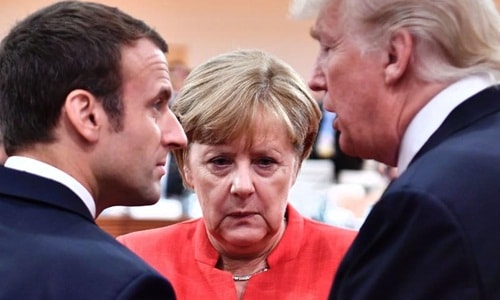 |
French President Emmanuel Macron (left), German Chancellor Angela Merkel (center), and US President Donald Trump exchange views at the G20 summit. Photo: AFP. |
After two days of meetings, the G20 summit of the world's largest economies in Hamburg, Germany, concluded with a joint statement "against protectionism, including unfair trade practices" and emphasized that the Paris Agreement on climate change is "irreversible".
This joint statement leaves US President Donald Trump on the sidelines, as he has long pursued an "America First" policy and has not supported global trade or the Paris Agreement on climate change. Earlier this year, after taking office, he signed an executive order withdrawing the US from the Trans-Pacific Economic Partnership (TPP). Last month, Trump announced the US withdrawal from the Paris Agreement.
Turn America into a 'private oasis'
For years, the United States dominated and set the agenda for the G20 summit. But on July 7, when President Trump met with world leaders at the G20 summit in Hamburg, he may have vaguely realized that the US was isolated on everything from trade to climate change, according to the New York Times.
In her opening address at the conference, host country Chancellor Angela Merkel noted the disagreements between the United States and the other G20 member states.
The US president has likely accepted his isolation. For Trump, the most important moment of July 7th was the high-level meeting with Russian President Vladimir Putin, marking a long-desired reset of US-Russia relations.
While his predecessor portrayed America as a "benevolent" superpower, seeking to increase prosperity through open markets and multilateral cooperation, Trump portrays himself as a nationalist, a supporter of unilateralism, and a protectionist, eagerly defending American jobs.
To advance his position, Trump alienated allies and turned America into an isolated oasis because no nation today is large or powerful enough to impose its will on others, New York Times writers Steven Erlanger and Julie Hirschfeld Davis observed.
Disagreements over trade
Experts say Trump is most clearly isolated on the issue of trade. He argues that the U.S. is unfairly disadvantaged in free trade agreements, such as the North American Free Trade Agreement (NAFTA) between the U.S., Canada, and Mexico, or the Trans-Pacific Partnership (TPP).
According to him, the American steel industry is being threatened by globalization. In the coming days, he may order restrictions on steel imports and impose new, higher import tariffs on the commodity. This would be a provocative move affecting trade between the US and more than 10 major countries, even though it is supported by his ardent supporters.
Measures using tariffs to protect domestic trade could also spark a global trade war. European officials at the G20 summit threatened retaliation. "We will take countermeasures if necessary, but hopefully this will not be truly necessary. We are ready to fight," European Commission President Jean-Claude Juncker declared on July 7.
Italian Prime Minister Paolo Gentiloni warned that protectionist trade measures could stifle global economic growth.
However, while Trump relentlessly pursued protectionism, the European Union (EU) and Japan signed the EU-Japan free trade agreement on July 6th. Mexico and China, two of the US's largest trading partners, are also considering signing similar agreements with the EU.
For weeks, Trump and his economic advisors have been undecided on how to protect the domestic steel industry due to internal disagreements. For the past few weeks, trade lawyers, steel industry leaders, and lawmakers have anxiously awaited a proposal from the Commerce Department on this issue. They view the President's decision as a crucial point in clarifying whether he is willing to fulfill his campaign promises to protect struggling American industries with tariffs.
Some economists are concerned about Trump's unconventional stance on trade because they have seen damage from actions based on such positions in the past.
Last year, the U.S. imported 30.1 million tons of steel, becoming the world's largest steel importer, according to the International Trade Administration (ITA) of the U.S. Department of Commerce. Canada, Brazil, and South Korea were the three largest steel exporters to the U.S., followed by Mexico and Turkey. China, the most targeted country in anti-globalization rhetoric, was not a major factor, at least not for the steel industry.
Michael Strain, an economist from the American Enterprise Institute (AEI), fears that retaliatory actions by China and Europe against any increase in steel import tariffs would hurt American exporting companies and potentially lead to job cuts at a time when Trump is trying to protect and create jobs for Americans.
On July 7, EU Trade Commissioner Cecilia Malmstrom warned the Trump administration that new tariffs on steel imports into the US would be opposed at the World Trade Organization (WTO). A similar opposition from the WTO in 2002 forced the US to withdraw high tariffs on steel imports imposed by the George W. Bush administration.
"If global trade rules are not followed, the EU will retaliate, but I can't say exactly how or when. We understand that the US is concerned about the overcapacity of steel in China, but we don't think imposing high import tariffs is the right approach because you can't fight protectionism with protectionism," Malmstrom asserted. Yet, Trump even considered withdrawing the US from the WTO.
Being excluded from the issue of climate change.
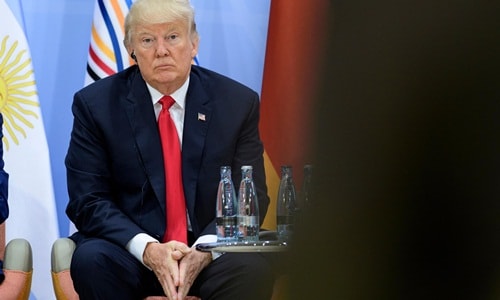 |
US President Donald Trump maintained his individual positions on trade and climate change at the G20 summit. Photo: AFP. |
Just a year ago, the U.S. was a leading voice advocating for global action to reduce greenhouse gas emissions. However, President Trump disappointed and angered many world leaders when he announced the U.S. withdrawal from the Paris Agreement on climate change, which had set commitments to reduce greenhouse gas emissions to combat global warming.
"I criticize the United States for its decision to withdraw from the Paris Agreement," German Chancellor Angela Merkel emphasized in her closing speech at the G20 summit.
The G20 joint statement included the following passage: "We take note of the U.S. decision to withdraw from the Paris Agreement. The other G20 leaders affirmed that the Paris Agreement is irreversible."
In an effort to portray the US as an outsider for rejecting the agreement, G20 negotiators worked late into the night of July 7 to insert the phrase "irreversible" into the joint statement.
However, US officials pressured for the inclusion of the following sentence in the joint statement: "The United States affirms its commitment to working with other nations to help them access and use fossil fuels in cleaner and more efficient ways." Previously, French President Emmanuel Macron had strongly opposed this sentence.
According to VNE