
Bamboo bed village in Vinh City
(Baonghean.vn) - In contrast to the bustling and dynamic streets not far away, Hamlet 6, Nghi Lien Commune (Vinh City) still retains its rare peaceful and rustic charm.
(Baonghean.vn) - In contrast to the bustling and dynamic streets not far away, Hamlet 6, Nghi Lien Commune (Vinh City) still retains its rare peaceful and rustic charm.
It is also the only village in the city that still preserves the craft of making bamboo beds, with many skilled artisans.
We arrived at Hamlet 6, Nghi Lien Commune, as the sun was setting. From afar, we could see groups of adults and children gathered on bamboo benches, enjoying the breeze. It was a peaceful scene, rarely found amidst the hustle and bustle of the city.
As evening approached, the sounds of chiseling and carving occasionally echoed through the air. These pleasant sounds led us to the home of Mr. Le Duy Dong, who has been involved in the craft of making bamboo beds for over 30 years. Notably, all three male heads of his family—his father, himself, and his older brother—are skilled craftsmen in Nghi Lien.
Right at the entrance to the small house, there was an abundance of bamboo, reeds, and other materials. Inside, in the spacious courtyard, a man with graying hair, a tanned complexion, and calloused, sinewy hands was busily carving and shaping bamboo strips to assemble the legs of a bed frame.
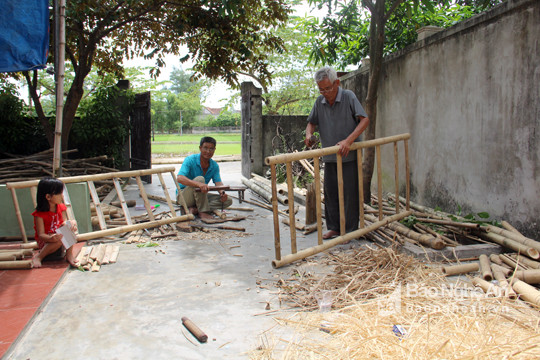 |
| Mr. Le Duy Dong (right) and his brother are among the most skilled bed-making craftsmen in Hamlet 6, Nghi Lien Commune. Photo: TQ |
On the other side, Mr. Dong's wife was fanning a large charcoal brazier. Once the charcoal was burning, she carried each bamboo pole one by one and placed them beside the brazier. Mr. Phuong then took a break, quickly drank some water, and went to the brazier. Recognizing his guest, he smiled and said, "Yesterday I found nearly a dozen bamboo poles with thick, old roots and solid cores that I really liked. But unfortunately, they were bent, so I had to heat them over the fire to straighten them. I put in the effort to heat and bend them, it took a little time, but in return I made a sturdy bed."
Then, he meticulously heated each bent section of the bamboo. While heating, he quickly rotated it to prevent the outer layer from burning black, then swiftly placed it on the ground. He firmly gripped the bamboo with one foot, using both hands to press and straighten the bent parts. He continued this process until all the bamboo was perfectly straight, his shirt soaked with sweat.
Making bamboo beds is hard work, but he finds joy in it. Perhaps it's because the bamboo bed has been an indispensable companion since he first took his first steps, and later, when he helped his father make beds; and after each trip to the market, his mother would be rewarded with pieces of powdered candy and chewy candy.
He recounted that back then, his family was so poor that they didn't have beds; everyone slept on a cot. Even without money to buy hammocks for the children, his father designed a small cot and hung it from the rafters at all four corners. He then tied a rope to the window bars, and whenever they lay on the cot, they just pulled the rope gently and the cot would swing back and forth.
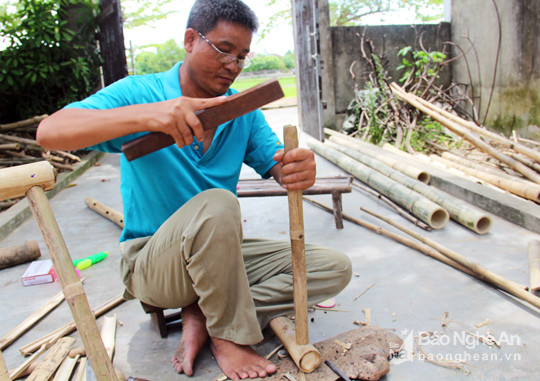 |
| The parts of the bed frame were assembled precisely and fit together perfectly. Photo: TQ |
And so, Mr. Dong grew up to the rhythm of the rocking of the wooden bed. By the age of 13, he was able to make his first wooden bed with his own hands. Although his mother immediately took the finished bed to the market to sell, even now, decades later, he can still remember and describe its dimensions and every small detail clearly.
In 1986, at the age of 20, Mr. Dong enlisted in the army and fought in the Cambodian battlefield. After three years of service, he returned home. Since then, after each day of farming, he has been dedicated to making wooden beds.
According to him, learning how to make a bamboo bed frame isn't difficult; you just need to pay attention, watch others make them, and you can get the hang of it. However, making a bamboo bed frame that meets standards, is durable, and beautiful is extremely difficult. It requires not only patience and perseverance but also a bit of talent and dexterity. From the material selection stage, the bed frame maker must have a keen eye for bamboo. Just by looking at the base of the bamboo, they can tell which is young and which is good for making a bed frame. Straight, thick, and sturdy bamboo stalks aren't necessarily good.
After being selected, the bamboo must be soaked in a pond before being taken out and dried. This is done to prevent termite infestation and to ensure the frame doesn't warp, crack, or split due to dry weather. While measuring and calculating are important, it's crucial to be able to estimate precisely so that each saw cut and chisel stroke is accurate. This ensures that when the bamboo sections are assembled and joined, they fit together perfectly.
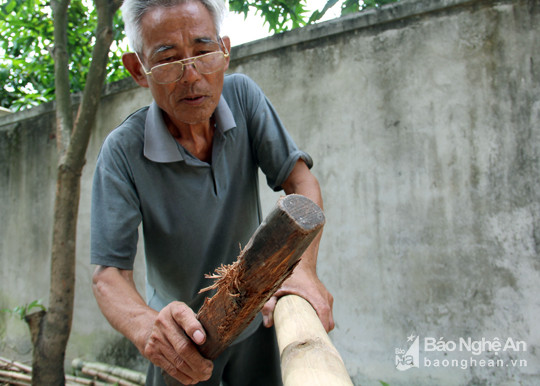 |
| Despite being over 70, Mr. Le Duy Dong remains dedicated to his work. Photo: TQ |
Nowadays, with bamboo and rattan becoming less readily available, the process of making bamboo beds has changed somewhat. Makers can use other materials like bamboo and reeds as substitutes. Depending on the materials used, the bed maker must know how to adjust the thickness, tighten and shape the joints to ensure the bed is sturdy, the legs are firm, the pegs are smooth and tight, and the knots are neatly braided to prevent discomfort for the user.
Because of the meticulous attention to detail in each product he makes, Mr. Dong's goods sell out as soon as they're produced. On average, he sells 25 to 30 beds per month during the summer. Each bed costs around 300,000 VND, but if customers order a larger bed, the price can go up to 700,000 - 1,000,000 VND.
During off-peak months, consumption remains stable, primarily serving the needs of families with young children for steaming and drying, or for elderly people with serious illnesses to facilitate washing and cleaning.
 |
| Bamboo beds are not only beautiful but also durable enough to last for many years. Photo: TQ |
In many localities, preserving traditional crafts faces considerable difficulties. However, in Hamlet 6, the craft of making wooden beds is still preserved, with nearly 20 households involved. In fact, multiple generations, with siblings in one family working together, make beds and constantly innovate designs and styles to meet the increasingly high demands of customers.
For them, preserving the craft is not just about making a living, but also about their love for the traditional craft that has been passed down for hundreds of years.
Thanh Quynh