

Will shipping costs increase in line with fuel prices?
Following four consecutive fuel price increases, many businesses are beginning to consider raising transportation fares. If this happens, it will negatively impact consumers.
Businesses are "waiting and watching".
Effective September 5th, the Ministry of Finance and the Ministry of Industry and Trade jointly decided to increase gasoline prices across the board. Specifically, RON 92 gasoline increased by 306 VND/liter, E5 gasoline by 285 VND/liter, 0.05S diesel by 155 VND/liter, kerosene by 149 VND/liter, and 180CST 3.5S fuel oil by 43 VND/kg. This marks the fourth consecutive gasoline price increase, with a total increase of 1,777 VND/liter (equivalent to a 10.8% increase) since July 2017.
Since the beginning of 2017, with 7 price increases (an additional 2,934 VND/liter) and 7 price decreases (a reduction of 2,682 VND/liter), and 3 adjustments where the price remained unchanged, gasoline prices have increased by an additional 261 VND/liter.
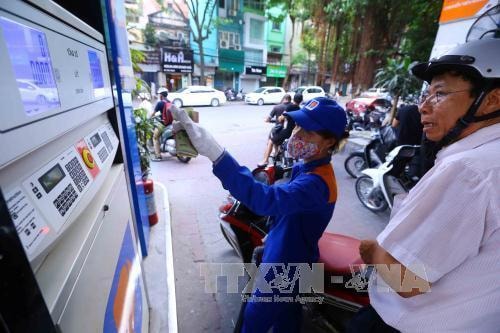 |
| From September 5th, the price of A92 gasoline increased by 306 VND/liter. |
Observations show that in previous instances of freight rate increases following fuel price hikes, when fuel prices rose by around 5%, businesses would consider adjusting rates to offset input costs. Therefore, this time, with gasoline prices increasing by 10.8% and diesel by 8.6%, transportation businesses will likely be considering raising freight rates.
Many transport businesses, when asked, said they were "waiting and watching" the market and had not yet submitted official fare increase plans to the authorities, but affirmed that if fuel prices increased, businesses would find it difficult to "tighten their belts." However, raising fares is not a simple matter.
According to Mr. Nguyen Van Thanh, Chairman of the Vietnam Automobile Transport Association, traditional transport businesses are facing intense competition, especially from technology-based transport services, which often offer strong promotions and discounts. Furthermore, each time they have to submit a proposal to adjust fares, they have to go through quite a few procedures…
According to Mr. Nguyen Anh Quan, Vice Chairman of the Hanoi Taxi Association, while fuel prices are currently adjusted every 15 days, transportation and taxi companies find it difficult to continuously increase or decrease prices according to that cycle. Therefore, they must plan and forecast their business activities over a specific period.
Experts believe that in a level playing field, transportation businesses must solve the problem of structuring costs rationally and whether price increases will be accepted by the market. Currently, transportation fares are entirely determined by the market, so prices must be competitive in both price and quality.
No approval for fare increases based on gasoline prices.
According to Mr. Dao Viet Long, Head of the Transport Management Department (Hanoi Department of Transport), in August 2017, the Hanoi Department of Transport received applications for fare increase plans, but none were approved because the businesses proposing the plans did not comply with regulations on pricing methods. They did not show the costs that make up the price, and there was no column for adjacent cost components for comparison.
 |
| Many transport companies are considering raising freight rates in response to rising fuel prices to offset costs. |
At the same time, the Department of Transport issued Document No. 2522/SGTVT-KHTC regarding the stabilization of passenger transport fares by automobile. The document requested transport businesses in the city to review the cost components of their fares; not to declare fare increases, to proactively adjust fares downwards, to collect fares according to the declared plan, and to submit a document and fare plan to the Hanoi Department of Transport.
It is known that Circular 233/2016/BTC of the Ministry of Finance, amending and supplementing some articles of Circular 56/2014/TT-BTC dated April 28, 2014, of the Ministry of Finance guiding the implementation of Decree 177/2013/ND-CP dated November 14, 2013, of the Government detailing and guiding the implementation of some articles of the Law on Prices, clearly stipulates that if a business increases prices within the 5% range, it has the right to proactively increase them, but must submit a price declaration to the Department of Transport where the business is registered. Therefore, businesses must be truthful in their declarations, specifically stating the grounds for proposing price increases...
According to the News Report
| RELATED NEWS |
|---|