

Why does Real Madrid have the nickname 'The White Vultures'?
'The White Vultures' is a familiar nickname for Real Madrid, but few know that behind it lies a whole historical story of the club itself as well as Spanish football.
In November 1975, dictator Franco died after nearly 40 years of absolute power in Spain. Real Madrid's history is closely linked to Franco, as their success largely followed the end of the Spanish Civil War in 1939. Franco's death also coincided with the Royal team's rapid decline in the 1980s. This was also the period when Johan Cruyff arrived in Catalonia to play for Barcelona.
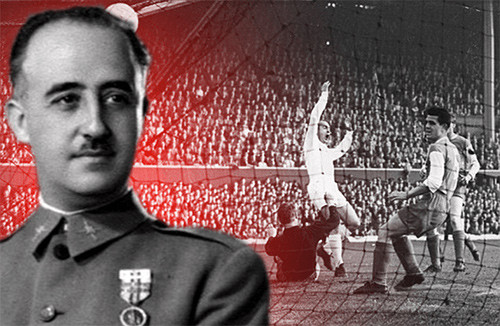 |
Following the fall of Franco's dictatorship, Real Madrid entered a period of severe crisis. |
As a result, Barca defeated Real on the pitch, and in the political arena, a wave of democracy swept across the country. The first civilian government was elected after half a century of repression under Franco's dictatorship. This wind of change helped to cleanse the minds of the Spanish people after years of being suppressed under dictatorship, and thanks to that, football life became richer and more open.
These are important prerequisites for the emergence of the next generation."Quinta del Buitre" - also known as "The White Vultures" at Real Madrid.
This phrase refers to five players who came through Real Madrid's Castilla academy and all have Madrid roots. These five are: Manuel Sanchis, Miguel Pardeza, Michel, Martin Vazquez, and Emilio Butragueno. Of these, Butragueno is considered an icon of Real Madrid's elegance and sophistication on the pitch.
Before the name was used for an entire generation of five players and became the club's nickname, "The Vultures" (El Buitre) was Butragueno's nickname. This nickname was used by fans to describe his killer instinct on the pitch.at that timeButragueno and his contemporaries were born in the era of Alfredo di Stefano, Ferenc Puskas, and Gento, and witnessed Real Madrid's absolute dominance in Europe. Therefore, for them, there is no greater pain than having to watch Barcelona rise.
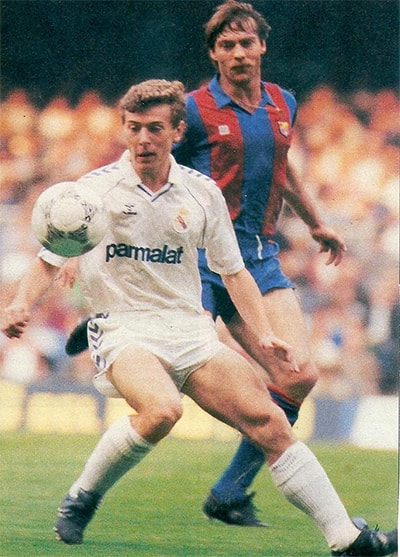 |
"The White Vultures" comes from "Vulture" - the nickname Real Madrid fans gave Butragueno because of his goal-scoring instinct. |
But besides the talent of the aforementioned homegrown stars from Madrid, the "White Vultures" probably wouldn't have been able to soar to such heights and demonstrate their instinct for chasing titles without one special figure - Ramon Mendoza.
In the first half of the 1980s, Real Madrid suffered a severe crisis with five consecutive years without a trophy – unacceptable for the club's great tradition. The change only came when Ramon Mendoza appeared as president in 1985. According to renowned writer Gabriele Marcotti, prior to Florentino Perez's arrival (in 2000), Mendoza's influence was second only to Santiago Bernabeu.
Mendoza is a controversial businessman, a left-wing supporter, and a conservative at Real Madrid. He has been criticized for using the club's image for political purposes – a point that has led to comparisons with two close friends who are famous Italian club owners: Silvio Berlsuconi (AC Milan) and Gianni Agnelli (Juventus).
To win over Real Madrid's fans, Mendoza aimed to restore the Madrid spirit that had faded over the years. And instead of spending money on international stars, the policy of "Madridizing" the team, valuing the talents of the capital's natives who had come through Real Madrid's own youth academy, was a historic turning point that helped the club regain its dominant position.
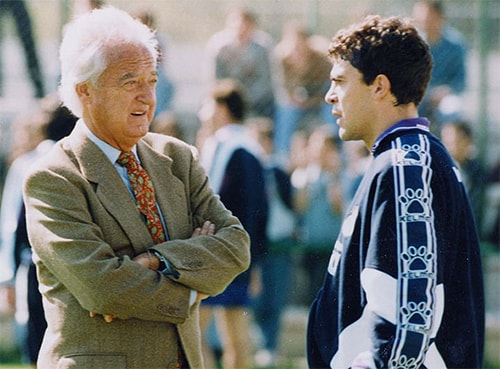 |
Mendoza's (left) trust in homegrown talent like Sanchis (right) was the foundation for Real Madrid's later success. |
"We are all young men from Madrid, sharing the same views on how to play football, all wanting to play attacking football regardless of the risks involved," Manuel Sanchis confided when speaking about the football philosophy of the "White Eagles" generation.
Speaking of football culture in Spain during this period, you've probably heard of the Spanish national team's nickname, La Furia Roja (The Red Storm). This nickname stems from the fact that the Spanish team was influenced by the aggressive, physically demanding English style of play, which originated in the Basque Country and spread throughout the country.
It was an ugly and brutal style of play, most notably exemplified by the foul on Diego Maradona by "executioner" Andoni Goikoetxea in 1983. Inadvertently, that style of football also represented a Spain ruled by violence and guns. The situation was so bad that then-Barcelona coach Cesar Menotti remarked: "Only when the Spanish become gladiators, instead of bulls, will they begin to win on the pitch."
And with the "White Vultures" generation, especially Emilio Butragueno, the Spanish people suddenly saw glimmers of hope for national revival on the football pitch. In his book Morbo, historian Phil Ball uses the word "master" to describe Butragueno's exceptional "First Touch" technique. Thanks to this masterful technique, Butragueno transformed even the narrowest spaces into his own personal football pitch.
To talk about Butragueno using only his goal tally is insufficient. Butragueno's face has the innocent charm of Peter Pan, his movements are as graceful as a Flamenco dance, but Phil Ball describes that hidden beneath that is a cold-blooded "killer" with a sharp sword; with the slightest opportunity, Butragueno will easily finish off his opponent. For the Spanish, he has realized the dream of an "El Matador" (a gladiator) instead of the bulls on the football field.
* Butragueno's talent during his time at Real Madrid.
With Butragueno and four of his contemporaries as pillars, that "White Vultures" generation helped Real Madrid reclaim five consecutive La Liga titles (from 1986 to 1990), in addition to creating the elegant and beautiful style of football that became the identity of the Royal team. If there is anything more regrettable about this generation, it is that they were never able to win the European Cup.
Real Madrid's history is written by great men, from the shrewd Santiago Bernabeu to the valiant Alfredo Di Stefano on the pitch. And the tradition is worthily inherited by successors like Butragueno's "White Eagles"—the second great generation in the club's history. More than that, they are sons of Madrid, who shaped the playing style and outlook on life for an entire new generation of democratic Spain.
According to VNE
| RELATED NEWS |
|---|