
Eating salty foods increases the risk of stomach cancer.
Dr. Vu Truong Khanh: "Helicobacter pylori bacteria, lifestyle habits, and a diet high in salt are risk factors for stomach cancer."
Dr. Vu Truong Khanh: "Helicobacter pylori bacteria, lifestyle habits, and a diet high in salt are risk factors for stomach cancer."
"The rate of stomach cancer, drug resistance, and antibiotic resistance to H. pylori in Vietnam is quite high. Many H. pylori treatment drugs in other countries achieve an effectiveness rate of 80% to 90%, while in Vietnam the success rate is below 80%."
This figure was provided by Dr. Vu Truong Khanh, Head of the Gastroenterology Department, Bach Mai Hospital.
Why are the rates of stomach cancer and H. pylori infection relatively high in Vietnam? Dr. Vu Truong Khanh explains: “Japan and South Korea have the highest rates of stomach cancer. In Vietnam, the rates are much lower than in Japan. The reasons are H. pylori bacteria, our lifestyle habits, and our diets which are high in salt. We consume many foods containing nitrates – these are the metabolic pathways that cause stomach cancer.”
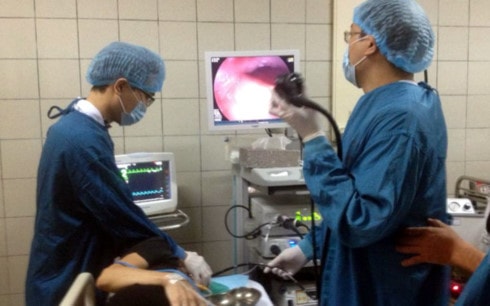 |
| Gastrointestinal endoscopy at the Gastroenterology Department, Bach Mai Hospital. |
According to a recent study in Hanoi, more than 700 out of every 1,000 people are infected with Helicobacter pylori (HP). In Ho Chi Minh City, 90% of people with gastritis have the presence of HP bacteria. Treating HP infection to prevent stomach cancer is essential.
Dr. Vu Truong Khanh emphasized: "Helicobacter pylori (HP) bacteria are produced due to the misuse of medication and the improper use of antibiotics (meaning we don't use the medication for the required duration or dosage). We don't control the quality of the drugs, so they don't kill the bacteria, leading to antibiotic resistance. When resistance occurs, the bacteria spread from one person to another."
Many believe that H. pylori is transmitted through the digestive tract, and exactly how it is transmitted remains a big question. However, we live in an environment where many people are infected, so the likelihood of transmission through the digestive tract is high, and this will affect many people.
In Japan, the incidence of stomach cancer used to be high, but it has now decreased due to changes in lifestyle. Each person has their own set of eating utensils, divided into separate trays, instead of sharing like in Vietnam. Westerners eat separately, and their infection rates are also lower.
How to detect H. pylori bacteria
Dr. Vu Truong Khanh said there are two ways to detect H. pylori bacteria: gastroscopy or a breath test. In some countries, they also use a stool test, which is also effective.
Serum blood tests are meaningless and only applicable for epidemiological purposes, i.e., determining the percentage of a population affected. This method is not intended for clinical practice, and in some places, it is still used inaccurately, causing great confusion among patients.
In many countries, when H. pylori bacteria are present, they are eradicated because it is linked to stomach cancer. However, not everyone who has H. pylori will develop stomach cancer. Stomach cancer can be related to several factors, including genetic predisposition and diet. If someone in the family has cancer, the likelihood of other relatives developing it is higher.
Dr. Khanh specifically noted the importance of a high-salt diet, citing the example that while the Japanese used to consume an average of 20 grams of salt per day for a long time, they now consume very little, around 5 to 6 grams per day. Just as we use salt to pickle vegetables, the Japanese use it similarly. "Eating too much salt is a major cause of increased stomach cancer," Dr. Khanh emphasized.
Which individuals are at high risk and should get tested?
Dr. Vu Truong Khanh advises that those who need treatment for H. pylori infection include: people with stomach or duodenal ulcers, as the recurrence rate is very high if left untreated. Secondly, those with parents, siblings, or first-degree relatives who have stomach cancer have a higher risk, as do those with persistent epigastric pain who have H. pylori infection.
Dr. Khanh advises that many diseases are related to diet, so hygiene must be prioritized. Eating and living a balanced lifestyle are also important.
"To maintain good physical condition, we must exercise and improve our health," Dr. Khanh further noted.
According to VOV
| RELATED NEWS |
|---|