

Ha Giang rock apples: Super scams selling Chinese goods are rampant in Northern Vietnam.
Priced at 25,000-40,000 VND/kg, these crisp, sweet "stone apples" have been advertised as a specialty of Ha Giang, leading many to trust and consume them for decades. However, authorities affirm that Ha Giang does not grow these apples. This type of apple has long been imported from China.
At Long Bien wholesale market at 6 am, even though the market was almost closing, it wasn't difficult to see large trucks still parked in the fruit section (adjacent to the vegetable section), loaded with this type of apple, and unloading goods for smaller retailers.
Mr. Nguyen Van Tan, a wholesaler at the market, said that the type of rock apple he is wholesaling is actually from China, but retailers still call it Ha Giang rock apple to deceive consumers.
"I don't know exactly when these apples were first imported to the market, but I've been selling fruit here for over a decade, and every year at this time I import Chinese rock apples to sell," Mr. Tan said. Everyone in this market knows that rock apples are from China, packed in cardboard boxes with Chinese characters all over them.
According to Mr. Tan, retailers often "self-proclaim" their apples as Ha Giang rock apples to gain customer trust and encourage them to buy more.
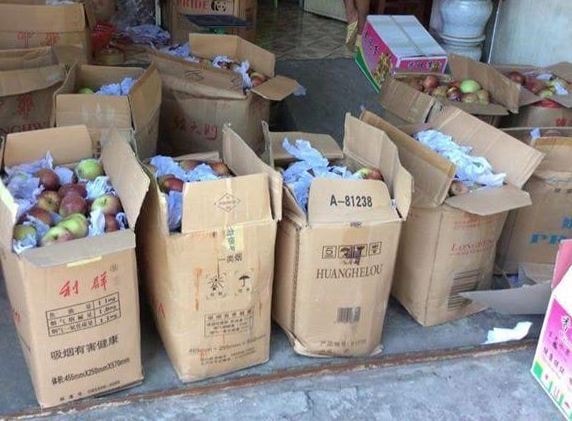 |
| Traders at the wholesale market and authorities alike confirm that rock apples originate from China. |
The head of the Crop Production Department (Hanoi Department of Agriculture and Rural Development) also confirmed that no locality in the province grows this type of apple.
According to the aforementioned leader, the rock apples currently sold on the market are grown in temperate climates. Surveys conducted in neighboring provinces such as Lao Cai, Son La, and Dien Bien, which have similar weather conditions, revealed that they do not grow rock apples.
Mr. Nguyen Van Thanh, Head of the Sub-Department of Quality Management of Agricultural, Forestry and Fishery Products (Ha Giang), added that this type of apple is also sold quite widely in Ha Giang province. However, businesses selling them all claim that these apples are imported from China.
Similarly, Mr. Phan Thong Quyet, Chairman of the People's Committee of Nghia Thuan commune, Quang Ba district (Ha Giang), said that Nghia Thuan does not grow rock apples either, but they are grown in some localities in China bordering the commune.
In fact, recently, throughout markets and streets in Hanoi, the type of "stone apple"—advertised as a specialty of Quang Ba and Dong Van (Ha Giang)—is being sold widely, priced from only 25,000 to 40,000 VND/kg; if bought in bulk, the price is only 15,000 VND/kg.
Specifically, at Nghia Tan Market, Dong Tac Market, Kim Lien Market, or along streets like Ho Tung Mau, Giai Phong, Nguyen Xien, etc., market stalls and carts are piled high with a type of apple that traders informally call "Ha Giang stone apples."
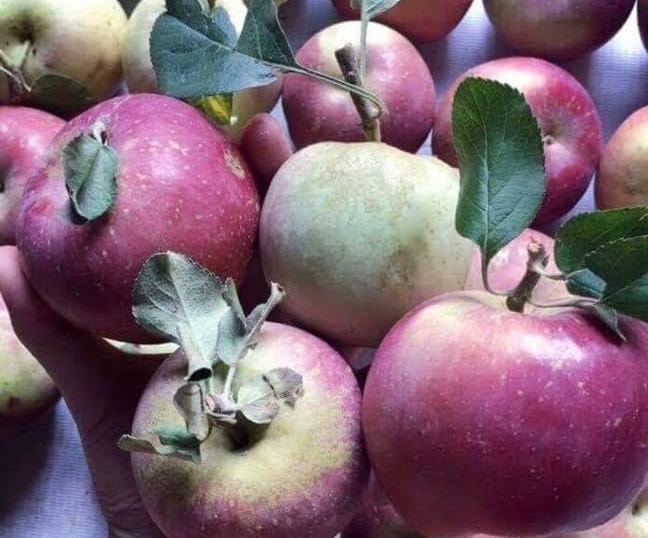 |
| Chinese rock apples labeled as Ha Giang apples are priced at 25,000 - 40,000 VND/kg. |
Based on observation, this type of apple has a reddish-purple skin, with occasional green patches due to unripeness. The apples are quite sweet, juicy, and very crisp. Notably, the seller claims that these apples are grown in the mountainous regions of Ha Giang province, so you can eat them with confidence, even with the skin on.
As a result, this type of apple is quite popular, with each vendor able to sell up to 100 kilograms of apples per day.
Notably, rock apples are also creating a sensation on online marketplaces, with vendors advertising them as a delicious, clean specialty from the highlands, accompanied by the firm assertion that "this type of apple is unique to Vietnam; China cannot grow it."
To gain customers' complete trust, online vendors even post pictures of unsightly, damaged apples and advertise them as "clean apples, that's why they look bad because they've been eaten by worms."
As a result, housewives and office workers rushed to order it, with some even ordering whole bunches of apple-flavored bird's nest to eat or give as gifts to friends and relatives.
An online seller named Dang Van Nam boasted that he sells over 2 tons of apples every day, with half a ton sold retail and the rest wholesale. He says all the apples he receives are sold out the same day they arrive; he never has any unsold stock.
According to VNN
| RELATED NEWS |
|---|