

Vietnam automates 37mm and 57mm anti-aircraft guns.
To meet the current requirements of national defense, Vietnam has independently researched and upgraded its 37 and 57mm short-range anti-aircraft guns.
Currently, playing a crucial role in the low-altitude air defense network protecting Vietnam's airspace are the Type 65 37mm and S-60 57mm anti-aircraft guns. These are important weapons for countering low-flying targets and protecting cities, industrial facilities, and high-altitude missile sites.
Still good after more than half a century.
Type 65 37mm and S-60 57mm anti-aircraft guns were supplied to Vietnam in large quantities by China and the Soviet Union starting in the 1960s.
Specifically, the Chinese-made Type 65 37mm anti-aircraft gun is used to attack low-altitude airborne targets; it can also be lowered to fire directly at armored vehicles and surface vessels (small enemy boats approaching the coast or islands).
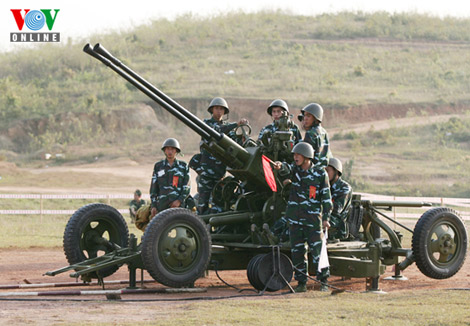 |
| 37mm twin-barreled anti-aircraft guns during live-fire exercises. |
The Type 65 is designed with two 37mm cannons, operated entirely manually (the gun crew consists of 7-9 people). Aiming relies on daytime optical sights; there is no radar assistance. The gun is capable of engaging low-altitude airborne targets up to 3.5km (ground targets up to 8.5km), with a firing rate of 160-180 rounds per minute.
The second type is the Soviet-made S-60 57mm. Similar to the 37mm cannon, the 57mm cannon, in addition to its anti-aircraft capabilities, can also lower its barrel to fire directly at armored vehicles and surface vessels. The S-60 is equipped with a manually operated 57mm cannon (7-person crew), achieving a maximum range of up to 8,000m and a firing rate of 105-120 rounds per minute.
More modern than the 37mm, the 57mm cannon is equipped with a command and control system (for calculating firing elements) and a radar system for tracking low-altitude targets.
Thanks to the skillful hands of the Vietnamese, these two types of artillery shot down many advanced American tactical fighter planes. Currently, our 37mm and 57mm artillery still play an important role in the low-altitude air defense network.
 |
| 57mm anti-aircraft guns firing live ammunition. |
However, although these two types of artillery still met combat requirements, they were generally quite outdated compared to their time.
These types of artillery all suffer from the drawback of limited night-time combat capability. However, in modern warfare, attacking forces often conduct air strikes at night.
Furthermore, manual combat is ineffective due to slow firing rates and low synchronization. In air defense operations, simultaneous firing (from multiple guns) at a single target creates a high density of firepower, thereby increasing the probability of hitting the target.
In response to this urgent need, our military's engineering units have independently researched and modernized 37mm and 57mm artillery.
Increase the power of 37mm and 57mm cannons.
According to the People's Army Newspaper, engineers at the Institute of Military Engineering Automation have upgraded the equipment for 37mm cannons to semi-automatic night-time firing capabilities. With this system, our troops can detect targets at a range of 40km in day and night conditions, even when subjected to enemy electronic jamming. The calculation of firing parameters for the 37mm cannon is performed by a computer.
We also equipped the artillery with an electric trigger system and an automatic loading machine. Accordingly, upon receiving the order, the gun crews would simultaneously fire at the target, ensuring a high density of firepower and a high probability of hitting the target.
 |
| Semi-automatic night-firing equipment of the 37mm artillery unit. |
Besides the project to upgrade the night-firing capabilities of 37mm cannons, the Military Mechanical Engineering Institute (General Department of Engineering) previously also implemented the project "Research on installing twin-barreled 37mm cannons on Ural-375D wheeled transport vehicles". This will significantly increase the mobility – a crucial factor in modern air defense warfare – of 37mm cannons.
The project is considered quite successful, with automatic deployment time of no more than 3 minutes and automatic retraction of the system of no more than 2 minutes. When fighting in different positions, it achieves a precision equivalent to that of a ground-based artillery system.
 |
| The 37mm artillery battery fired at targets during the night. |
For the modernization of the S-60 57mm anti-aircraft gun, technical officers from the Anti-Aircraft Artillery and Missile Department focused on improving the K59-03 command system and the K8-60 reconnaissance radar.
Previously, the K59-03 command system used an electronic amplifier and a potentiometer to calculate the targeting elements, resulting in low accuracy, long calculation times, and the inability to detect and track targets flying at night without lights.
Therefore, our officers have improved the system using digital computers, resulting in higher accuracy and faster calculation times. The integration of optoelectronic systems also helps observers detect targets better at night.
Watch the upgraded 57mm cannon test-fire:
According to Knowledge
| RELATED NEWS |
|---|