

Scuba diving: Beware of decompression sickness.
(Baonghean.vn) - Previously, decompression sickness was a disease specific to divers. But recently, as diving has become a popular activity for marine exploration tourism, decompression sickness may pose a risk to many people.
"Fisherman in critical condition rescued in Truong Sa."
Decompression sickness encompasses pathological disorders that occur when there is a rapid decrease in external body pressure, leading to an excess of gases (primarily nitrogen) that have been saturated in the blood at high pressure. This creates gas bubbles within blood vessels and tissues, causing circulatory arrest.
When decompression sickness manifests severely and is not treated promptly or according to standard protocols, the patient will suffer lifelong disability. Therefore, if you're not careful, a diving trip could turn you from a wealthy person into a slave to a wheelchair.
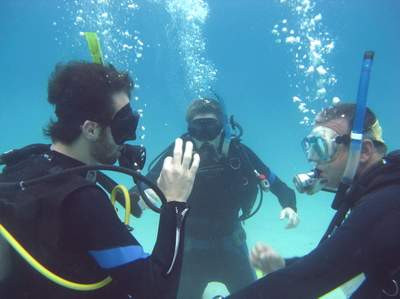
It is important to follow proper procedures and use appropriate protective gear when diving. Photo: Internet |
Symptoms of decompression sickness
Normally, when on land, we are only subjected to an air pressure of about 1 atm (760 mmHg). When in water, we have to "carry" not only all the air from the land but also the mass of seawater. This mass of water is the added pressure. For every 10 meters of depth, the pressure increases by 1 atm. The deeper you go, the greater the pressure.
When descending to depths, we must ascend slowly according to the instructions. However, in some cases, divers have violated this rule, leading to a sudden drop in pressure that causes decompression sickness.
In the blood vessels of these patients, numerous air bubbles appear due to the drop in pressure.
Characteristic symptoms include itchy skin and joint pain immediately after coming ashore:
Itchy skin on the trunk. This itching is accompanied by typical and easily detectable purplish-red striated petechiae (blood-red spots) on the skin.
Joint pain commonly occurs in the wrist, elbow, knee, hip, and ankle joints, impairing mobility.
In severe cases, there may be paralysis of the opposite side of the body, or paralysis of both lower limbs.
Patients may experience pulmonary hemorrhage, myocardial infarction, shock, and death due to a lack of timely emergency treatment.
How to provide emergency care to a patient with decompression sickness.
Unfortunately, treating decompression sickness requires specialized hospitals equipped with decompression chambers, such as the National Burn Institute, Military Hospital 108, Vietnam Maritime Medical Institute, and the Khanh Hoa Hyperbaric Center. However, these locations are often far from beaches or construction sites. First aid must be administered promptly on-site. Therefore, saving the patient's life is paramount. We need to do the following:
The firstRemove all diving equipment to allow the patient to breathe more easily. Diving suits often contain many devices and are tight-fitting, which can hinder breathing.
MondayThe patient should be placed on their back on a hard surface, with their head tilted if they appear drowsy or have a headache. Lying on their back helps maintain good blood pressure and blood flow to the brain.
TuesdayIf possible, administer intravenous fluids immediately. The fluid of choice is isotonic saline solution. Do not administer protein or any other nutritional solutions as this will only worsen the condition.
WednesdayThe goal is to transport patients to the hospital as quickly as possible and to a facility equipped with specialized equipment as quickly as possible, especially in severe cases.
 |
| There are many dangers when humans dive deep underwater. Photo: Internet |
Ways to prevent decompression sickness
Avoid strenuous physical activity for 3 days before going into the water.
You should take three deep breaths before diving.
You should drink plenty of water to avoid feeling thirsty.
Do not dive too deep (above 12 meters depth);
When surfacing, it is absolutely essential to follow the correct procedure.
When entering the water, one must be equipped with full protective gear and must be trained in handling incidents that lead to decompression sickness.
Hoa Le
(Synthetic)
| RELATED NEWS |
|---|