

How to answer 11 tricky questions from children.
Ignoring questions, lying, or laughing at a child's naivety are not the right ways to raise children.
Bright Side offers suggested answers to some of children's tricky questions.
1. Where do you come from?
For a potentially confusing question that any child would be curious about, you should answer honestly but without going into too much detail.
You could say: "When two people are in love, they hug and kiss. The father gives the mother his cells. Those cells develop along with the mother's body, and a baby begins to grow in the mother's womb. The baby is tiny and swims like a fish in there. Then the baby grows bigger and bigger, and one day there is no more room in the mother's womb, and the baby is born."
Older children may be introduced to the concepts of sperm and egg.
2. Why are boys and girls different in that respect?
You shouldn't be embarrassed when asked this question, because it's perfectly natural for a child to be interested in their genitals.
The answer might be, "The differences there are what allow children to be born. Boys have a penis and two testicles. Girls have a vagina and a uterus—a special sac to hold a baby someday. Boys and girls grow up, fall in love, and want a baby. They will create the baby together thanks to these differences."
3. When I grow up, will I marry you, Mom?
Many children ask this question when they begin to feel attracted to the opposite sex. You should politely answer "no," and explain further: "Everyone has a different role in the family. Your sister can't be your father, your father can't be your grandmother, and you can't be your mother's husband. As you grow up, your mother will grow old. You will still love and care for your mother, but you will marry someone else and love them with the same affection you have for your father and mother."
4. Why do parents argue?
Children often feel guilty when their parents argue. Therefore, you need to soothe them by saying: "People argue because they disagree on each other's viewpoints. Children argue, and adults sometimes do too. But parents always make up because they love each other, and they love you very much."
5. Why is that woman so fat?
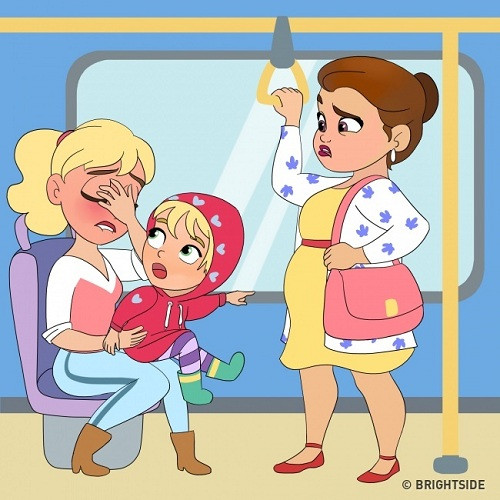 |
Criticizing other people's appearances is something you should instill in children from a young age. |
You shouldn't scold your child and tell them to be quiet when they describe or comment on other people's unusual appearances, as this can easily lead to the formation of negative thinking patterns.
You should explain: "Everyone looks different. They might be tall or short, fat or thin. Sometimes people change their appearance because of illness. If you point out the differences, you might hurt their feelings. You shouldn't do that. You can ask me later, when it's just you and me, to make sure no one gets upset by those words."
6. Does Mom love you more, or your older sibling?
Siblings often feel jealous of their parents' affections. You shouldn't use one child as an ideal role model for the others to emulate, nor should you say you love someone more because they are better academically.
"My children are not alike, and my love for each of them is expressed differently. But I love them all the same, just as they love their father and mother equally" is the answer you should use.
7. Will the doctor hurt my baby?
You need to explain to your child that treatment is necessary, and never laugh at them or call them a coward when they show fear.
A suitable answer would be: "The doctor doesn't want to hurt you. The doctor's job is to fight bacteria and disease. It will hurt a little, but if you don't endure the pain now, you won't get better. When I was sick, I got injections too. I was very scared, but I managed it. You will too. Remember, our rabbit was sick, and we had to take it to the doctor. It was very scared. But you can explain to the rabbit why it shouldn't be afraid of the doctor?"
8. Will I die? Will you die too, Mom?
You shouldn't lie to this question. Children can accept the truth.
You can gently whisper to your child: "Humans, animals, and even flowers will all die someday. That's the law of life. We will all die, but that day is still a long way off. I will die when I'm very old, when you'll be grown up and have children. Then, when your children grow up, you will also grow old and pass away. But what's important is that you live a meaningful life and discover many interesting things."
9. Why did my mother leave me to go to work?
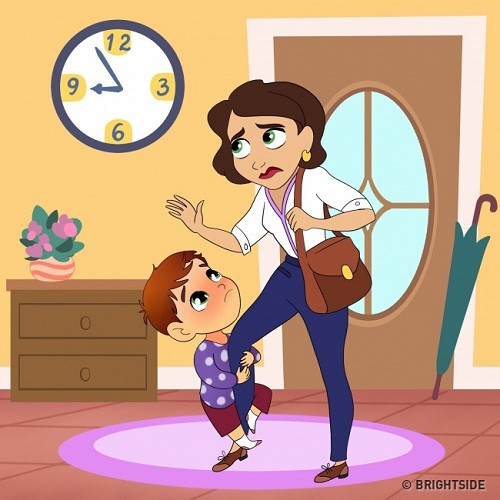 |
When children whine because their parents are at work, getting angry is not encouraged. |
You should explain that work is necessary, emphasizing the joy of returning home and the happy moments you share with your mother.
The answer might be something like this: "Mom doesn't want to be away from you, but I have to go to work, there's no other way. My job is very important. But remember, I'll be home tonight, and we'll have so much fun. Let's swap things, you take my bracelet, and I'll take your toy. We'll feel like the other person is here even though we're not."
10. Why are parents allowed to do this, but children are not?
The truth is, you're not the ideal parent, and don't be afraid to admit that. The important thing is that children understand they shouldn't imitate everything their parents do.
You should reply to your child: "Yes, Dad smokes, and sometimes he stays up late using the computer. But I don't want you to repeat those mistakes of mine. It's a bad habit that I'm trying to break because I want to become a better person."
11. What if the monster under the bed eats my child?
Take your child's fear seriously and find ways to improve the situation. You could let your child talk about the monster. Then, gently offer advice like, "Did you know that monsters are afraid of spells?" and come up with a suitable phrase that your child can easily memorize.
Or you could give your child an old TV remote and say, "Do you see the secret button here? When you press it, the monster will disappear. Keep the remote next to your bed."
According to VNE
| RELATED NEWS |
|---|