
Surprisingly, two BOT projects have the same toll station.
An unusual situation has just emerged regarding the BOT model in the transportation sector: The Phước Tượng - Phú Gia road tunnel BOT project (Thừa Thiên - Huế) and the Hải Vân tunnel BOT project have overlapping toll stations, essentially cutting in each other's way.
An unusual situation has just emerged regarding the BOT model in the transportation sector: The Phước Tượng - Phú Gia road tunnel BOT project (Thừa Thiên - Huế) and the Hải Vân tunnel BOT project have overlapping toll stations, essentially cutting in each other's way.
In recent days, public opinion has been heated by the conclusions of the Government Inspectorate regarding the Phuoc Tuong - Phu Gia road tunnel BOT project (referred to as the Phu Gia - Phuoc Tuong BOT project, located in the south of Thua Thien Hue province).
The most concerning issue, as pointed out by the Government Inspectorate, is that instead of placing the toll stations at the entrances of the Phu Gia and Phuoc Tuong tunnels as per the original contract, in 2014, the Ministry of Transport allowed the stations to be moved outside the project area, approximately 10 km south of the tunnel entrances, right before the northern entrance of the Hai Van tunnel (the border between Thua Thien Hue and Da Nang).
This resulted in a dramatic increase in project revenue compared to the initial financial plan. Investors reaped substantial profits but tightened the choices and budgets of commuters.
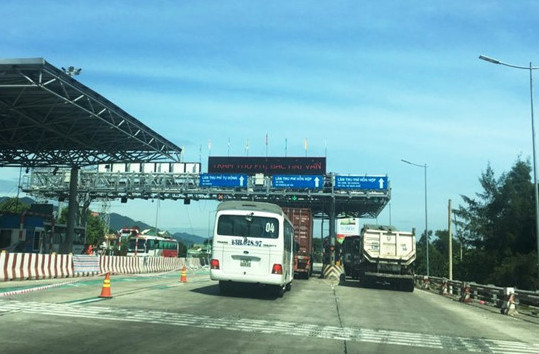 |
| Phuoc Tuong - Phu Gia BOT toll station (Thua Thien - Hue). |
Accordingly, drivers, regardless of whether they pass through the Phu Gia - Phuoc Tuong tunnel or not (small cars can easily navigate the two mountain passes where this tunnel project is being built), must stop and pay at the toll station at the northern entrance of the Hai Van Tunnel. Residents of the surrounding areas (especially Lang Co Town and the Chan May - Lang Co Economic Zone in Phu Loc District), even if they do not travel through the Phu Gia - Phuoc Tuong tunnel, must also pay tolls at this station.
In its audit report issued in June 2016 regarding the Phuoc Tuong - Phu Gia BOT project, the State Audit Office concluded that placing the toll station north of the Hai Van tunnel on National Highway 1A leaves road users with no alternative route. The station's location also forces residents in the surrounding area to pay tolls even though they do not use the tunnel. Following this, the State Audit Office recommended that the Ministry of Transport promptly develop a toll station plan and place the Phu Gia - Phuoc Tuong project toll station in accordance with regulations.
While this proposal remains stalled and without a solution, a more intractable problem has recently emerged: The BOT project to build the second Hai Van tunnel (including maintenance and operation of the first Hai Van tunnel, and resurfacing of National Highway 1A through the Hai Van pass) is also located south of the Hai Van tunnel, at the toll stations of the Phuoc Tuong - Phu Gia BOT project, spanning 11 km.
According to the BOT contract for the Hai Van Tunnel expansion project, the investor (Deo Ca Investment Joint Stock Company) was permitted to collect tolls on the southern side of the Hai Van Tunnel from January 1, 2017, to generate capital for repairing and operating Tunnel 1 and constructing Tunnel 2 (which had already begun construction in 2016). However, the investor hesitated to take action because drivers could not accept having to pay tolls just as they were about to enter the tunnel and then immediately have to pay again upon exiting.
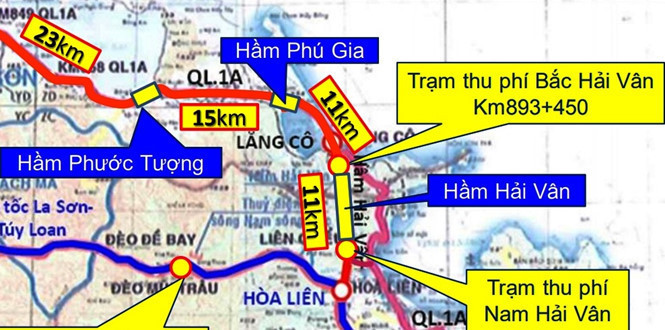 |
| Map showing the locations of toll stations and facilities of the Phuoc Tuong - Phu Gia BOT and Hai Van Tunnel BOT projects. |
However, after more than a year of construction, with an expenditure of approximately 150 billion VND on repairing the old tunnel and building a new one, the Deo Ca Company was forced to appeal to the Ministry of Transport to address this unfair practice of "taking advantage of the situation."
Mr. Vo Hoang Anh, Head of Quality Management and Research & Development Department of the Transport Engineering Design Consulting Corporation (Tedi), observed: Placing the toll station of the Phu Gia Phuoc Tuong project north of the Hai Van tunnel leaves drivers and vehicle owners with no choice; they still have to pay the toll even if they don't use the tunnel. “The Phu Gia and Phuoc Tuong passes are not too high; small cars can still travel on National Highway 1 without needing to use the tunnel. But because the project collects tolls at the Hai Van tunnel entrance, drivers and vehicle owners have to pay the toll whether they use the Phu Gia - Phuoc Tuong tunnel or not,” Mr. Hoang Anh said.
Mr. Nguyen Ngoc Canh, former General Director of Project Management Board 85 and former Director of the Hai Van Tunnel project, also stated that placing the toll station at the Hai Van Tunnel under the Phuoc Tuong - Phu Gia BOT project is incorrect and unreasonable. “Cars and small buses can easily travel through the Phu Gia - Phuoc Tuong pass; only heavy trucks and large buses truly need to use the tunnel. Having a tunnel is good, but it should be fair and allow people to have a choice,” Mr. Canh said. According to Mr. Canh, only relocating the Phu Gia - Phuoc Tuong toll station to its designated location within the project can ensure fairness.
To address this dilemma, the Ministry of Transport has also proposed solutions on several occasions. Specifically, on January 17, 2017, the Ministry of Transport issued Notice No. 20/TB-BGTVT requesting the Public-Private Partnership Department of the Ministry to report to the Minister and the Steering Committee of the Ministry of Transport on the toll collection plan for the two projects, including a plan to move the toll station of each project to the tunnel entrance of that project.
However, since then, there has been no consensus on how to resolve the issue. In a concluding statement last June, Deputy Minister of Transport Le Dinh Tho was forced to issue an ultimatum to the specialized agencies of the Ministry of Transport and the investors of the two projects to find a reasonable solution; otherwise, they would be forced to report to the Prime Minister for thorough handling.
According to Tien Phong Newspaper