

Request to reclaim forest land allocated to local people for production.
(Baonghean.vn) – Continuing to reclaim land from the Co Ba Forestry Station and allocate it to the people for production is a proposal from the representatives of the village management board of Chau Binh commune (Quy Chau district) to the National Assembly's Ethnic Council's monitoring delegation.
On the morning of September 6, 2017, the National Assembly's Ethnic Affairs Council conducted an inspection of the situation and results of implementing policies and laws on land and forest allocation to ethnic minority and mountainous communities and households in Chau Binh commune, Quy Chau district, during the period 2006-2016. The inspection team included Ms. Cao Thi Xuan, Vice Chairwoman of the Ethnic Affairs Council, as the head of the delegation, along with members of the Ethnic Affairs Council, specialists from the Ethnic Affairs Department (National Assembly Office), and representatives from the Central Highlands Steering Committee and the Ministry of Agriculture and Rural Development. Representing Nghe An province were the Standing Committee of the Provincial People's Council; the Provincial Delegation of National Assembly Deputies; leaders of the Departments and Agencies: Agriculture and Rural Development; Natural Resources and Environment; the Provincial Ethnic Affairs Committee; the Forest Protection Department; and leaders of Quy Chau district and Chau Binh commune. |
According to a report from the Chau Binh Commune People's Committee, the implementation of guiding documents on land and forest allocation from the Government and central ministries and agencies has been carried out regularly, creating conditions for people to access them promptly. Before 2005, the commune organized land allocation according to Decree 163/1999/ND-CP to 8 village communities in the area with a total area of 270.91 hectares.
In 2013, after receiving land reclaimed by the Provincial People's Committee from the Co Ba Forestry Farm, the commune continued to allocate 128.96 hectares of forest land to a local community (Ke Can village) for conservation and protection. Currently, this forest area is well managed and protected by the community.
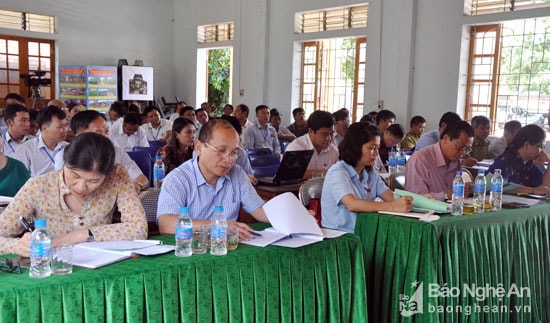 |
| A view of the working session at the People's Committee of Chau Binh commune (Quy Chau district). Photo: Cong Kien |
The allocation of land and forest land to households, individuals, and ethnic minority households is mainly carried out according to Decree 163/1999/ND-CP. From 2003 to 2012, the commune compiled land allocation records for 861 households with 2,889.0 hectares. From 2013 to 2016, the commune continued to compile records and allocate land to 763 households with 1,135.48 hectares. 726 out of 1,252 ethnic minority households (accounting for 58% of the total ethnic minority households in the commune) received land allocations.
Based on this, the management and organization of production by the community and households are carried out in accordance with regulations, the forests are well managed and protected, and annual plans for exploitation and utilization are developed. Forest planting plans are ensured, aiming for efficient and sustainable use and exploitation. The rights of the community and households are guaranteed.
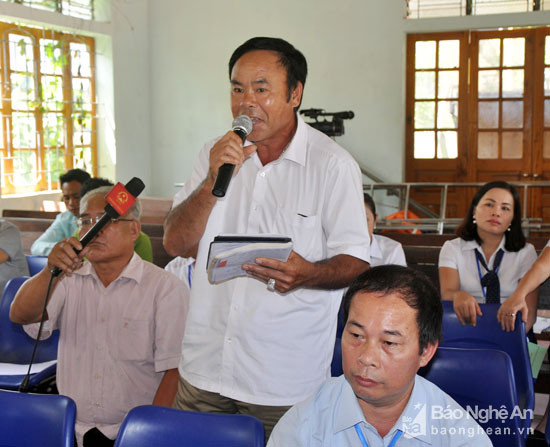 |
| Mr. Nguyen Van Thien, head of village 3/2 in Chau Binh commune (Quy Chau district), reported on the shortage of land for production among the local people. Photo: Cong Kien |
However, currently, Chau Binh commune still has over 930 households, including 526 ethnic minority households, lacking land for production. This stems from the sloping terrain, partial flooding due to the construction of the Ban Mong water reservoir, a high population growth rate, and the unauthorized transfer of land use rights.
The policy of allocating land and forests has met the practical needs of ethnic minority communities and households in mountainous areas, creating more jobs, increasing income, exploiting advantages, and raising awareness of forest management and protection. The main limitations are the very limited remaining local land, and ongoing disputes and lawsuits that disrupt security and order.
Based on local realities, Chau Binh commune proposes continuing the policy of allocating land and forests to local communities and ethnic minorities. Support should be provided for forest planting, care, and protection according to established policies. The commune also requests consideration of adjusting the land fund of Co Ba Forestry Farm back to the locality to allocate to ethnic minorities for production purposes, aiming to alleviate poverty and improve living standards.
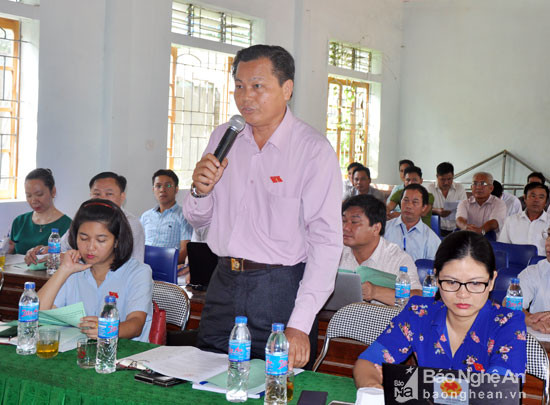 |
| Members of the National Assembly's Ethnic Affairs Committee's monitoring delegation raised questions about the income structure of people in Chau Binh commune. Photo: Cong Kien |
During the meeting, representatives from the village management boards also reported that a significant number of households, including ethnic minority families, have yet to be allocated forest land. Therefore, it is necessary to continue the process of reclaiming land from the Co Ba Forestry Station and allocating it to the people for production, ensuring stable livelihoods.
Members of the monitoring team raised issues regarding the total income and income structure of the Thai ethnic minority in the area, the benefits received by households receiving forest land allocation, the consequences of land shortage for production; the status of transactions and transfers after land and forest allocation; and the actual area of forest managed by the commune allocated to households.
In response to the inspection team's questions, the leaders of Chau Binh commune and local forest rangers clarified the actual situation regarding the management and use of forest land, and the effectiveness of land and forest allocation policies. Regarding average per capita income, Chau Binh commune currently has an income of 22 million VND/person/year, mainly from agricultural production (livestock farming, crop cultivation) and partly from service development.
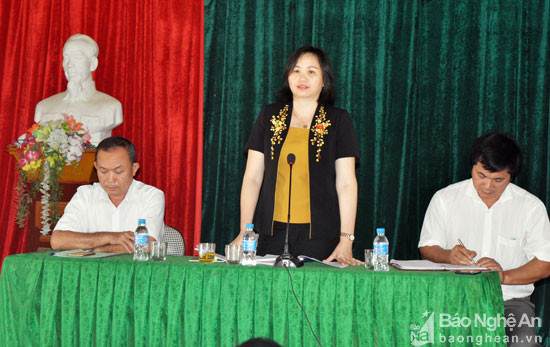 |
| Ms. Cao Thi Xuan, Vice Chairwoman of the National Assembly's Ethnic Affairs Council, urged localities to be more proactive in organizing the allocation of land and forests to the people. (Photo: Cong Kien) |
The shortage of arable land has led to land disputes in forests, causing insecurity and disorder, and deforestation still occurs, although no major hotspots have yet arisen. Trading and selling of forest land under the commune's management continues to take place within the area, even though the land has been allocated to households.
On behalf of the Supervisory Delegation, Ms. Cao Thi Xuan noted that the locality needs to be more proactive in processing and organizing the allocation of land and forests, accelerating the recovery of forest land to hand over to the people, and promised to bring this issue to the National Assembly.
Cong Kien