

The US nuclear deterrence missile system is nearly 50 years old.
The Minuteman III ballistic missile, one of the three pillars of the U.S. nuclear deterrence system, is becoming obsolete with no replacement in sight.
The procedure for firing a Minuteman III missile.
"My first order as president is to renovate and modernize the American nuclear arsenal. Hopefully, we won't have to use them, but America will always be the strongest nation in the world," U.S. President Donald Trump declared after taking office. However, the U.S. is facing the rapid aging of its nuclear deterrence triad, most seriously its ground-based intercontinental ballistic missiles (ICBMs), according to National Interest.
The U.S. strategic deterrence force is built on three pillars: nuclear-armed bombers, ballistic missile submarines, and ground-based ICBM launchers. Of these, ICBMs are concealed in reinforced concrete underground silos, capable of carrying the largest warheads and possessing high accuracy, sufficient to destroy an enemy ICBM stockpile in a single preemptive strike.
The US now has only one type of ground-based ICBM, the LMG-30G Minuteman III, with 450 units in service since 1970. The newer LGM-118 Peacekeeper was deployed from 1986 but was completely retired in 2005.
The development of the Minuteman series began in the mid-1950s, based on a series of advances in solid-fuel engines. This type of weapon had many advantages, such as the ability to maintain combat readiness for extended periods without requiring extensive maintenance, and a very short launch preparation time. Meanwhile, liquid-fuel missiles required hours to refuel before launch, making them vulnerable to destruction in a surprise preemptive strike.
The Minuteman I variant was commissioned in 1962 with the mission of deterring the Soviet Union. However, the advent of the Polaris ballistic missilewith a similar roleThe subsequent equipping of the US Navy prompted the US Air Force to modify the Minuteman line, increasing its accuracy and enabling it to strike military targets, including Soviet ICBM silos.
The Minuteman II variant entered service in 1965 with a series of major upgrades to improve accuracy, as well as survivability against Moscow's developing ballistic missile shield at the time. The Minuteman III, introduced in 1970, used multiple smaller warheads instead of one large warhead, making it very difficult to intercept.
The power of the Minuteman III missile.
The Minuteman III became the world's first ICBM equipped with multiple independently targetable re-entry vehicles (MIRVs). Each missile has a range of over 13,000 km and carries up to three nuclear warheads, each with a destructive power equivalent to 32 atomic bombs dropped on Hiroshima.
The U.S. ground-based ICBM force peaked in the late 1970s with 1,000 operational missiles. This number has gradually decreased to 450 today, deployed at Malmstrom, Minot, and FE Warren air bases. By February 2018, this will be further reduced to just 400 operational missiles and 50 unloaded missiles in storage.
The U.S. Air Force still wants to maintain its Minuteman III arsenal until 2030, but degradation may force them to seek alternatives. The most likely solution currently is the Ground-Based Strategic Deterrent (GBSD). According to Northrop Grumman, the GBSD would completely overhaul the current ICBM system, adding new missiles, a modern launch control center, and supporting logistics.
However, the GBSD's thermonuclear warhead will be repurposed from the Minuteman III missile, and the launch silo system will also be reused instead of being completely rebuilt.
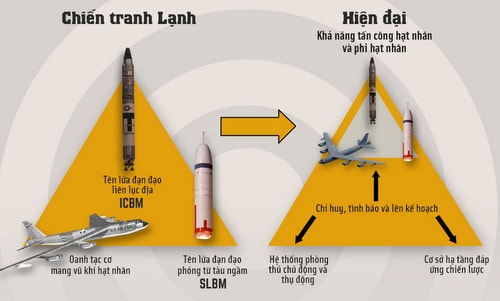 |
Minuteman III is one of the three pillars of the U.S. nuclear deterrence system. Click on the image to see the full picture. |
The GBSD missile could possess features similar to the Minuteman III, especially its 13,000 km range. This ensures Washington can strike any enemy nation in the northern hemisphere, while in the southern hemisphere it has no rivals. Furthermore, the US warhead control treaty with Russia means the missile doesn't need to be larger.
However, many experts have expressed skepticism about the project. Washington doesn't really need these weapons, especially since advances in submarine-launched ballistic missile technology have made them as powerful as land-based ICBMs. Investing a large sum of money in a new ICBM system may not yield the results the US Air Force expects, military expert Kyle Mizokami argues.
According to VNE
| RELATED NEWS |
|---|