

Life of one of the five ethnic minority groups in Vietnam
(Baonghean) - The O Du ethnic group is also known as Tay Hat. According to the locals, O Du in Thai means "very pitiful" or "very unfortunate"; while Tay Hat means "poor and ragged people".
No one can remember when this ethnic group was officially identified, but it is known that while hundreds of years ago, hardship and poverty were the defining characteristics of the O Du people, nothing has changed today. The O Du people remain very poor and are facing the risk of losing their cultural identity.
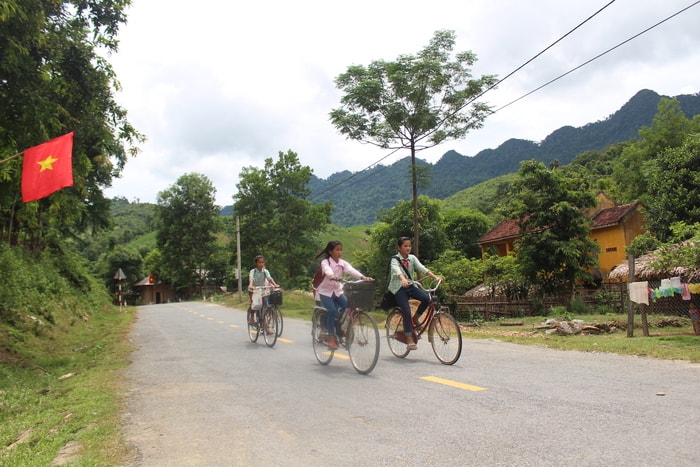 |
| Students from the O Du ethnic minority group on their way to school. Photo: Phuoc Anh |
Life in my new hometown
The O Du people are one of the five smallest ethnic groups in Vietnam and currently live mostly in Tuong Duong district. Eleven years ago, reaching the O Du people required traveling by swallow-tailed boat, crossing the Nam Non River and dozens of fierce waterfalls. In 2006, responding to the call for resettlement under the Ban Ve Hydropower Project, 308 O Du people living in eight villages across four communes (Kim Da, Kim Tien, Huu Khuong, and Huu Duong) moved to build a new life in Van Mon village, Nga My commune. Today, the O Du population in Van Mon has grown to 418 people, comprising 100 households. The road to their new homeland is very convenient, with over 60km of paved road connecting the district center to the village.
Ms. Mac Thi Tim, the head of Van Mon village, led us on a tour of the village while sharing stories. The O Du people are very excited about their new home. The village is located close to the road, making transportation and trade convenient and easy. Thanks to this, O Du children are more enthusiastic about going to school than before; currently, the village has 26 preschool children, 41 primary school children, about 25 secondary/high school students, and 12 university students. "More than a decade ago, the road was long, families were poor, and the children were constantly on the verge of dropping out of school. We never dared to dream of these results," Ms. Tim said with a smile.
However, the new settlement also presented many difficulties. Dozens of resettlement houses, built with cement, reinforced steel, red tiles, and bright yellow paint, stood silently with their doors locked. Most residents had built a thatched house next to the brick house to live in. "We're not used to living in brick houses; it's too hot, and people are used to cooking inside, so it's very stuffy and hard to breathe," said Ms. Tim. The village head led us to the house of Mr. Lo Dai Tinh, one of the households that had recently escaped poverty. Although they didn't build a thatched house, no one in the family lived upstairs either. Instead, they used straw and bamboo to build the four walls at the base of the stilt house and huddled together there.
Mr. Tinh's household has six members, including four children and grandchildren of school age. Mr. Tinh is over 60 years old, and his wife has been blind for many years and requires care. Every year, the whole family relies on a few small plots of corn and cassava fields for their income; in 2016, their earnings were only slightly above the poverty line. "We've escaped poverty, but we're still just like a poor household, very poor. We have four children of school age, so there are many things to buy and worry about. This year, I'm afraid we'll fall back into poverty," said Mr. Lo Dai Tinh.
Food shortages are a common concern for many O Du households. A few years ago, the rice aid from the Ban Ve Hydropower Plant for the resettled villagers ended, while rice cultivation on this land yields negligible harvests. “For example, if you sow 1 ton of seeds, you might not even get 100 kg of rice. This land is unsuitable for rice cultivation; only corn and cassava can grow, but in this resettlement village, land allocation is limited, so we can't cultivate more,” explained village head Mac Thi Tim. Mr. Vi Van Dau, Chairman of Nga My commune, provided more specific figures: The poverty rate in Van Mon is currently 80%, with an average income of about 2-3 million VND per person per year, and food shortages lasting up to 6 months a year!
Only two people in the whole village know how to speak the O Du language.
It's not easy to find an elderly person knowledgeable about the history and culture of the O Du ethnic group, even in their own community. Life is very difficult, and the life expectancy of the O Du people is lower than that of other ethnic groups in the area. The O Du language is gradually fading with the passing of the elderly; now, only two people in the entire village know the O Du language. "But I only know about 30-40% of it. When speaking O Du, I still have to add Thai and Vietnamese," said Mr. Lo Thanh Binh (born in 1948), one of the two people who know the O Du language.
Furthermore, not many of the customs and traditions of the O Du people have been preserved. The O Du people celebrate the sound of thunder, "cham phtrong," around January or February each year; the characteristic dishes that must be included in the offering tray for Tet (Lunar New Year) are pa boc and raw lemongrass rice wine. The people of Van Mon village say that they do not have their own musical instruments; they do not have folk songs or dances; and as for clothing, they only vaguely remember the styles because no one has made them for a long time. Now, the communication and daily habits of the O Du people are similar to those of the Thai and Vietnamese people.
“Nowadays, none of the young people in the village know how to speak the O Du language. They all grew up and went to school or work far away. The O Du people only have one surname, “Lo,” and people within that surname are not allowed to marry each other, so the daughters-in-law and sons-in-law of the village are all Thai or Khmu people. Therefore, the customs and traditions are not preserved,” said village head Mac Thi Tim. Even village head Tim herself is Thai, having married into the O Du family more than 20 years ago. No one in her family speaks the O Du language either; she only found one set of traditional clothing left behind by her ancestors and keeps it as a family heirloom to remind her children and grandchildren.
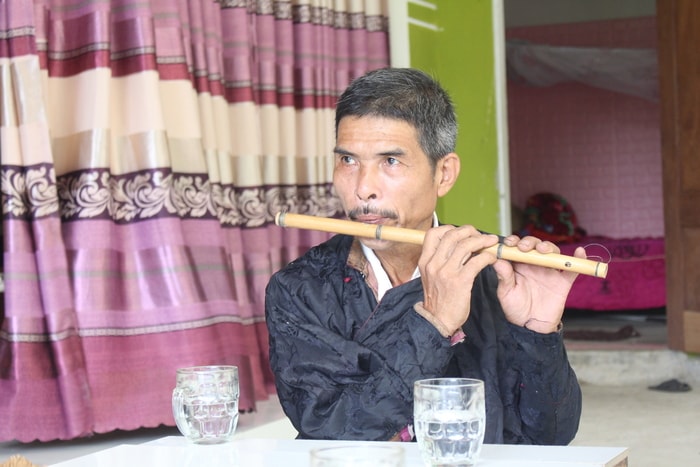 |
| The Party Secretary of Van Mon village, dressed in the traditional attire of the O Du people. Photo: Canh Nam |
Restoring and practicing the O Du language is a long-held aspiration of many elderly people in the village. It is known that many years ago, the Provincial Ethnic Affairs Committee, in coordination with the People's Committee of Tuong Duong district, organized two language classes for the O Du people. However, due to financial difficulties and challenges in selecting teachers, these classes have not been implemented regularly or continuously. Most recently, on August 22, 2017, the Provincial People's Committee approved the Project to support the socio-economic development of the O Du ethnic group in Nghe An province for the period 2016-2025, with an initial estimated budget of 120 billion VND.
Mr. Tran Nhat Phuong, Head of the Ethnic Policy Department of the Provincial Ethnic Affairs Committee, said that the project is currently awaiting funding. The most difficult challenge now is preserving the O Du language, and it is planned to invite O Du people from Laos to teach it. While not yet implemented concretely, this initial information is kindling hope for hundreds of O Du people regarding solutions to improve their socio-economic lives and preserve their cultural identity in the near future.
Phuoc Anh - Canh Nam
| RELATED NEWS |
|---|