

Inside a CIA sleep-proof cell in Afghanistan.
There were CIA cells in Afghanistan where prisoners were not allowed to sleep, were handcuffed, and forced to go shirtless in sub-zero temperatures.
 |
Prisoner Gul Rahman. Photo: AP. |
The prison has 20 cells, each a separate concrete block. In 16 cells, prisoners are shackled to iron shackles attached to the wall. In the other four cells, prisoners must stand, their wrists chained to a horizontal bar above their heads, preventing them from sleeping. Those in the regular cells use plastic buckets for toileting. Those in the special cells must wear diapers. The cells have no heating system, remaining perpetually dark day and night, with continuous, persistent music playing.
"The atmosphere is very good," John "Bruce" Jessen told a CIA investigator in January 2013, two months after he interrogated a prisoner named Gul Rahman at the prison. "Terrible, but safe."
Jessen, one of two psychologists who developed the CIA's "enhanced interrogation techniques," spent 10 days in a secret prison near Kabul, Afghanistan, in November 2002. Five days after he left, Rahman was discovered.Died in prison cell due to hypothermia.In a semi-naked state, chained to the cold concrete floor.
In August, the Gul Rahman family, along with Mohamed Ben Soud and Suleiman Abdullah Salim, two surviving prisoners from a secret CIA prison in Afghanistan, reached an out-of-court settlement in a lawsuit seeking compensation from psychologists Jessen and James Mitchell for alleged torture.
By settling the case out of court, Mitchell and Jessen avoided a public trial that could have shed light on what really happened to the prisoners inside the Cobalt prison in Afghanistan.
However, many details in the 274 documents that the CIA and the Pentagon were forced to declassify and release during the evidence-gathering phase before the trial painted a full picture of what prisoners endured in the "secret CIA dungeon," according to The Guardian.
Break the spirit
 |
John "Bruce" Jessen (left) and James Mitchell. Photo: AP. |
The most prominent of these documents is a report sent by investigators to CIA Deputy Director of Operations James Pavitt on January 28, 2003, concerning the death of Gul Rahman. In the 32-page document, as well as notes from interviews with Jessen and a young CIA officer in charge of the prison, investigators reconstructed the decisions that contributed to the death of a prisoner just 69 days after the prison opened.
The prison opened in September 2002 and was full in less than a month. The cells were designed to isolate the prisoners' senses. But the prison warden interfered with the established procedures himself. It was he who came up with the idea of playing music continuously in the cells.
"Regarding the decision to turn off the lights in the cell, that remains the manager's decision," investigators said. According to interrogation records, there was a switch controlling all the lights in the cells, and "when faced with the choice of keeping it on or off all day, he chose the latter."
The name of the prison administrator was omitted from public documents in the lawsuit, but in a footnote to the report submitted to the U.S. Congress, he was identified as Matthew Zirbel. He had no experience in prison administration and, three days after arriving in Cobalt, he still did not know he would be in charge of the facility.
Previous findings helped reveal many of Zirbel's actions during the time Rahman was held captive. But new documents suggest that Rahman might still be alive if Jessen hadn't gone to Cobalt and interrogated him in person.
Jessen, who questioned Rahman six times over a two-week period, and Mitchell, who met Rahman only once, claimed they were only trying to alleviate the harsh conditions of Rahman's imprisonment.
But according to investigators' notes, it was Jessen who debated with CIA headquarters about whether or not to apply advanced interrogation techniques to Rahman. It was also Jessen who offered advice when he and Zirbel planned the interrogation of Rahman in order to break his spirit and will to resist.
"He may have said that the prison administration followed all of his suggestions," the investigators' notes state. "Jessen said he was the one who came up with all the schemes."
Jessen told Zirbel not to trust Rahman when he complained about being cold because Rahman was using a sophisticated counter-technique employed by al-Qaeda militants.
According to Jessen, when Rahman "complained about not being able to think because of the cold," "complained about the terrible conditions," or "complained about human rights violations," it was all a tactic of resistance "based on health and welfare conditions."
But in a dark, unheated prison, when winter came, Rahman truly only felt cold. The cold was so dangerous that within two weeks, Rahman died of hypothermia.
A CIA supervisor visited Cobalt prison around the time Rahman was transferred there. He told CIA investigators that "the prison was very cold... He immediately thought of hypothermia when he saw Rahman wearing only socks and diapers."
In fact, according to the prison guards and interpreter, Rahman was practically naked, wearing only diapers, throughout his imprisonment.
Jessen was aware of this but dismissed it as a psychological effect. He admitted to investigators that he had "seen Rahman trembling, an early sign of hypothermia" after "applying the technique of sensory deprivation by giving Rahman a cold shower."
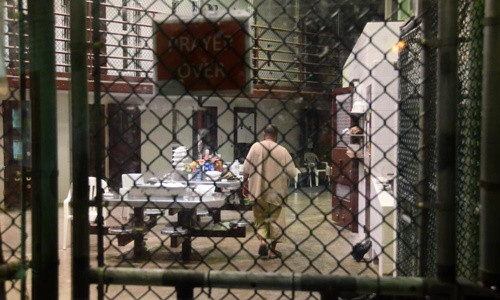 |
Camp 6 at Guantanamo Bay, Cuba. Photo: Guardian. |
Notes from one of Jessen's interrogations include the passage: "SAfter the final meeting with the officers,Rahman spent many days in freezing conditions with minimal food and sleep. Rahman apparently did not adapt to some parts of this process."
However, when Jessen left Cobalt around November 14, 2002, he noted to Zirbel that in order for Rahman to abandon his opposition, similar measures aimed at weakening him needed to be continued.
"This process doesn't happen quickly," Jessen told investigators during questioning in January 2013. "Rahman is physically strong, so beating him won't solve anything. You have to weaken him both physically and mentally... It takes one to several months to get him to cooperate."
Five days later, at approximately 3 PM on November 19, 2002, "Rahman was chained in a sitting position on the concrete floor, his lower body naked," the 2003 investigation recorded. Prison staff checked on Rahman four times, at 10 PM, 11 PM, 4 AM, and 8 AM. During the 4 AM cell check, the outside temperature was -0.56°C, and a guard "looked into Rahman's cell and whistled." At 8 AM, "Rahman sat up, still alive but trembling, his eyes wide open and blinking."
"Rahman's trembling didn't seem unusual; all the prisoners trembled," the guard told the investigator. Two hours later, a guard looked into the cell and found Rahman lying on the floor. Tapping the door with his baton, he found the prisoner motionless. Rahman had frozen to death.
According to VNE
| RELATED NEWS |
|---|