

Smart urban planning software for real estate
The concept of smart urban planning software for real estate.(Tpizi)We met engineer Kieu Minh Tuan in early 2014. At that time, the CEO, who belonged to the early 70s generation, recognized that urban planning and management were still inadequate.
According to Mr. Tuan, the construction industry utilizes a very large proportion of social resources (both human and material), but its working methods and coordination apply very little information technology, resulting in low work efficiency.
Despite high demand and supply in the real estate market, developers still manage projects using outdated methods. Buyers have to contact real estate agents and then visit the apartments in person. Customers lack a comprehensive overview of the project, struggle to visualize the design plans on paper, and are uninformed about the properties they intend to purchase.
In many cases, people go to ten different places but still can't find a suitable apartment. Furthermore, many projects haven't been approved yet, but customers are unaware and continue buying and selling, leading to financial losses and lawsuits.
"If there were a visual simulation software that was easy to understand and provided complete information for homebuyers unfamiliar with construction drawings, then properties would be more accessible to customers. Developers could then optimize project management costs and connect with buyers more easily," engineer Tuan pondered.
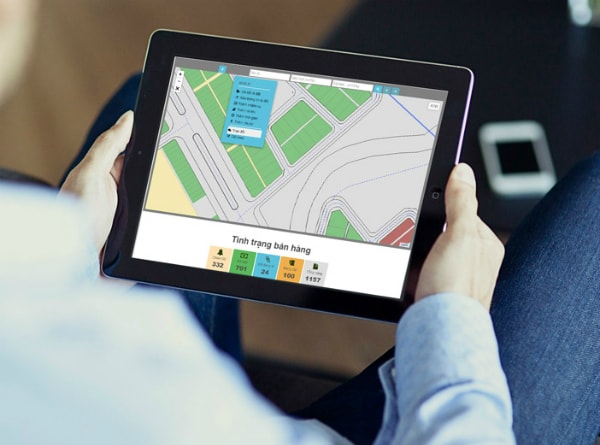 |
| Tpizi's intuitive interface provides comprehensive information for homebuyers who are unfamiliar with construction drawings. |
After doing some research, the 45-year-old CEO invited his close friend, engineer Nguyen Anh Tuan, to join forces in building Tpizi. The two had previously co-founded a construction company in 2005. For this new project, Tuan had to invite additional experts in urban planning, real estate, and information technology to collaborate.
Tpizi is a relatively large technology product, encompassing areas such as databases, cloud computing, global geographic information systems (GIS), and building information management (BIM), making its development relatively complex and time-consuming.
The entire software is geared towards smart cities, digitizing urban areas, buildings, and technical infrastructure systems to serve as databases for management applications. In addition, the software also serves as a platform for government administration, business management, and information retrieval for citizens.
Engineer Kieu Minh Tuan likens TPIZI to a drone flying overhead, encompassing all information about urban real estate in Vietnam, from geographical location, shape, size, selling price, accompanying infrastructure to buying and selling status, legal documents, etc.
The application transforms complex design drawings, often difficult for most people to understand, into vivid and intuitive images on Google Maps. Users can quickly and easily access all project information. Conversely, businesses can easily manage (records, contracts, customers, inventory levels, etc.) from the preparation stage to sales launch and completion.
The "Real Estate Exchange" feature allows connecting buyers and sellers, registering reservations, and online exchanges. For the government, the software digitizes the entire urban planning and buildings, helping management agencies to announce planned projects, their locations, and timelines to businesses and citizens.
Despite its many advantages, after more than a year, the startup still hasn't received any orders because its target customer base is quite niche, only suitable for businesses with many real estate projects.
The startup received positive news when it secured an order from an urban development project in Thai Binh province. The investor hoped the software would help them overcome the problem of multiple customers simultaneously purchasing the same plot of land, and the high operating costs of their sales team. After a month of testing Tpizi, the investor sold 70% of the 1,000 plots of land without any significant errors.
Following that first transaction, many other major investors continued to approach Mr. Tuan. To date, the application has digitized nearly 100 projects across provinces and cities in Vietnam.
Besides real estate, Mr. Tuan also created Tpizi, a smart urban management tool for the government. The engineer, born in the 1970s, said that the world is entering a period of accelerated urbanization. In 1950, about 30% of the world's population lived in cities. Today, urban dwellers account for 55% of the total 7.5 billion people. According to forecasts, by 2050, when the world population reaches 9 billion, 65% will move to cities. Cities are like magnets attracting young people and real estate businesses; the larger they become, the more difficult it is for the government to control them.
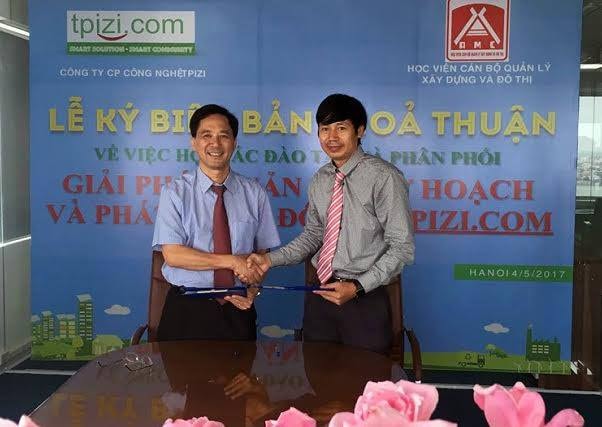 |
| Engineer Kieu Minh Tuan (left) signs a software development cooperation agreement with the Academy of Construction and Urban Management Cadres. |
Accordingly, all planning and infrastructure data is digitized and connected to online maps, providing a database for specialized departments to carry out management and construction permitting tasks. TPizi also digitizes planning projects by ward, district, city, and province, and allows for information modification after each field inspection.
"We steered the startup to operate on a cost-effective model. The nature of the work requires intellectual effort and computers connected to the internet, so we were able to minimize many costs. Tpizi uses open-source platforms like MongoDB, the backend uses Node.js, and the GIS server uses Geo-Server... These open-source platforms are low-cost, run on multiple platforms, and allow us to maintain technological independence when scaling up," Tuan shared about how they overcame difficulties in the early stages.
In May 2017, Tpizi also signed a software development cooperation agreement with the Academy of Construction and Urban Management Officials. The software is easy to learn, easy to use, compatible with all devices, and is considered a smart urban management solution in the era of the 4.0 industrial revolution.
Throughout the development of the Tpizi software project, CEO and engineer Kieu Minh Tuan stated that true perseverance and passion are essential to completing the journey. "Creativity and intelligence are inherent qualities in young people, but perseverance is key to success," he shared.
According to VNE
| RELATED NEWS |
|---|