

The US Navy has tested its Global Strike weapon for the first time.
The hypersonic weapon being tested by the US Navy is believed to be capable of striking any target on Earth within an hour.
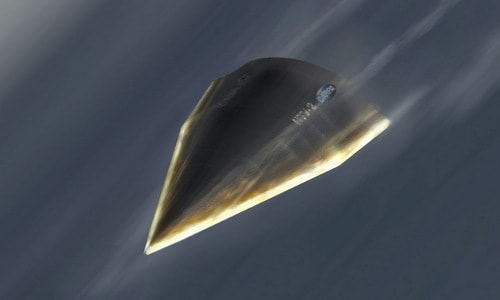 |
Hypersonic warhead design in the PGS project. Illustration: DARPA |
The U.S. Navy announced on November 7th that it had tested a hypersonic weapon system in its Global Strike (PGS) capability last weekend. This weapon technology allows Washington to strike anywhere on Earth within an hour, minimizing the enemy's ability to detect and counter it, Popular Mechanic reported.
The U.S. began showing interest in ultra-long-range precision-guided weapons in 2001, when the administration of former President George W. Bush wanted to incorporate non-nuclear warheads into a long-range ballistic or cruise missile. This would allow the U.S. to strike any target in a short amount of time, when other strategic weapons such as aircraft carriers and bombers would not have time to react.
The PGS concept gained significant traction after the September 11, 2001 terrorist attacks. It was considered an effective weapon for attacking short-lived and hard-to-detect targets, such as terrorist group meetings. In fact, the US used this method to attack the residence of former Iraqi President Saddam Hussein before the 2003 military campaign, but Hussein was not present at the location.
U.S. military officials believe PGS could be used to destroy nuclear missiles on launch pads in North Korea or Iran, attack stockpiles of weapons of mass destruction held by terrorist groups, or even deliver a swift preemptive strike in the event of a conflict with China or Russia.
Initially, the U.S. deployed a variety of weapons in the PGS, including a conventional warhead variant of the Trident D-5 submarine-launched ballistic missile. However,adversaries possessing nuclear weapons are veryIt is difficult to distinguish whether the recently launched Trident D-5 missile is a nuclear-armed variant or not. This could force them to activate a devastating retaliatory strike.
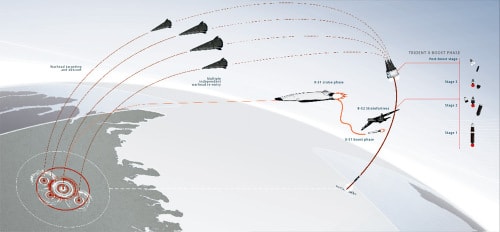 |
The operating mechanism of a Trident missile carrying a conventional warhead. Photo: DARPA. |
The US Navy is testing hypersonic weapon technology capable of speeds of 6,175-12,350 km/h, 5-10 times the speed of sound. The warhead is mounted on a ballistic missile; the projectile gains high altitude and speed before the warhead separates, allowing it to accelerate and glide towards its target. Hypersonic weapons have different flight trajectories than ballistic missiles, making them easier to distinguish on radar screens.
The test last weekend was the first time the U.S. Navy tested a missile under the PGS program. Submarines are the ideal platform for this lightning strike, as they can remain hidden near the target, shortening the reaction time for a preemptive strike.
However, Washington still faces difficulties in developing hypersonic weapons, as they become very difficult to control and lose accuracy at high speeds. The warhead's temperature can reach nearly 1,000 degrees Celsius at maximum speed, requiring the use of advanced technology and materials. These are significant technological challenges, but not necessarily insurmountable.
The US is not the only country researching hypersonic weapons. China has tested a weapon codenamed DF-ZF, while Russia is also developing the Yu-71 hypersonic glide weapon with similar capabilities.
According to VNE
| RELATED NEWS |
|---|