

The nuclear briefcase always accompanies President Putin.
President Putin is one of three people who hold the device that would order a response in the event of a preemptive nuclear attack on Russia.
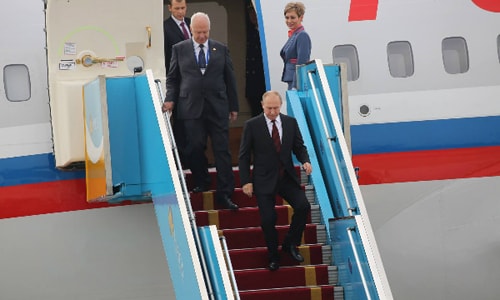 |
| President Putin disembarked from his plane at Da Nang airport. |
Russian President Vladimir Putin's plane landed at Da Nang airport today, bringing the Russian leader to attend the APEC 2017 conference. In Putin's entourage, there is always a person carrying a nuclear briefcase who stays close to the President, ensuring Russia's ability to retaliate with nuclear weapons at any time.
In the United States, the president is the only person authorized to access and use the "nuclear football," the briefcase containing the tools necessary to launch a nuclear attack. Meanwhile, in Russia, three different individuals possess these briefcases that serve a similar purpose.
These three briefcases, known as Cheget, are a key component of Russia's strategic nuclear forces' automated command and control system, held by the President, the Minister of Defense, and the Chief of the General Staff, according to Foreign Policy.
The Soviet Union created its nuclear command and control system at the height of the Cold War in the early 1980s. Three nuclear briefcases were put on standby when Mikhail Gorbachev became leader of the Soviet Union in 1985. They were later transferred to former President Boris Yeltsin and later to Russian President Putin.
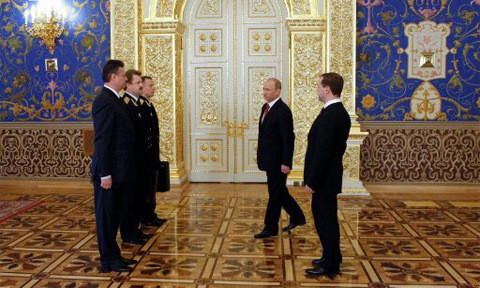 |
| President Putin receives the Cheget briefcase at the Kremlin in 2012. Photo: AFP. |
The Cheget briefcase, weighing approximately 11 kg, is always carried by officers accompanying the Russian president. It provides early warning information about any nuclear attack globally, becoming a symbol of the power of the Russian leader.
In post-Soviet Russian history, Cheget was only once under the control of the Russian chancellor, when Yeltsin underwent heart surgery in 1996. During President Putin's term from 2000 to 2008, there is no information about Cheget being given to the chancellor when he traveled abroad.
Essentially, Cheget is a terminal communication device that provides users with information about a potential attack, allowing the three people holding it to consult with each other before making a decision. Inside each briefcase is a mobile device connected to the command and control network of Russia's strategic nuclear forces.
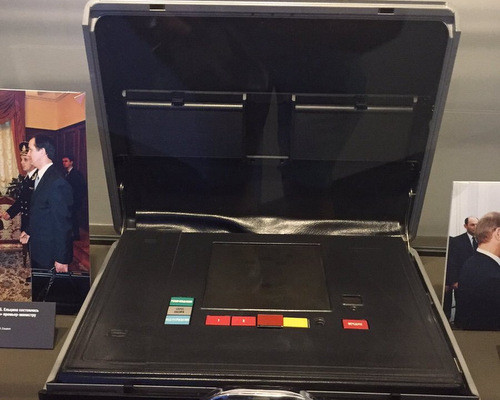 |
| Inside a decommissioned Cheget suitcase. Photo: Wikipedia. |
The briefcases are connected to a subsystem called Kavkaz, which includes signal cables, radio communication equipment, and satellites. In the event of a nuclear attack on Russia, the three nuclear briefcases, equipped with electronic systems, would immediately alert those holding them.
The Cheget briefcase itself does not contain a button to launch a nuclear attack; it only serves as a device to transmit missile launch orders to the military. If the Russian President decides to launch a retaliatory nuclear strike, Cheget will transmit the message to the Bakan receiver at the headquarters of the Chief of General Staff, the missile forces, the navy, and the air force via the Kazbek communication network.
Upon receiving the signal, the duty officer of the strategic nuclear forces will use a unique code to confirm that it is a decision made by the President, and simultaneously establish a hotline to contact the President, the Secretary of Defense, and the Chairman of the Joint Chiefs of Staff. Only after confirmation can the order to fire nuclear weapons be executed.
Even in the worst-case scenario where those wielding Cheget are unable to issue orders, Russia maintains its nuclear retaliation capability thanks to the Perimeter operational system, which works in parallel with Cheget.
The Perimeter system is activated when the entire Russian leadership is incapacitated in a preemptive attack. In that case, the decision on a nuclear response would be made by a group of surviving officers in underground bunkers. Perimeter is considered Russia's ultimate deterrent, aimed at ensuring no adversary dares to use nuclear weapons to launch a preemptive strike.
According to VNE
| RELATED NEWS |
|---|