

A trick to improve your Wi-Fi at a cost hundreds of times cheaper than an antenna.
Scientists have revealed a simple trick to improve Wi-Fi signals and enhance network security, at a cost hundreds of times cheaper than antennas.
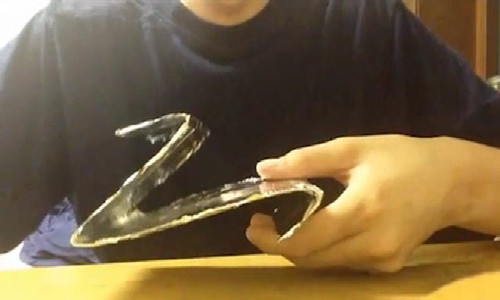 |
| How to use aluminum foil to improve your home Wi-Fi signal. |
Researchers at Dartmouth University and Columbia University in the US have developed a low-cost technique that allows the creation of a virtual wall to improve Wi-Fi signals in multi-room homes, Science Alert reported yesterday.
The new technique relies on a 3D-printed reflector wrapped in foil, directing signals toward specific areas and away from unwanted locations. The device works best with 3D-printed materials because they can accurately capture signals and maintain optimal shape for the required coverage. But the research team says people can create similar structures using cardboard.
According to researchers, directing Wi-Fi signals to the areas where they are most needed can reduce interference and signal distortion from building materials, while also improving the system's protection against cyberattacks.
The research team designed an algorithm to optimize the shape of the reflector to reach a wider coverage area. They simulated signal coverage and how the signal interacts with objects in the environment.
The research team said their algorithm could find the best shape in just 23 minutes, using information about the space, access points, and target area. After printing the plastic structure, they wrapped it in a thin, foil-like layer of reflective metal.
For those without a 3D printer, the researchers recommend using cardboard. "Cardboard would be a reasonable alternative to 3D printing. However, you'll have difficulty bending the cardboard as desired, and the sheet might not hold its shape," said Justin Chan, a member of the research team.
In the study, the team tested the method with existing Wi-Fi access points and found a significant increase in coverage. "For about $35, we can create a custom wireless reflector that performs better than antennas costing thousands of dollars," said Xia Zhou, associate professor of computer science at Dartmouth University.
According to VNE
| RELATED NEWS |
|---|