

Customer catches F-35 sending classified information to the US.
RT has just revealed shocking information: Norway has discovered that its F-35s have been secretly sending classified information directly to the manufacturer in the United States.
Sources indicate that the Norwegian Air Force has currently received 3 out of the 40 F-35 fighter jets ordered from contractor Lockheed Martin.
According to Norway's F-35 program director, Major General Morten Klevar, this aircraft is a crucial element in the modernization of the armed forces, while also demonstrating the ability to protect national and allied interests.
However, for some reason, Norwegian authorities recently discovered that F-35 fighter jets were secretly transferring large amounts of sensitive information to Lockheed Martin's servers in Texas after each flight, regardless of whether it was for training or combat exercises.
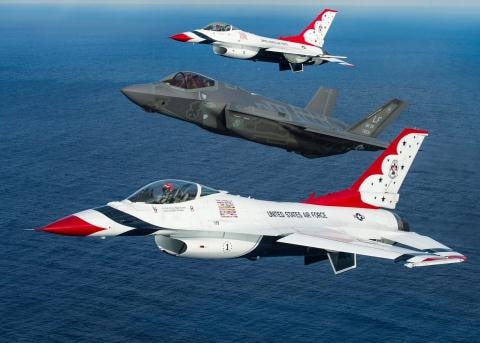 |
| F-35 fighter jet (center). |
"Each country using the F-35 needs to filter the stream of information that the aircraft is transmitting to the manufacturer," said Lars Gjemble, an advisor to the Norwegian Ministry of Defence, without specifying what sensitive information the country had detected.
Before this shocking information was made public, according to Flightglobal, a number of US allies had expressed concern that, with its specialized automated information processing system, the F-35 could become a spy for the US.
According to this source, the F-35's software system currently allows for the recording of all pilot and aircraft actions, as well as information on the aircraft's survival indicators. After landing and connecting to the logistics management system, all this information is automatically analyzed and then transmitted to Lockheed Martin's server system.
The issue that particularly concerns countries purchasing F-35s is that, in addition to information about the technical condition of the equipment, a great deal of sensitive information related to combat operations and flight information is also transmitted to the United States. This information processing system is known as ALIS.
In response to this situation, F-35 customers argue that the collection of military aviation-related information could affect their national security. To reassure U.S. allies, Lockheed Martin asserts that the issue will be resolved by developing the Sovereign Data Gateway (SDG) firewall system between F-35 aircraft and the ALIS server system in Texas.
According to the manufacturer, F-35 aircraft information will be processed by SDG. This means that military experts in the host country can intervene to erase information related to military secrets before it is transferred to the ALIS server in the United States.
However, some military strategists argue that the ALIS system is currently considered the biggest flaw on the F-35 fighter jet, a problem Lockheed Martin has yet to overcome. These problems with ALIS are putting 2,500 F-35s at risk of being grounded, CNN reports, citing sources from the US Air Force.
ALIS, which the Pentagon describes as the "brain" of the F-35, is a large, complex system encompassing the entire supply chain supporting maintenance and repair, including the necessary computing equipment to ensure components are properly installed before takeoff.
According to veteran defense commentator Zachary Cohen, the current problem lies in the lack of a testing system to ensure the F-35's software operates smoothly, given that these aircraft have been deployed to the US Air Force and several customers since late 2016.
The U.S. Marine Corps has announced plans to upgrade and address software issues on its F-35 fighter jets, which have been operational since July 2015. However, the U.S. Government Accountability Office (GAO) says there is no guarantee that this software upgrade will be completed before 2019.
Unlike aircraft hardware such as wings or engines, the control software is installed on computers located at a command center to support operational deployment, maintenance, and servicing.
The GAO noted that the U.S. Department of Defense lacked a plan to ensure that the software system would operate smoothly and on schedule for the F-35 to be mass-produced. This is a common requirement for all weapons programs to ensure that the equipment operates reliably and has a trustworthy logistical support system.
If these software glitches are not resolved, all of these fifth-generation super fighter jets will be grounded, the GAO warns. To address these technical issues, the GAO estimates that an additional investment of $20-100 billion will be needed.
TBaodatviet pig
| RELATED NEWS |
|---|