

Phan Boi Chau - a great patriot of the early 20th century.
Phan Bội Châu (formerly known as Phan Văn San), pen name Hải Thụ, later adopted the pen name Sào Nam (and many other pseudonyms), was born on December 26, 1867, in Đan Nhiễm village (now Xuân Hòa commune, Nam Đàn district, Nghệ Tĩnh province).
As a child, he was known for his intelligence. By the age of six, he had memorized everything.Three-Character ClassicAt seven years old, he understood classical texts; at eight, he mastered the essays for the imperial examinations. At thirteen, he passed the district examination with the highest score. At sixteen, he passed the provincial examination with the highest score, hence he was also called the top scholar of San.
At the age of nine, he consciously joined the movement of Tran Tan and Dang Nhu Mai against the colonialists. At seventeen, upon hearing of the uprising in Northern Vietnam, he drafted a proclamation.Pacification of the West and the NorthAt the age of 19, responding to Emperor Hàm Nghi's call for resistance against the French, he organized a contingent of 60 young soldiers to join the cause, but before they could act, the enemy launched a raid on their village. The mission was unsuccessful, but his determination to save the country was clear.
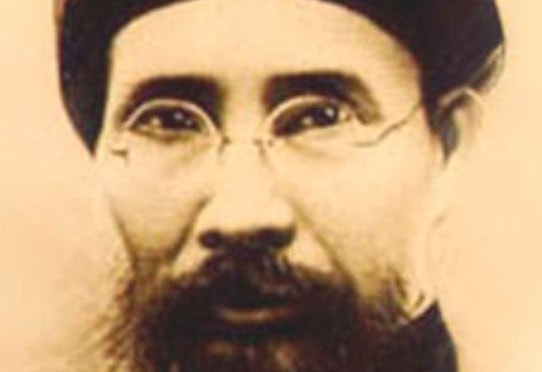 |
| Mr. Phan Boi Chau. |
Following that, Phan Bội Châu spent ten years as a teacher. In 1900, he graduated at the top of his class at Nghệ An school and officially embarked on his revolutionary career. Phan establishedDuy Tan Society(1904), chose Prince Cuong De as his leader, advocating violence and seeking foreign aid to restore independence. In early 1905, he went to Japan and then returned to start an Eastward Movement in 1905-1908. He wrote many revolutionary propaganda works such as "History of Vietnam's Loss of Independence," "Blood Letter from Overseas," etc.
As a leader of the Dong Du movement, Phan Boi Chau organized the Cong Hieu Hoi (Public Society), gathering 200 Vietnamese students to study politics, science, and military in Japan. In his final years in Japan, he established various societies of a "international solidarity", like a meetingDien, Que, - Vietnam Alliance(an alliance between people from Yunnan, Guangxi and Vietnam) and the associationEast Asian allies(including some Japanese, Chinese, Korean, Indian, etc.) to help each other fight against the imperialists.
Around March 1909, the Dong Du organization was disbanded and Phan was expelled by the Japanese government. After temporarily hiding in China for a short time, Phan Boi Chau went to Siam to continue his activities. More than a year later, when the Xinhai Revolution (1911) succeeded, Phan returned to China and established a new organization.Vietnam Restoration Associationwhose sole purpose was to drive out the French invaders, restore Vietnam, and establish a new nation.Republic of Vietnam".
Following his patriotic activities, Phan was arrested and imprisoned on December 24, 1913, by the French colonial authorities at the request of Chinese warlords.
In 1917, when Phan Boi Chau was released from prison, World War I was nearing its end. The influence of the Russian October Revolution and the fervent national liberation movements around the world greatly impacted Phan Boi Chau. He wrote articles praising the great leader Lenin, the Soviet Union's workers' and peasants' state, etc. During these years, although he had to make a living as a journalist in Hangzhou, working as an editor for the magazine "Binh Su," Phan did not forget to use the press to spread anti-French propaganda and continue his search for a way to save the country.
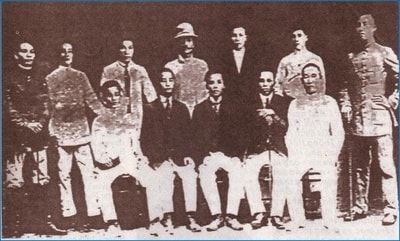 |
| Some Vietnamese students in the Đông Du movement (1905-1909). |
In mid-1924, adapted fromChinese People's PartyFollowing Sun Yat-sen's teachings, Phan Boi Chau reformed the Vietnam Restoration Society.Vietnam Nationalist PartyIn December 1924, after meeting with Nguyen Ai Quoc, Phan planned to reorganize the following year (1925).Vietnam Nationalist Partyin the most progressive direction.
But on June 30, 1925, on his way from Hangzhou to Guangzhou to meet with his comrades, Phan Boi Chau was kidnapped by the French colonialists upon arriving at Shanghai North Station and taken back to Vietnam. They secretly plotted to assassinate Phan Boi Chau, but the plot was discovered, so he had to be tried at the Hanoi Criminal Court. His life was in danger.A hero, an angel, a selfless figure for independence, revered by twenty million people under slavery."(1) was threatened, causing a massive nationwide school strike, work strike, and market boycott movement. Faced with that strong struggle movement, the French colonialists were confused and had to declare Phan's acquittal, but forced him to return to live in Hue and not go anywhere else.
From 1926 onwards, Phan Bội Châu was a prisoner under house arrest in Bến Ngự. At this point, his revolutionary life, dedicated entirely to the Fatherland, had to be cut short. The Vietnamese revolutionary movement, following the new course of history, advanced like a storm. Although the "Old Man of Bến Ngự" had to live a life of confinement, he continued to write poetry and prose to express the suffering and humiliation of a people who had lost their country, and the responsibility of the people towards their nation...
These works include: *Nam Quoc Dan Tu Tri*, *Nu Quoc Dan Tu Tri*, *Bai Thuoc Cui Benh Dan Gioi*, *Cao Dang Quoc Dan*, *Luan Ly Van Dap*, *Loi Hoi Thanh Nien*... *Phan Boi Chau Bien Bien*, *Lich Su Viet Nam Dien Ca*. These also include extremely extensive scholarly works such as *Confucianism*, *Buddhism*, *Socialism*, *Chu Yich*, *Nhan Sinh Philosophe Hoc*, along with over 800 poems in the vernacular, dozens of rhyming prose pieces, funeral orations, and miscellaneous writings.
------------
(1) Ho Chi Minh: Complete Works, Volume 2, article The Farces or Varen and Phan Boi Chau, Truth Publishing House, Hanoi, 1981, p.18.
According to Nhan Dan Newspaper
| RELATED NEWS |
|---|