

Industry 4.0 Revolution: Universities must change.
"Immediate solutions are needed to effectively reform education, especially higher education, if we do not want to fall further behind other countries in the region and the world."
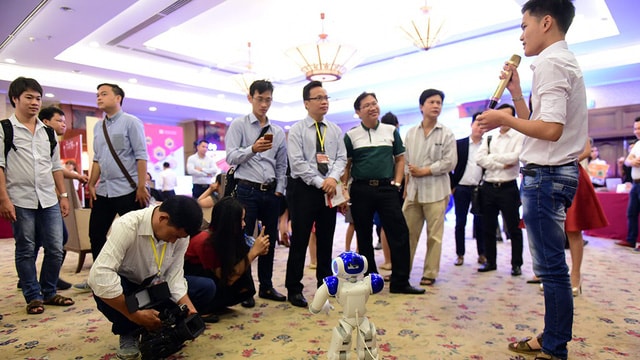 |
| Ho Chi Minh City National University showcased robots at the Youth Technology Day on December 8th. In the Fourth Industrial Revolution, robots will replace many human jobs. Photo: Quang Dinh |
This is an excerpt from the document "Vietnam and the Fourth Industrial Revolution" (Industry 4.0) by the Central Economic Committee of the Communist Party of Vietnam, edited by Mr. Nguyen Van Binh, the head of the committee.
How will universities cope with the Fourth Industrial Revolution?
Major impact
Many experts predict that the Fourth Industrial Revolution will present higher education with numerous significant challenges.
Dr. Dam Quang Minh - Rector of Thanh Tay University - informed: "According to the assessment of Professor Frey and Professor Osborne at Oxford University (United Kingdom), up to 47% of jobs will be affected by the 4.0 Industrial Revolution."
Most noticeably, the demand for certain industries related to Industry 4.0, such as information technology and biotechnology, is beginning to increase. Besides the varying increases and decreases in training demand across different fields, the training content also differs.
For example, the marketing industry is undergoing a strong shift from traditional marketing to modern marketing and digital marketing. Meanwhile, jobs are a product of universities, so universities naturally have a huge impact..."
Mr. Le Tri Tin - Director of Sales for the Drive and Control Division at Bosch Rexroth, and an expert on Industry 4.0 systems - also stated that Industry 4.0 will affect the professional qualifications and skills required in certain professions, leading to changes in those fields.
Specifically, fields such as automation, mechatronics, applied informatics, and data processing will see an expansion in training knowledge and specialized skills. "Therefore, universities also need to change," Mr. Tin emphasized.
The structure of industries is changing rapidly.
From a university perspective, Associate Professor Dr. Do Van Dung - Rector of Ho Chi Minh City University of Technology and Education - believes that the distinctive features of the 4.0 Industrial Revolution are the emergence of artificial intelligence, automation technology, new materials, and information technology in data analysis (big data).
Given these characteristics, the structure of industries will change very rapidly. Most devices in the era of the Fourth Industrial Revolution are multi-disciplinary devices; for example, the smartphone combines many functions, not just a tool for listening and speaking. Creating this product requires the coordination of many different industries.
"Due to the specifics of the times, lecturers no longer project lectures onto screens because almost all the knowledge students need can be easily found online. With Industry 4.0, students have to rely primarily on self-learning."
The role of the teacher also shifts from teaching to guiding. Instructors guide students through projects, solving real-world problems. This requires instructors to increase their practical experience to develop projects for students.
"If teaching is confined solely to the school environment, lecturers will no longer be able to teach effectively," Mr. Dung asserted.
Similarly, Associate Professor Dr. Nguyen Van Thu - Rector of Ho Chi Minh City University of Transport - believes that advancements in information technology will give rise to new forms of training. Mass online training systems and online education are new forms of training that challenge traditional training methods.
These are open online university courses with tens of millions of students. In the future, centers of excellence will offer online courses that are on demand and highly relevant to real-world situations.
Accordingly, these centers invite the best professors in each field to write on this topic. These excellent centers will then offer such courses. Initially, the course may be expensive, but it will gradually become cheaper and even free.
"These challenges require universities to, on the one hand, accelerate research and development of new technologies to meet the demands of Industry 4.0, and on the other hand, adapt themselves to suit the new industry," Mr. Thu said.
Associate Professor Ho Thanh Phong - Rector of the International University (Vietnam National University Ho Chi Minh City) - concluded: "With the Fourth Industrial Revolution, we need a 4.0 education system. In this system, people, machines, equipment, and work are connected everywhere to create an education system focused on personalized training."
In this new concept, schools, people, programs, traditional means... are transformed into smarter entities, placed within an ecosystem of innovation and entrepreneurship. With Education 4.0, the focus is on creativity and value creation. Training programs are no longer single-discipline but "multi-disciplinary".
The training program is not flexible enough.
Associate Professor Dr. Dinh Duc Anh Vu, head of the University's Board of Directors at the Vietnam National University Ho Chi Minh City, believes that the current training programs are not yet flexible enough, and their content is not suitable for the needs and trends of the Industry 4.0 labor market.
Universities conduct training activities in two directions: on the one hand, they must meet social orientation requirements, and on the other hand, they must train and provide human resources to meet the demands of the labor market.
Meanwhile, research by the World Bank and the International Labour Organization shows that the future of the workforce will require more skills and a greater diversity of skills.
Some jobs may be replaced by machines, equipment, and robots, but jobs requiring human skills such as communication skills, teamwork skills, creativity, and problem-solving skills will be difficult to replace by robots.
Therefore, these skills will become crucial for the future of Industry 4.0, alongside technical skills such as automation, mechatronics, and information technology.
According to TTO
| RELATED NEWS |
|---|