

NATO's breach of promise has eroded Putin's trust in the West.
NATO had initially pledged to the Soviet Union not to expand eastward in exchange for the reunification of Germany, but later broke that promise.
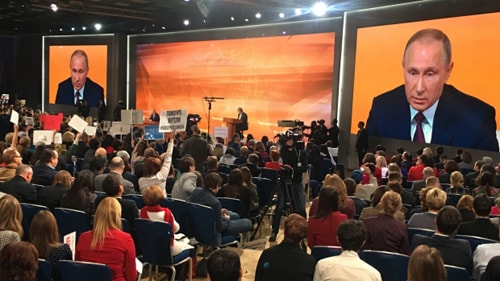 |
President Putin answers questions from reporters at a press conference yesterday. Photo: CBC. |
In a four-hour "super press conference" attended by thousands of reporters yesterday, Russian President Vladimir Putin praised his American counterpart Donald Trump for performing very well with a rising stock market and falling unemployment rate. However, the Kremlin leader criticized the West, claiming that the ban on Russia participating in the Winter Olympics in South Korea was a "conspiracy" to tarnish his image ahead of next year's election, according to CBC.
Observers believe this is not the first time Putin has expressed anger and distrust of the West. Many experts argue that Russia's current geopolitical stance stems from a pivotal moment in history when the West broke its promise not to expand NATO eastward.
After searching through declassified records at the U.S. National Security Archive, researchers at George Washington University found that these documents all indicated that senior U.S., German, and British officials in the 1990s had promised Soviet leader Mikhail Gorbachev and Foreign Minister Eduard Shevardnadze that NATO would not expand toward Russia's borders after German reunification.
When tasked with persuading the Soviet Union to agree to the reunification of East and West Germany, then-West German Foreign Minister Hans-Dietrich Genscher understood that only a promise not to expand NATO eastward could guarantee success, according to Bloomberg.
He presented this view to the German people and key allies, such as British Foreign Secretary Douglas Hurd. With the intention of bringing a unified Germany into NATO rather than maintaining its neutral status, the United States agreed with Genscher's position. U.S. Secretary of State James Baker made this clear to his Soviet counterpart Shevardnadze during their meeting in Moscow on February 9, 1990.
"A neutral Germany would certainly have independent nuclear capabilities. But a Germany closely aligned with a changed NATO—I mean, a NATO that is less military and more political—would not need such independent nuclear capabilities," Baker said, according to the transcript of their meeting.
"Of course, there will be firm assurances that NATO will not expand its forces eastward. This will be done in the most reasonable way for Germany's eastern neighbors," Baker assured Shevardnadze.
The US Secretary of State reiterated this point to Soviet leader Gorbachev during their meeting that same day. "If we maintain a presence in a NATO Germany, the alliance will not expand an inch eastward," Baker asserted. He clarified that this was the West's commitment in exchange for Germany remaining united within NATO, rather than becoming a neutral nation.
Gorbachev replied that under any circumstances, NATO expansion was "unacceptable." "We agree with that," Baker responded.
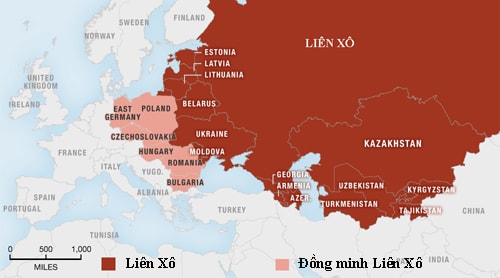 |
The Soviet Union and its allies before their collapse. Graphic: NPR. |
During a simultaneous meeting, CIA Director Robert Gates also made a similar proposal to KGB head Vladimir Kryuchkov.
In subsequent discussions, the Soviet side desired to build a common security structure in Europe, based on the Organization for Security and Cooperation in Europe, established nearly 20 years earlier, as a forum for cooperation between the Soviet Union and the US-led alliance. Western negotiators agreed but said they wanted to retain NATO, making it a more open organization for cooperation with the Soviet Union and the Warsaw Pact.
By the end of March 1991, six months after German reunification, British Prime Minister John Major was still reassuring Soviet Defense Minister Dmitri Yazov that NATO would not move eastward and that he saw no future conditions under which Eastern European countries could become NATO members.
NATO Secretary General Manfred Woerner later assured the Russian delegation, on behalf of President Boris Yeltsin, that 13 out of 16 NATO members opposed the expansion of the alliance, and that he himself was against it.
However, none of these Western commitments were incorporated into concrete agreements, because the Soviet Union was then in a very difficult situation and desperately needed the aid that Germany offered in exchange for reunification, as well as being heavily dependent on loans from the West.
That situation left the Soviet Union in no position to make demands of the West, even as they realized that the promises of a common security system were nothing more than a sham.
Observers suggest that during negotiations with the Soviet Union, the US considered itself the victor, disregarding Gorbachev's non-binding proposals and promises. When the Soviet Union collapsed and Eastern European countries expressed interest in joining NATO, the West forgot all its promises.
Poland, the Czech Republic, and Hungary joined NATO in 1999, and then three of Russia's Baltic neighbors—Estonia, Latvia, and Lithuania—also became members of the alliance in 2004.
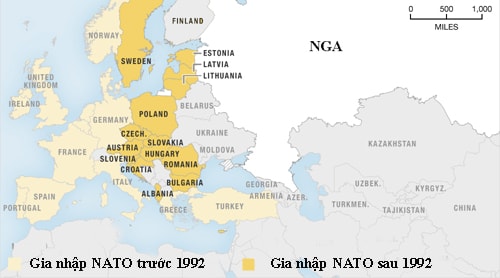 |
NATO has been continuously expanding eastward since 1991. Graphic: NPR. |
According to experts at George Washington University, as a former KGB officer who served for five years in East Germany, Putin likely had access to Soviet documents detailing promises made by NATO during the 1990-1991 period.
In his famous 2007 speech at the Munich Security Conference, Putin cited Woerner's commitment not to expand NATO. He later seemed to want to negotiate with the West in a way that he believed the West had used to negotiate with the Soviet Union in the past.
Western negotiators now realize they can't negotiate with Putin because he "says one thing but means another" and doesn't reveal what he really wants. This is how the winner negotiates with the loser.
Putin has consistently stated that the collapse of the Soviet Union was a "tragedy," and researchers suggest that studying this historical period has altered his perspective on the West. From his point of view, the West only truly speaks with force, while promises are merely a game, much like what U.S. President George H.W. Bush and Secretary of State Baker played with Gorbachev and Shevardnadze.
Researchers at George Washington University argue that the West's breaking of promises to the Soviet Union isn't the only reason Putin has a negative view of the West, but it played a significant role in the shift in his worldview.
This is why the West will never be able to truly negotiate with Putin or his successor. They will not easily forget the promises that have been shattered by history, meaning the confrontation between Russia and the West could continue for many years, even decades to come.
According to VNE
| RELATED NEWS |
|---|