

Farmers in Nghe An are in the season of processing turmeric starch.
(Baonghean.vn) - This year, Nghi Loc district cultivated over 120 hectares of turmeric, with an estimated yield of 2,400 tons of tubers. Currently in the peak harvest season, the turmeric starch processing industry here is also bustling.
Mr. Nguyen Cong Anh's family in Hamlet 17, Nghi Kieu Commune, cultivates 5 sao (approximately 0.5 hectares) of turmeric, with 1 sao already ready for harvest. According to Mr. Anh, they must harvest quickly in sunny weather; if it rains, the muddy soil will make harvesting very difficult. At the beginning of the season, the price of turmeric roots and starch is quite high, and traders haven't yet forced down prices, so they are harvesting quickly to process it as soon as possible.
Nghi Kieu has a total area of over 100 hectares of turmeric, double the amount compared to last year; it is mainly grown in hamlets 17 and 18. This year's turmeric harvest is bountiful, with an average yield of about 1 ton of tubers per sao (approximately 1000 square meters). Due to the increased area, the harvested turmeric yield is already quite high compared to previous years, even at the beginning of the season.
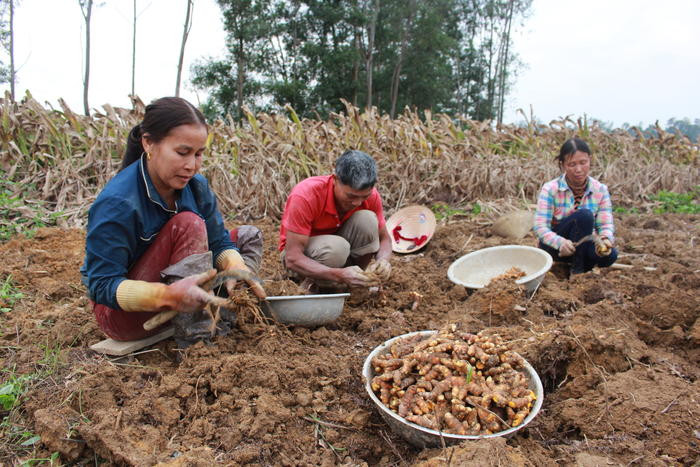 |
| Farmers in Nghi Kieu commune (Nghi Loc district) harvest turmeric. Photo: Nhat Tuan |
The entire commune currently has about 200 households growing turmeric and providing starch processing services. To produce good turmeric starch, the turmeric roots must first be thoroughly washed to remove all soil and sand. Previously, washing was done manually, but now most of this process is done by machine, ensuring clean raw materials and reducing labor time and effort.
Many investors have purchased large-capacity turmeric grinding machines, capable of grinding 1.2-1.5 tons of turmeric roots per day. After grinding, the turmeric is soaked in clean water for a period of time, then squeezed to extract the starch. Previously, this was done by hand, but now it's all done by machine. Many households have invested in modern equipment, capable of squeezing 300 kg of ground turmeric in just half an hour.
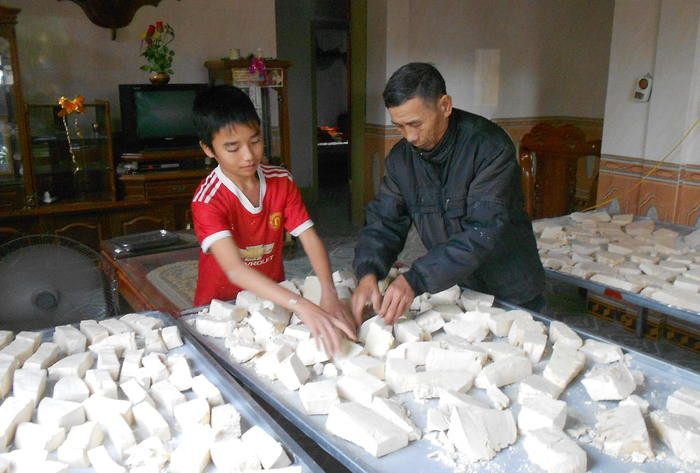 |
| Turmeric starch, after being extracted and filtered, is air-dried before being processed in a drying machine. Photo: Nhat Tuan |
Previously, this drying process depended on the weather, but now it is more proactive thanks to electric starch drying equipment. Therefore, turmeric starch processing can still take place even on rainy days.
Currently, the turmeric starch processing industry in Nghi Kieu provides employment for over 200 local workers; the average income reaches over 35 million VND/person/year. Many households have expanded their production scale to purchase turmeric tubers or accept turmeric starch processing orders from other families in and outside the locality.
For example, Ms. Hoang Thi Hang's family in Hamlet 17, Nghi Kieu Commune, invested nearly 100 million VND in building a workshop, drilling a well, buying an RO water filter, a pressing and filtering machine, and a turmeric starch drying machine. Every day, she processes more than 1 ton of turmeric for local people; each season, she processes about 300 tons of tubers.
Mr. Le Van Thuong from Hamlet 15B has opened a turmeric starch processing factory in Hamlet 18. He is currently finalizing the production line and preparing for operation. According to Mr. Thuong, once production begins, the factory will be able to process up to 5 tons of turmeric roots per day, yielding over 300 kg of starch. He already has many customers in Hanoi and southern provinces placing large orders.
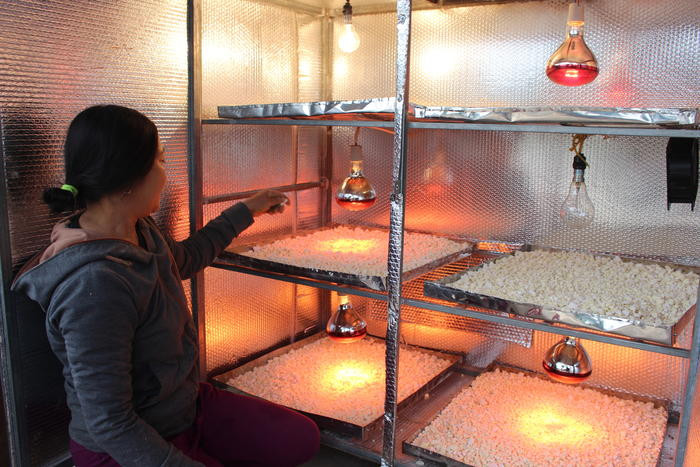 |
| Some families have invested in equipment to increase productivity in turmeric starch processing. Photo: Nhat Tuan |
Last year, the price of premium turmeric starch was 300,000 VND/kg during peak season, rising to 450,000-500,000 VND towards the end of the season. This year, due to increased production, the price is currently 250,000-260,000 VND/kg. On average, one sao (approximately 1000 square meters) of turmeric yields 1 ton of tubers, worth 10 million VND. When processed, this yields 70 kg of starch, bringing in 18 million VND.
Many families produce turmeric in large quantities, such as Mr. Hoang Thanh Bien and Mr. Hoang Van Nga in Hamlet 17; Mr. Nguyen Van Dong, Mr. Nguyen Duc Thuy, and Mr. Nguyen Duc Tin in Hamlet 18, who produce turmeric on a sample scale, earning over 200 million VND per harvest in previous years.
Thanks to the development of turmeric cultivation and starch processing, in 2017, Nghi Kieu commune was recognized by the Provincial People's Committee as a traditional village specializing in turmeric starch production and processing for two villages: Tan Hop (hamlet 17) and Kieu Moc (hamlet 18).
This year, turmeric cultivation has expanded not only within Nghi Kieu commune but also to neighboring communes such as Nghi Lam and Nghi Van. Each commune has 10 hectares. Currently, the turmeric tubers from these two localities are mainly supplied to households for processing in Nghi Kieu commune.
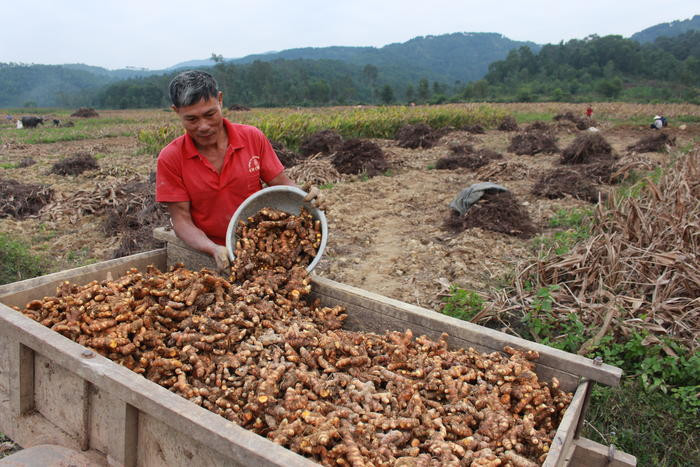 |
| The total turmeric production in Nghi Loc district reached 2,400 tons. Photo: Nhat Tuan |
With a total area of 120 hectares in the district, the turmeric yield reaches 2,400 tons; after processing, nearly 170 tons of starch will be obtained. Based on current prices, the total value of turmeric starch production and processing in Nghi Loc is estimated at approximately 43 billion VND.
Mr. Dong Binh Dinh, Deputy Head of the Agriculture and Rural Development Department of Nghi Loc district, said: the district is directing Nghi Kieu commune to gradually build a brand for turmeric starch products, promote and expand the market, and find partners to consume the products for the people. For the time being, the district will not expand the area planted with turmeric, but will focus on intensive cultivation of this crop within the existing 120 hectares. The local authorities need to guide farmers in selecting high-yielding turmeric varieties with good starch quality to achieve high economic efficiency in production.
Nhat Tuan