
The challenges awaiting Trump in 2018
The domestic midterm elections, the North Korean crisis, and tensions in the Middle East are three of the many challenges Trump faced in 2018.
The domestic midterm elections, the North Korean crisis, and tensions in the Middle East are three of the many challenges Trump faced in 2018.
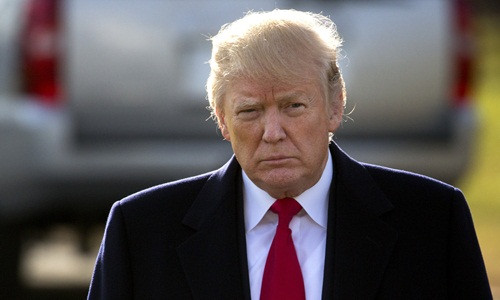 |
US President Donald Trump. Photo: Bloomberg. |
The Trump administration ended 2017 with a resounding victory, with the passage of the Republican-backed $1.5 trillion tax reform bill. This success gives the White House leader a more positive position as he prepares to enter his second year in office. However, experts believe 2018 may not be easy for President Trump, according to The Hill.
Domestic issues
Internal tensions within the US administration flared up at a meeting in the Oval Office on December 20th when President Trump and his senior advisers discussed political strategy for the coming year, according to CNN.
Corey Lewandowski, former campaign manager for Mr. Trump,"We stressed to the President that there are genuine concerns that the White House and the Republican National Committee (RNC) are not adequately prepared for the upcoming midterm elections," a source familiar with the meeting said. "And if they're not ready for the midterms, they're not ready for re-election."
The incident reflects growing tensions within the White House and the Republican Party as they face crucial midterm elections, observers say. Furthermore, it raises questions about the White House's relationship with its allies in the RNC and on Capitol Hill.
When RNC officials met in early October to plan for the midterm elections, "one of the biggest questions raised at the meeting was about the RNC's role in supporting the president," a source familiar with the matter said.
Although committee chair Ronna McDaniel remains committed to President Trump, some Republican members remain skeptical that the RNC's strategy may not align with the White House's strategy.
A senior White House adviser said the Trump administration and Republicans are scrambling to send a strong message ahead of the midterm elections, but all efforts are currently "stuck in place."
"Many of us understand that close coordination is necessary to maintain a majority," the adviser said. "But there are factions both inside and outside the White House and Congress that aren't following suit, purely for their own self-interest, and I feel growing concern about whether we can truly act effectively together."
In addition, President Trump's record-low approval rating also poses significant challenges for him, as his policies will now face greater skepticism.
The US government could shut down on January 19 if Democrats and Republicans fail to reach an agreement on a budget for the remainder of fiscal year 2018, which ends on September 30.
All of these issues will be major obstacles for the Trump administration in achieving its priorities in the coming year.
Trump will need votes from Democrats if he wants to pass his agenda. And things will become even more difficult with the midterm elections in November.
Democrats now need 24 seats to win the House of Representatives and just two seats to gain control of the Senate following the victory of candidate Doug Jones over Republican opponent Roy Moore in the Senate election in Alabama, a traditionally Republican state.
Advisers to President Trump are confident that he will regain the political advantage once Americans see their wages rise thanks to the tax reform law. But some Republicans don't share this view. They warn that the political problems Trump faces won't just disappear on their own.
Furthermore, according to observers, the impulsive and outspoken statements frequently made by the US President may excite his supporters, but in the long run, they will create unintended consequences.
"Every week, their achievements, such as positive jobs reports, are overshadowed by angry rhetoric," said Doug Heye, a Republican strategist.
If Trump continues to make "wrong" actions or statements, they will "put our majority" at risk, emphasized Ryan Williams, a former advisor to Mitt Romney, the Republican presidential candidate in 2012. "If we lose the House, the Senate, or both, Trump will be in big trouble."
Democratic control of Congress could also further accelerate investigations into Russian interference in the US presidential election, putting President Trump in a difficult position. Committee chairmen could expedite congressional investigations into allegations that the Trump campaign colluded with Moscow to interfere in the 2016 election, or even initiate impeachment proceedings, depending on how serious their findings. This is a worst-case scenario that President Trump would never want to face.
Challenges abroad
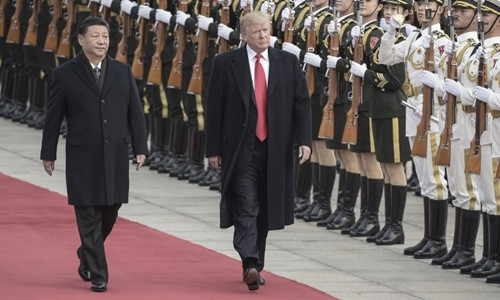 |
Chinese President Xi Jinping and US President Donald Trump at an official welcoming ceremony in Beijing on November 9. Photo: AFP. |
During his 2016 presidential campaign, Trump strongly criticized China, accusing it of taking advantage of the US through unfair business practices and offering little help in resolving the North Korean crisis. A year into his presidency, relations between Washington and Beijing have warmed. However, experts predict 2018 will bring new challenges for both countries.
Evan Medeiros, managing director for Asia at the consulting firm Eurasia Group, believes the Trump administration will launch a series of "very serious" unilateral trade actions against China in early 2018 to promote a mutually beneficial trade relationship. This move will certainly not be welcomed by China.
"There's an optimistic assumption that the U.S. could simply launch 10 economic missiles into the air and China would say, 'Ah, we made a mistake. We have to give in to our American friends,'" commented Kevin Rudd, president of the Asia Society Policy Institute. "I've studied China for the past 35 years and have never found any evidence that they would do that."
Rudd also predicted that the "disorderly" nature of US policy toward North Korea could trigger a crisis in relations with China, given that the Trump administration has been constantly pressuring Beijing to pressure Pyongyang over its nuclear and missile programs.
"I feel that these two things combined will create a deeper crisis in the US-China relationship," Rudd stated.
Regarding the North Korean crisis, experts believe the prospects for dialogue between Washington and Pyongyang in 2018 remain bleak. To date, neither the US nor North Korea has indicated a willingness to engage in such discussions.
North Korea has adamantly refused to abandon its nuclear and missile programs. The North Korean government told a senior UN envoy that it was "too early" to consider negotiations with the United States.
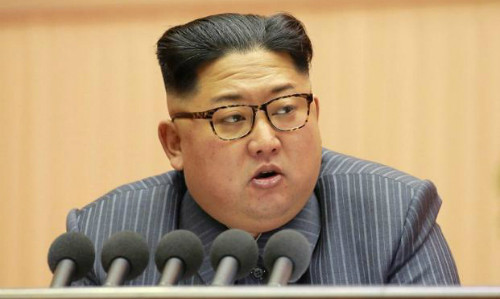 |
North Korean leader Kim Jong-un. Photo: AFP. |
The Trump administration reiterated in December that "now is not the right time to sit down at the negotiating table" with North Korea. Earlier that month, U.S. Secretary of State Rex Tillerson proposed talks with North Korea with certain conditions related to its nuclear program. However, the White House subsequently denied this, and Tillerson quickly changed his stance, asserting that there would be no talks unless "North Korea ceases its threatening behavior."
Regarding relations with Russia, after the Trump administration released its new national security strategy, calling Russia and China "revisionist forces" seeking to undermine American interests and values, experts predicted that relations between Washington and Moscow in 2018 would be "colder," according to CNN.
The new national security strategy marks a turning point in the way the US administration deals with Russia, moving from building warm, cooperative relations to confrontation.
This shift likely stems from the fact that the White House is besieged by investigations into alleged Russian interference in the 2016 US presidential election, as well as the fact that skepticism about Russia continues to grow within the intelligence community, diplomatic circles, military officials, and US lawmakers, CNN commentator Nicole Gaouette assesses.
"We're about to enter a year where policy toward Russia will likely be well-defined, and that policy will be quite confrontational," commented Matt Rojansky, director of the Kennan Institute at the Wilson Center in the U.S. "This is certainly not the policy you would expect to see from Trump when he was a presidential candidate."
In the Middle East, President Trump has yet to offer a clear policy for peace in the region, and if he wants to make it a reality, he still has many issues to address, according to Aljazeera.
President Trump's recognition of Jerusalem as the capital of Israel is fueling tensions. A series of protests have erupted worldwide against the White House's decision. The United Nations General Assembly adopted a draft resolution demanding that the US reverse its decision, but Washington refused, even threatening to cut aid to countries that supported the resolution. Analysts believe that if the Trump administration does not take concrete action and allows this crisis to continue, America's standing on the international stage will certainly be affected.
On the other hand, the threat from the remnants of the Islamic State (IS) militants in Iraq and Syria is also a problem that the White House needs to solve. Although the US and Russia claim to have completely pushed IS out of Iraq and Syria, the reality shows that their seeds have not been eradicated. Instead, IS is gradually shifting to operating stealthily, carrying out attacks in Syria, Iraq, and around the world. A question now is whether, when weakened, IS will decide to ally with the terrorist organization al-Qaeda.
"If instability persists in Iraq, Syria, and Libya, ISIS or any other extremist group will still have the opportunity to rise again, exploiting political instability to gain strength," commented Joe Macaron from Aljazeera.
According to VNE
| RELATED NEWS |
|---|