

Mines: The "Ghosts" of the Ocean
It wasn't submarines or warships, but rather naval mines that struck the most fear into sailors during naval battles.
Although submarines, surface warships, and aircraft often attract media attention during naval battles, in reality, mines pose the greatest danger to any ship at sea, in both wartime and peacetime.
Compared to other naval weapons, mines have the lowest deployment costs.They can operate for months, even years at a time, controlling a specific body of water without needing any soldiers or warships to guard it.
The first names
Surprisingly, naval mines have a long history predating modern naval warfare. Floating explosive devices were used by the Chinese as early as the 14th century, and by the 16th century, the Dutch created a type of mine by filling unmanned vessels with explosives and releasing these "bomb ships" into enemy ports. However, the first true naval mine was invented during the American War of Independence by American military engineer David Bushnell.
FruitEarly generation naval minesBushnell's mines consisted of watertight barrels of gunpowder, fitted with a flint ignition mechanism to be triggered by impact. These floating mines were first deployed in the Battle of the Delaware River in 1777. Although innovative and unexpected, these mines were not very effective.
Next came Robert Fulton, also an American patriot. In late 1790, he createdfloating minesThese mines could be detonated by a timer. However, this type of mine was impractical, so he went on to design a double mine connected by a cable. His idea was that when an enemy ship entered between the two mines, the cable would snag them, pulling the two mines closer together and causing them to collide with the ship's hull before exploding.
|
| Early naval mines were also known as water mines or floating mines. Image source: Naval. |
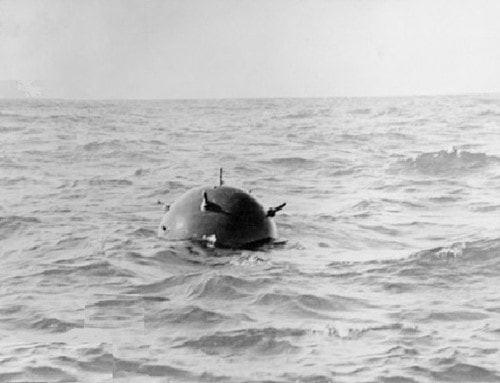
After several trials, Fulton also developed submersible mines to ensure they would detonate better below the ship's draft. In 1805 and 1807, Fulton successfully tested this weapon on large warships, demonstrating the effectiveness of this novel weapon.
Detonation by impact
However, it wasn't until the 19th century that the era of naval mine warfare truly began. Throughout the first half of the 19th century, the United States and Russia continuously improved their naval mines, even developing modern versions of electromagnetically detonated mines.
During the Crimean War (1854-1856), Moritz Jacobi, a Prussian living in Russia, successfully developed a contact mine, which would detonate when a ship struck its chemical fuse. One such mine inflicted significant damage on the British warship HMS Merlin.
|
| A "distorted" torpedo washed ashore. Image source: Histclo. |
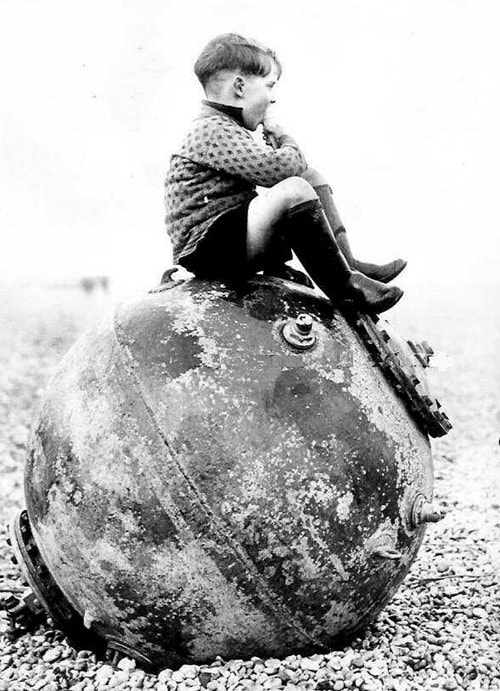
By the 1860s, naval mines constituted a significant portion of the modern navy's arsenal. Commonly used types were contact-detonated or electrically detonated mines. The former could be deployed at sea, either freely drifting or anchored, while the latter were placed near shore to protect harbors and docks by connecting an electrically charged cable from the mines to an onshore outpost.
In terms of combat effectiveness, naval mines had a significant impact in the American Civil War, sinking a total of 50 ships (mostly Union ships). During the Russo-Japanese War (1904-1905), naval mines were used in even greater numbers and caused extremely serious losses.
|
| A surface vessel struck by a mine. Image source: Quora. |
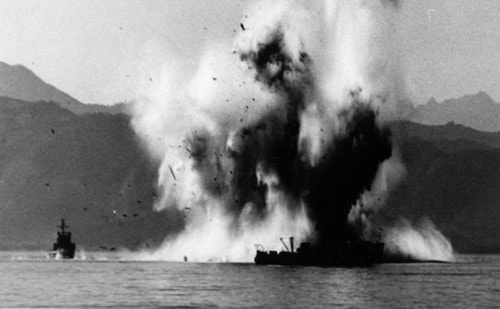
Specifically, the Japanese Navy lost three battleships and four cruisers to mines, while the Russian battleship Petropavlovsk was sunk by a Japanese mine, taking 638 sailors to their graves. It was from this Russo-Japanese War that the usefulness of mines was proven.
During World War I, 310,000 naval mines were laid in disputed waters. By World War II, the use of magnetically detonated, pressure-activated, or acoustically triggered mines, rather than those detonating through impact, significantly increased their effectiveness. Between 1939 and 1945, over 600,000 mines were laid in the Atlantic and European waters alone, causing the loss of millions of tons of cargo worldwide.
|
| A rusty torpedo washed ashore. Image source: Index. |
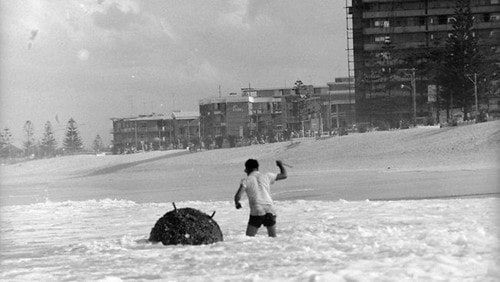
To this day, naval mines remain an international security issue because they are sophisticated, durable, inexpensive, and easily deployed from ships or aircraft. Since the end of World War II, mines have inadvertently destroyed or sunk countless cargo ships, and in the future, this will undoubtedly remain a challenge for navies worldwide.