
Land and people along the Pu Loi mountain range
(Baonghean.vn) - Nestled beside the majestic Pù Loi mountain range, Thai Minh village in Tien Ky commune (Tan Ky district) has preserved its unique identity for generations, with its ancient trees and traditional stilt houses. Visiting here, one can witness the renewed enthusiasm of the villagers in building a more prosperous and beautiful village.
On rainy days, the road leading to Thai Minh village becomes difficult. Nevertheless, this ancient village, home to nearly 170 Thai ethnic minority households, with its rich cultural traditions, still holds a strange allure. At this time of year, the villagers are harvesting sugarcane, and the roads are bustling with vehicles transporting goods, filled with the sounds of laughter and conversation...
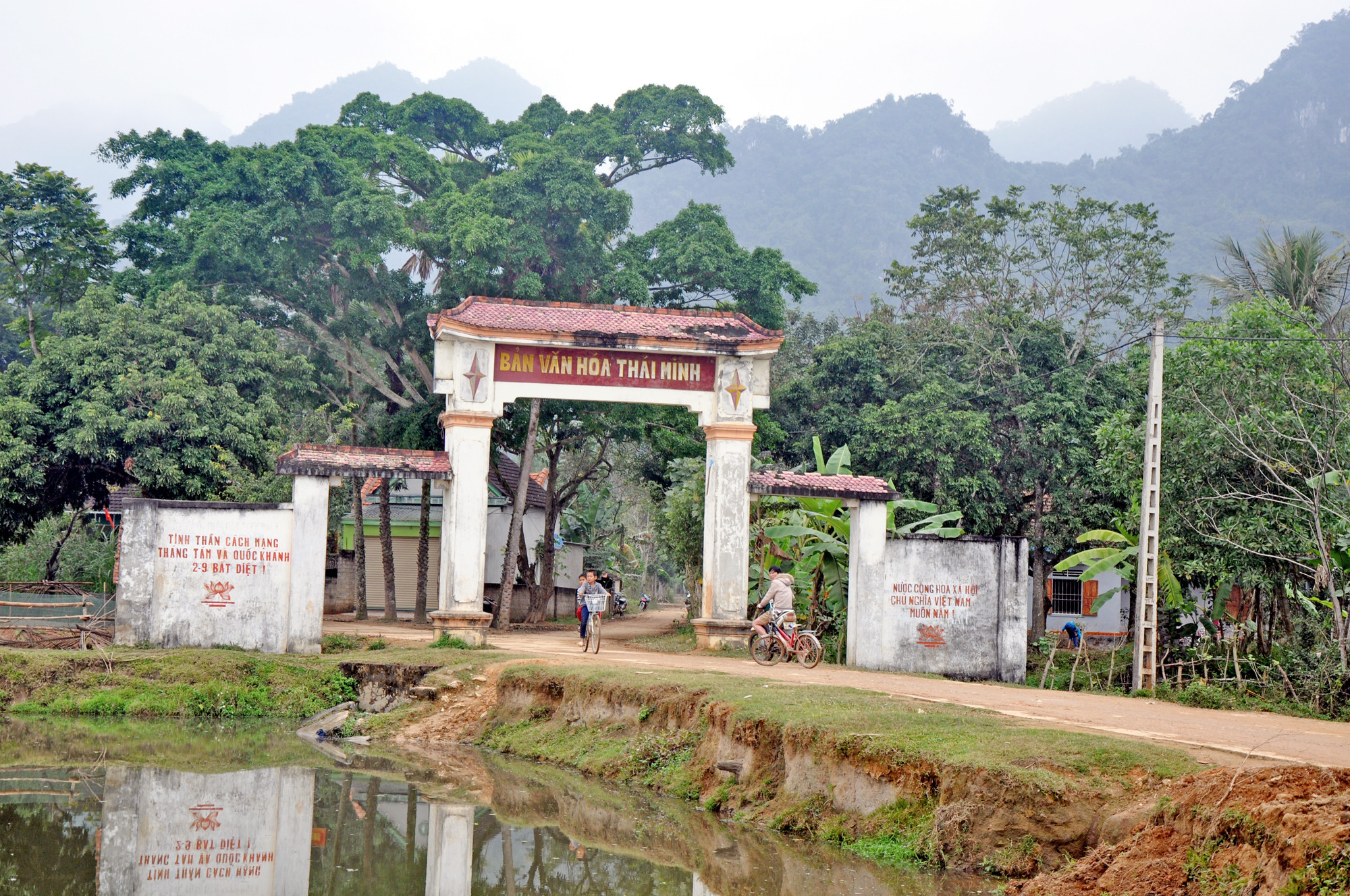 |
| The road leading to Thai Minh ancient village, Tien Ky commune (Tan Ky district). Photo: Cong Kien |
The entrance gate to Thai Minh village is quite special, not because of its architecture, but because of its prime location. In front is a large lake, full of lotus and water lilies in the summer. Behind it is an ancient banyan tree casting its lush shade. Further on are houses with moss-covered roofs nestled under the verdant trees.
The banyan tree by the entrance gate has been there for a very long time; no one remembers the exact year, only that the oldest person in the village says they've seen it that way since they were young. This means the banyan tree is hundreds of years old and has witnessed countless ups and downs and changes in life here.
Mr. La Van Minh is one of the elders of Thai Minh village. Approaching eighty years old, he remains remarkably sharp, remembering almost all the major events of the village. Currently, Mr. Minh is reconstructing the family genealogies for the Thai clans residing in Tien Ky, as he knows the last seven generations. From this, he is creating the family branches, helping future generations to understand their ancestral origins...
On their march, General Le Loi and his troops achieved a resounding victory at the Battle of Bo Dang (present-day Quy Chau district). Their next objective was to capture Tra Lan citadel (now in Bong Khe commune, Con Cuong district), a crucial waterway and land transportation hub; it served as both the capital and a vital military base for the enemy.
Le Loi chose the Tien Ky area (about 15 km from the city) as his strategic rear base, recruiting more soldiers, training them in martial arts, and receiving supplies from the local people to besiege the enemy within the city.
After a two-month siege that cut off enemy supply lines, by the end of 1424, the enemy troops at Tra Lan citadel were suffering from hunger, thirst, and disease. The Ming general, Cam Bang, was forced to surrender with 1,000 troops. Having captured Tra Lan citadel, the Lam Son rebels continued southward, capturing a series of enemy citadels before marching north to liberate Thang Long, thus ending Ming rule.
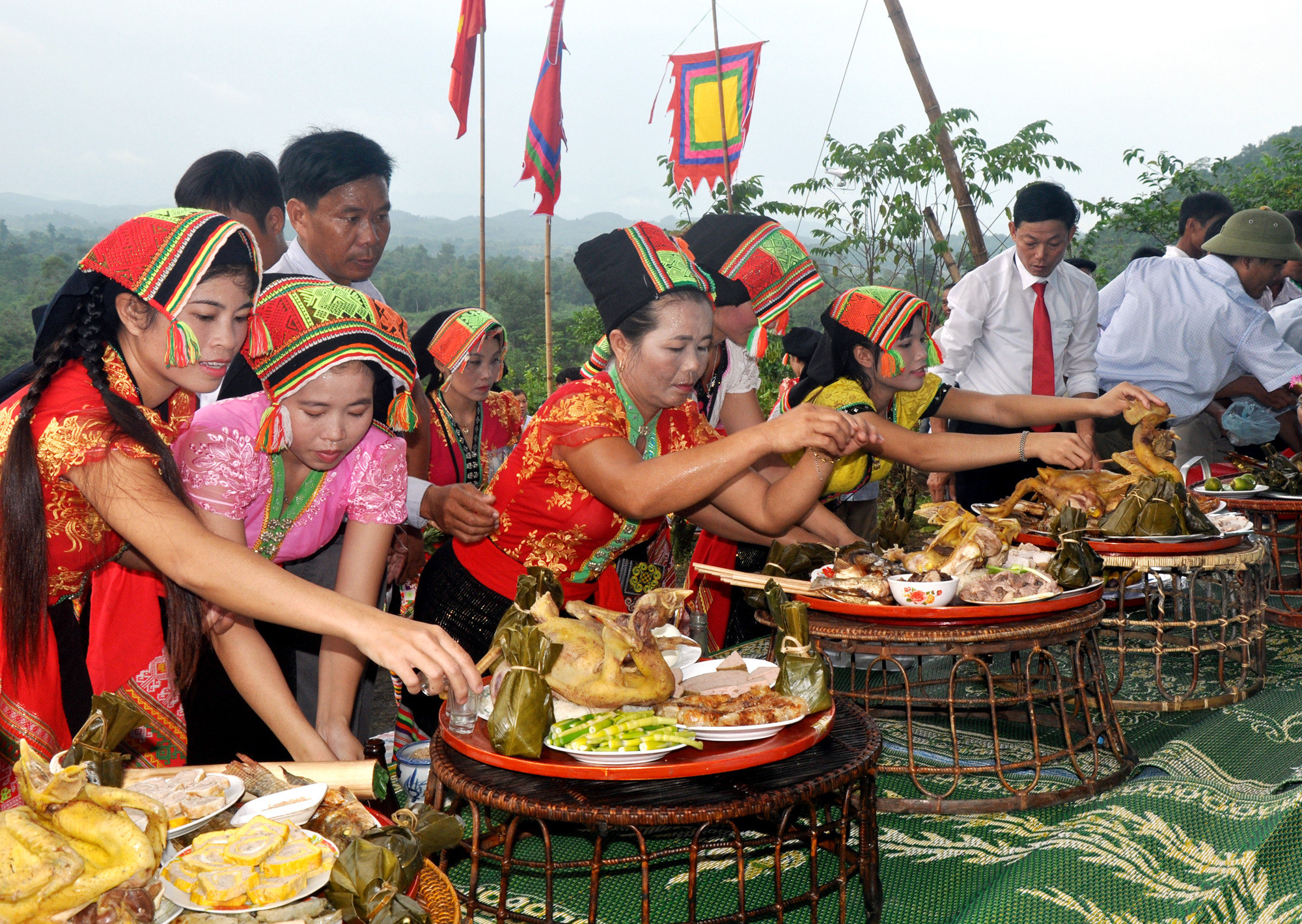 |
| People in Tien Ky commune (Tan Ky district) offer gifts to King Le Loi and the generals and soldiers of the Lam Son army. Photo: Cong Kien |
Since then, on the 20th day of the 8th lunar month, the Thai people in Thai Minh have maintained the Bươn Xao festival (meaning "the 20th day" in Thai). Families make moọc cakes and bring them up to Pù Pán mountain for the sacrificial ceremony, then celebrate together with enchanting songs and dances. Young men and women participate in the game of throwing the "con" (a type of ball), while the elderly sit and chat over jars of wine. The Bươn Xao festival has become a traditional cultural feature that embodies the unique beauty of the Thai people in Tiên Kỳ.
Mr. La Van Minh gazed towards the Pu Loi mountain range and continued his story: “There’s a very large cave on the mountain; you could walk through it for days and still not reach the end. Inside the cave, there’s a stream that never dries up. 55 years ago, I went in there to find a water source during the dry season, helping the villagers have water to irrigate their fields.”
The story takes place in 1963, a year of severe drought. Streams dried up, fish and crabs lay dead along the banks, the fields of Thai Minh cracked, while the sun blazed down relentlessly. The threat of famine was becoming increasingly apparent. The villagers were terrified. They held several rain-praying ceremonies, sacrificing many buffaloes and oxen, but still not a single drop of water came. The village elder suddenly remembered hearing stories from the past about a large stream on Pu Loi that never dried up, but going there would be extremely dangerous due to the treacherous path, the many wild animals, not to mention the terrifying stories woven from ancient times. The villagers wanted to send someone to Pu Loi to investigate the water source. Reaching the source was difficult enough, but bringing the water back to the village would be even harder than reaching... heaven. So, who would go?
A group of young men from Thai Minh village held a meeting and decided to go to Pu Loi together to find a water source to save their village. They included: Luong Van Hau (born 1927), La Van My (born 1925), Vi Van Phat (born 1934), La Van Minh (born 1939), and Vi Van Hieu (born 1943).
The five-man team climbed the sheer cliff, weaving through the bushes, walking on and on, until they reached a cave entrance. Inside, they turned on their flashlights, knives in hand, lined up, and cautiously probed their way forward. The deeper they went, the colder it became. They heard the sound of flowing water, shone their flashlights, saw the reflection of water, and upon closer inspection, saw a stream full of water. The five men hugged each other and cheered. Then they followed the stream downstream for a considerable distance before the water suddenly plunged into a deep, dark cave and disappeared...
The journey lasted three days, and the villagers joyfully welcomed the "heroes" back. Hearing about the journey, the villagers discussed ways to bring water from the cave to the village's fields. The agreed-upon plan was to use a large quantity of straw, old clothes, and plastic bags to block the water flow down into the deep cave. This task was again entrusted to the five young men mentioned above.
The "heroes" of Thai Minh village set off again, carrying the hopes of the community. A few days later, a cool stream flowed from the rocky mountains into the Thai Minh fields, and the villagers rejoiced, the sounds of gongs and flutes echoing throughout the mountains and forests. The cave with the stream was named Mo Cave by the villagers.
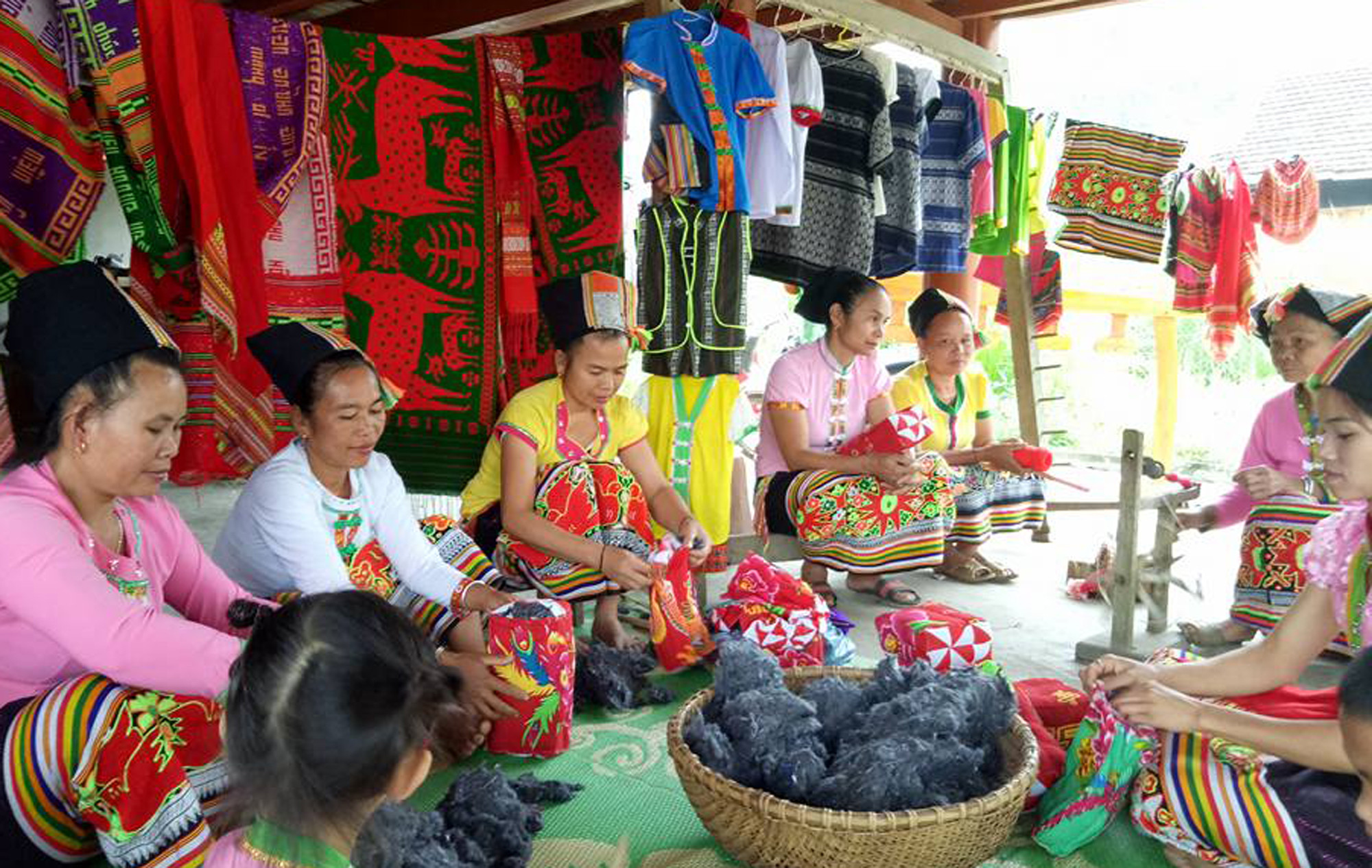 |
| Women in Thai Minh village, Tien Ky commune (Tan Ky district) making pillows. (Archival photo) |
Today, the fields of Thai Minh remain lush and fertile year-round thanks to irrigation from the Mo Cave, ensuring a prosperous life for the villagers. Along with sugarcane, corn, acacia trees, and livestock farming, these crops provide a substantial income for the villagers, enabling them to build houses and acquire modern conveniences. In particular, the traditional brocade weaving craft is still maintained by the women of Thai Minh, providing employment during the off-season, supplementing their income, and contributing to the preservation of their cultural identity. In 2016, the village was recognized as a Brocade Weaving Village.
Reportedly, Tan Ky district is planning to develop Thai Minh village into a community tourism destination, focusing on the scenic Mo Cave, traditional brocade weaving, and customs and traditions deeply rooted in Thai culture. Hopefully, this idea will soon become a reality, allowing friends near and far to discover Thai Minh – an ancient village nestled beside the majestic Pu Loi mountain range.
Cong Kien