

'Dead zones' are spreading across the oceans.
"Dead zones," areas of the ocean with low oxygen levels where life cannot survive, have expanded tenfold over the past five decades.
A study recently published in the journal Science reveals that many oceans around the world are in an alarming state, with virtually no life left to survive.
According to measurements, the oceans have lost approximately 2% of their total dissolved oxygen over the past half-century. This directly impacts the survival of marine life.
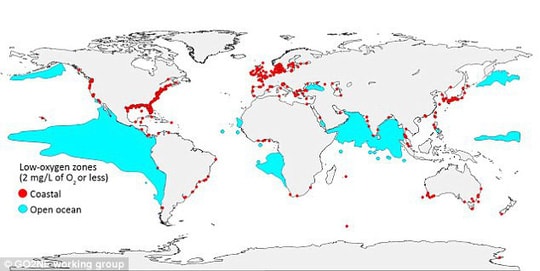
Dead zones (marked in red or blue) are spreading across the ocean (red: coastal areas; blue: offshore) - image provided by the research team.
That 2% figure is equivalent to a fourfold increase in the total volume of oxygen-free seawater, as well as a tenfold increase in dead zones with low oxygen concentrations unsuitable for life.
The study was conducted by a team of scientists from GO2NE – the Ocean Oxygen Network, a special working group established by the United Nations. According to Dr. Denise Breitburg, a marine ecologist at the Smithsonian Environmental Research Center (USA), the decline in oxygen in the ocean is one of the most serious impacts of human activity on the Earth's environment.
The main causes of dead zones are environmental pollution and climate change.
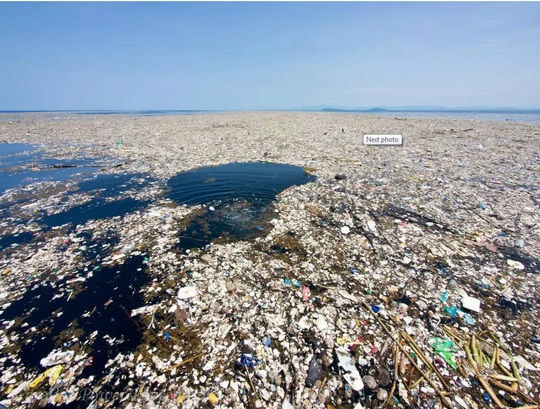
Pollution is one of the reasons why dead zones are expanding. In the photo: the Caribbean Sea is submerged in garbage.
However, despite the truly alarming numbers, we still have ways to address it. For example, an investment in better wastewater treatment technology in Chesapeake Bay (USA) has significantly increased oxygen levels in the area's seawater. Of course, one local effort alone cannot save the ocean. Scientists are calling for a global effort to tackle this urgent problem.