

Right now, the Party must act decisively.
History is not just about the past; it is also a teacher that helps us understand the present and predict the future.
Throughout thousands of years of nation-building and defense, our people have written glorious chapters in history. But along that long journey of many centuries, our people have also experienced countless hardships and bitterness. History is not just about the past; it is also a teacher that helps us understand the present and predict the future. Lessons from history also help us to understand ourselves...
|
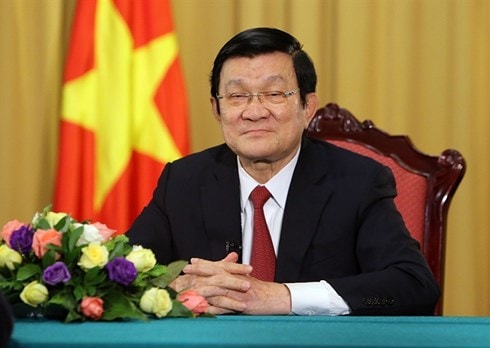
| Mr. Truong Tan Sang - Former Member of the Politburo, former President of the Socialist Republic of Vietnam. Photo: VNA |
Having worked for many years in Thang Long, a city with a thousand years of cultural heritage, I often passed by the Imperial Citadel and West Lake, in the early morning mist or at sunset. Sometimes I would stop beside the remnants of the golden age of the Ly and Tran dynasties, or gaze at the misty West Lake, reflecting on the periods of prosperity and decline of the country, and the reasons for the rise and fall of the times.
Each time this happens, the line "The old soldier with white hair, still recounts the story of Nguyen Phong" (Bạch đầu quân sĩ tại, vãng vãng thuyết Nguyên Phong) from King Tran Nhan Tong's poem "Spring Day Visiting Chieu Lang" (Spring Day Visiting Chieu Lang) flashes through my mind. The story of Nguyen Phong's victory over the Mongol invaders, a battle fought by the Vietnamese that shook the world, is still recounted by the old soldiers to their descendants and has become a source of strength for the Vietnamese people and army to continue their victories against the powerful Mongol invaders a second and third time.
History has such power! Those moments of immersing myself in history have shaped many of my thoughts and actions.
Fortunately, when an old friend gifted me a copy of the historical novel "Storms of the Tran Dynasty" by writer Hoang Quoc Hai, I read it and found many things I appreciated. Novels are the writer's creations, but they reflect the reality of life and offer valuable insights.
In the play "Storms of the Tran Dynasty," Mr. Hoang tells Lord Tran Thu Do: "Maintaining the nation is not merely governing it; maintaining the nation is much more difficult. Only by accomplishing that can we ensure its longevity and truly establish a glorious legacy for our ancestors. Protecting the nation is the work of all the people, of all citizens, while governing it is the work of only a select few."
Every dynasty, every king, established themselves and their nation through various paths, but once in power, they all had to build legitimacy. The Trần dynasty usurped the Lý dynasty because the Lý dynasty was in decline, no longer able to govern or build the nation; rebellions were rampant, and foreign powers were eyeing the country. The Trần dynasty's rise to power and its stability were due to the restoration of social balance, the people's peace and prosperity, and the court's reliance on the people's support. Judging a nation's destiny by the will of the people is always accurate.
In 1258, after more than 30 years of establishing the dynasty, Tran Thai Tong, the first emperor of the Tran dynasty, together with the royal family, revived a nation that had been weak and chaotic during the late reign of Ly Hue Tong, transforming it into a powerful nation respected by neighboring countries, capable of leading the entire population to defeat the mighty Mongol army. The miraculous defeat of the Yuan-Mongol empire under the Tran dynasty did not stop there. In 1285 and 1288, the invincible Yuan-Mongol army, whose horses had trampled across Asia and Europe, was forced to stop and suffer a crushing defeat at the hands of the Tran army and people.
The victory of Dai Viet against the army of one of the most powerful empires in the world at that time demonstrated the invincible strength of our people and pointed out a truth of national history: that when everyone is united, brothers are harmonious, and the whole nation contributes its strength (in the words of Hung Dao King Tran Quoc Tuan), no enemy can subdue our nation.
Although a controversial historical figure, Tran Thu Do was also renowned for his virtue, impartiality, willingness to listen to reason, and integrity. As Grand Tutor and pillar of the court, he ordered the amputation of his wife Linh Tu Quoc Mau's nephew's toes to distinguish him from other minor officials. This was because the nephew had asked the Queen Mother for a position as a village official, and only after much pleading was he spared. He was a man who put the national interest above all else, never mixing personal feelings with public affairs. Similarly, the character Hoang Tien Sinh in "Storms of the Tran Dynasty" advised Tran Thu Do before parting ways that the worst thing to do was to only establish rules that benefited those in power while harming the people, as this would be the root of chaos.
Avoiding that grave taboo allowed the Tran dynasty to last 175 years, but alas, it was precisely because they failed to heed that teaching that the Tran dynasty ultimately collapsed... This serves as a lesson for future generations.
More than 100 years after the first emperor of the Tran dynasty, on the early morning of the day when Chu An (Chu Van An), the national tutor of the two emperors Hien Tong and Du Tong, wiped away his tears, hung up his hat at the Huyen Vu gate, and returned to his hometown to teach, the capital Thang Long remained silent. The petition in which he risked his life to request the execution of seven treacherous officials at the beginning of the dynasty still lay untouched somewhere in the secret chamber or on the imperial throne... That day also foreshadowed the instability and collapse of the once glorious Tran dynasty.
The Complete Annals of Dai Viet record: Emperor Du Tong was fond of pleasure and neglected state affairs. Many powerful officials acted against the law. An advised Du Tong against this, but Du Tong did not listen. An then submitted a petition requesting the execution of seven sycophantic officials, all powerful figures favored by the emperor. This was known at the time as the "Seven Executions Petition." The petition went unanswered, so he resigned and returned to his hometown.
The Đại Việt Chronicle also records that even though he was no longer an official, Chu Văn An still deeply cared about the fate of the nation. Whenever there was a major court assembly, he would return to the capital. On those occasions, the king often wanted to entrust him with political affairs, but he resolutely refused, and he would often give away gifts to others. Our ancestors taught us through the New Year couplet: "Knowing contentment brings constant joy, not seeking brings inherent dignity."
The legacy that Grand Tutor Tran Thu Do painstakingly established, leading the entire nation through three victories against the Yuan-Mongol invaders under the Tran dynasty, sadly fell into the hands of Emperor Du Tong, a monarch who was debauched and extravagant. Even if I had fulfilled my duty as a loyal subject, if the emperor no longer acted as a wise ruler, despised virtuous people, disliked honest speech, favored incompetent individuals, allowed treacherous officials to run rampant, and corruption was widespread... then the title of "righteous" was no longer legitimate. His downfall was imminent.
Looking back at history, although the ruling dynasties differed, their downfall, as Chu An said, stemmed from the same causes: "disliking frank speech, hating virtuous people, neglecting talented individuals, despising the people, suspecting scholars, and valuing incompetent and immoral people." Emperor Dụ Tông's death (in 1369) left behind a legacy of misfortune. The Trần dynasty lasted for another 31 years with five emperors before falling to the Hồ dynasty in 1400. After seizing the throne, the Hồ dynasty accomplished many things, but they gained the country but not the people, and thus could not hold on for long, only seven years before the country fell again to the Ming invaders.
In the next phase of the country's history, unlike the Tran and Ho dynasties, the Le dynasty rose to the political stage based on the victory of the resistance against the invading Ming army. The leaders of the resistance were seen as saviors who led the nation out of the threat of foreign enslavement.
Naturally, dynasties founded by heroes are revered by the people as sacred values. The Le Dynasty, with its wise emperors like Le Thanh Tong, who commissioned the renowned scholar Than Nhan Trung to compose an inscription with the phrase "talented individuals are the lifeblood of the nation," relied on these talents to create a series of cultural and historical values passed down through generations, elevating Dai Viet to the ranks of regional powers.
Yet, that very dynasty eventually collapsed completely at the end of the 18th century. The paths to power and the rise of prosperity of these dynasties varied greatly, but the causes of their downfall were largely the same: the incompetence and moral decay of those in power.
During the Le Trung Hung era, the scholar Le Quy Don (1726-1784) summarized five dangers leading to national decline: the young not respecting the elderly, students not respecting their teachers, soldiers being arrogant and generals retreating, rampant corruption, and scholars turning a blind eye. All five are internal factors. The Vietnamese people have never feared foreign invaders; they only fear those in power lacking the courage to reform themselves and to strictly enforce internal rules.
Studying history is the path that leads us to a treasure trove of invaluable experiences that our ancestors have accumulated through their sweat and blood.
Today we enter a new year with a cheerful spirit, renewed confidence among the people, a somewhat recovered economy, and a wider dissemination of the country's standing. Looking back at last year, it must be affirmed that what our Party has done in personnel work and Party building is in line with the wishes and aspirations of the entire nation.
It must also be affirmed that the exposé and cleansing of corruption and negativity will not stop, but from here, with renewed confidence, the whole country will unite and work together to eradicate the internal enemy. Haven't the people and every Party member always been indignant and outraged by corruption and moral decay? Haven't we witnessed those with insatiable greed exploiting policy loopholes and abusing power to fleece the people, and then those same individuals and their cronies finding every way to "climb higher and higher" to ensure that their stolen wealth continues to grow and flourish?
If corruption and decay are not eradicated, where will this Party, this regime, this country go? Historians never write the word "if." That is why, right now, the Party and those in positions of leadership must act decisively.
The people have always stood by the Party, wholeheartedly following it with both reason and heart to carry out this struggle to the end. Each of us will eventually face the fair judgment of history and the nation. With that belief, we joyfully step into the year of the Dog 2018.
Written in Ho Chi Minh City, late 2017
(Title provided by VOV.VN)
Truong Tan Sang
Former Member of the Politburo, former President of the Socialist Republic of Vietnam