

The world's largest interceptor fighter jet.
Developed based on the Tu-98 bomber prototype, it's easy to understand why the Tu-28 (Tu-128) Fiddler fighter jet is so oversized.
The Tu-28 fighter jet began design in 1958, driven by the need for a vehicle capable of defending Soviet airspace against American strategic bombers armed with nuclear weapons. The requirements included a wide operational range, powerful radar, and potent air-to-air missiles.
The Tu-28 is based on the previously failed prototype of the Tu-98 supersonic bomber.
Initially, it received the designation Tu-28, but in 1963 it was changed to Tu-128, according to the design bureau's code.
The Tu-28's specifications are impressive, including a length of 30.06 m; a wingspan of 17.53 m; a height of 7.15 m; a wing area of 96.94 m2; an empty weight of 24,500 kg; a loaded weight of 40,000 kg; and a maximum takeoff weight of 43,700 kg.
The Tu-28 was significantly larger than most fighter aircraft of its time, both in general and in the present day.
|
| Soviet Tu-28 (Tu-128) Fiddler interceptor fighter. |
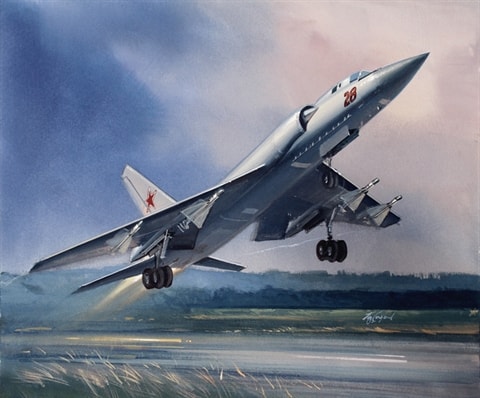
The heart of the Tu-28 is its two Lyulka AL-7F-2 turbofan engines, each with a dry thrust of 72.8 kN and up to 99.1 kN with afterburner engaged, giving it a top speed of 1,920 km/h without weapons or 1,665 km/h with full load, a range of 2,565 km, and a service ceiling of 20,000 m.
The Tu-28 made its first flight in 1961 and was introduced in 1964. The mass-produced Tu-28P version was equipped with the Smerch radar (NATO designation: Big Nose), a first-band radar with a detection range of 50 km and the ability to lock onto targets up to 40 km away.
Although its radar capabilities were relatively superior to other products of the time, the Tu-28P's combat methods still relied heavily on ground-based guidance.
|
| Tu-28UT (Tu-128UT) training aircraft. |
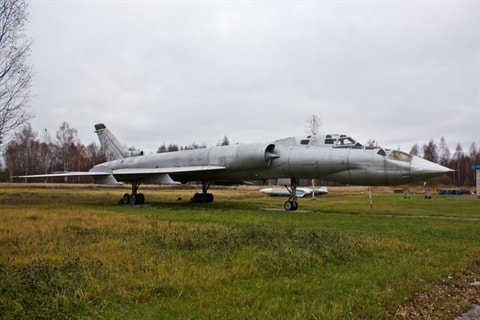
The Tu-28 had several drawbacks, such as a rather rudimentary electronics system, poor visibility, low payload capacity, and limited maneuverability. However, because its mission was to intercept enemy strategic bombers, these weaknesses in the air were actually quite significant.
The Tu-28's armament consists of four Bisnovat R-4 (AA-5 Ash) air-to-air missiles; it typically carries two R-4R (semi-active radar seeker) and two R-4T (infrared seeker) missiles.
The R-4 missile was also not highly regarded in terms of its technical and tactical capabilities.
A total of 198 Tu-28/Tu-128 aircraft were produced (including 10 Tu-128UT training variants).
Most of them were operational in the 1980s, with a few serving in the Russian Air Force until 1992 before being completely replaced by the MiG-31.