

Composer Hoang Van - a bridge connecting Music and Life
A rare and exceptionally talented musician, knowledgeable in many fields beyond music; the composer of timeless anthems, has passed away.
|
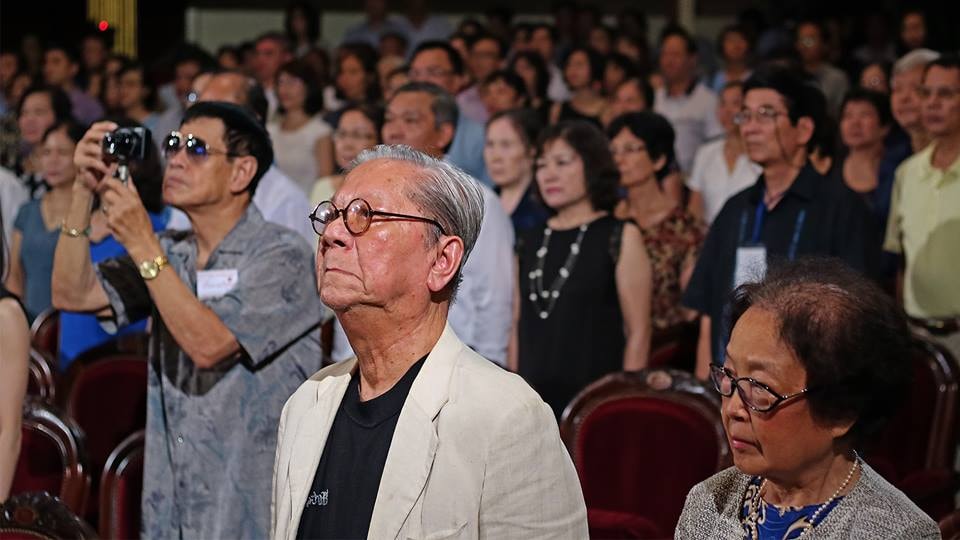
| Composer Hoang Van at the "Things That Remain" concert. Photo: Le Anh Dung |
Lifetime
Composer Hoàng Vân, whose real name was Lê Văn Ngọ, was born in 1930 into a scholarly family on Hàng Thùng Street. At the age of 16, he joined the Mai Hắc Đế National Salvation Youth Team, serving as a liaison officer for the Đông Kinh Nghĩa Thục (Zone I) self-defense force in Hanoi, and later as the head of the Cadet Corps of Regiment 165, Division 312. After 1954, when peace was restored, he was sent to study at the Beijing Conservatory of Music (China).
After graduating in 1960, he became the conductor of the Vietnam National Radio Music Ensemble and also served as artistic director, teaching composition and orchestration at the Hanoi Conservatory of Music (until 1989). From 1963 to 1989, he was a member of the Executive Committee of the Vietnam Musicians Association, Head of the Vocal Composition Department, and worked at the Vietnam Musicians Association until 1996. He was awarded the Ho Chi Minh Prize for Literature and Arts in 2000.
For a long time, composer Hoang Van was involved in teaching at the Hanoi Conservatory of Music, and composers such as Truong Ngoc Ninh, Phu Quang, and An Thuyen were all his students.
Compose
Composer Hoang Van began composing in 1951 with songs that became widely popular in the mountainous regions of Northwest and Viet Bac, such as "Victory at Hoa Binh," "News of Victory," and "Victory in the Northwest."
The young Le Van Ngo never imagined he would become the renowned composer Hoang Van later on. Even with his composition, "Ho Keo Phao" (Dragging the Cannon), he only thought of it as writing a wall newspaper to post on the bunker walls for his comrades to read, to share and encourage each other among the soldiers of Uncle Ho's army on the resistance war. Unexpectedly, the song, composed in time for "on the battlefield," reached the ears of General Vo Nguyen Giap. Finding "Ho Keo Phao" beautiful, the General popularized it on all fronts and said that Hoang Van and several other soldiers must be sent abroad for training. After graduating from the formal music school in Poland, he returned and became a composer.
The compositions of musician Hoang Van are closely linked to the two protracted wars of national liberation and the entire course of the country's history. Not only are his revolutionary songs timeless, but the genre of folk songs also immortalizes Hoang Van's legacy. No one would have imagined that the seemingly dry genre of folk songs could be so beautiful, so full of emotion and depth.
Besides writing songs, composer Hoang Van also had quite a few instrumental works: "Fugue for piano", "Suite for hautboy and piano", "Rhapsody for violin, bassoon solo", "Elephant March, flute solo" ("Joyful Harvest", "Fragrant Flowers and Fluttering Butterflies"), music for ballet: "Sister Su", "Concerto for piano and orchestra", symphonic poem No. 1: "The Impregnable Fortress of the Fatherland", grand chorus: "Dien Bien Phu"... In later periods, he still had major works such as "Lyric Symphony".
Private life
|
| Composer Hoang Van with his wife and children during his lifetime. |

Upon returning to the capital, composer Hoàng Vân secretly fell in love with a young woman of noble birth named Ngọc Anh. She was a medical student living on Trần Quốc Toản Street. Ngọc Anh's older sister was a renowned beauty in Hanoi at the time. He was then a poor soldier, and partly because he knew her parents were strict, he hesitated to visit her home. Not to mention, Ngọc Anh had many suitors, including the famous and talented painter Nguyễn Sáng.
Later, knowing that Ngoc Anh played the piano, he set to music a poem by the poet Nguyen Dinh Thi with heartfelt words: "The star misses someone, that's why it twinkles, illuminating the path of the soldier in the Cloud Pass..." and sent it to her with the pen name Y-Na signed under the musical score. Y-Na is an abbreviation of "I love Ngoc Anh".
Many of his later songs were also created under this pseudonym. That Tet holiday, Ngoc Anh visited the family of composer Hoang Van on Hang Thung Street to wish them a happy new year. There, she left him an elaborately carved lacquer box containing a long, hand-embroidered silk scarf complete with the musical score that the composer had sent her.
It was a gift he would never forget, and also a "signal" that made the men pursuing Ngoc Anh withdraw when they knew who her heart belonged to. Composer Hoang Van carefully kept this gift, rarely showing it off and never allowing anyone to photograph, film, or publish it in the press. Later, when he and Ngoc Anh got married, they named their daughter Y Linh - a name derived from that deep love. Ngoc Anh became his wife and lifelong partner, caring for him from meals and sleep to exercises and medication in his sickbed until his last moments.
Character
|
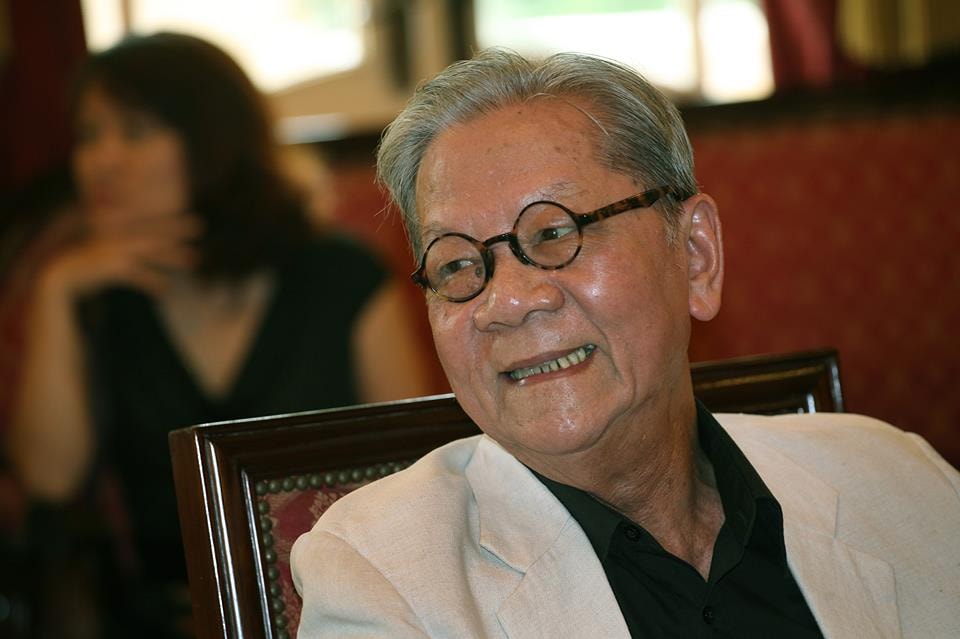
Born into a scholarly family, with both his father and grandfather being Confucian scholars, composer Hoang Van received his education in classical Chinese literature from a young age. He also acknowledged that his Confucian character greatly influenced his later life. Unlike his spirited and vigorous heroic songs, the composer himself remained calm, gentle, and mild-mannered in all circumstances.
He rarely lost his temper, raised his voice, or argued with anyone. Composer Hoang Van was also known as a man of integrity and always kept his promises. In him, this was a combination of meticulousness and demanding nature.
musical perspective
Composer Hoang Van wished for Vietnamese music to have pieces that reflect the spirit and nuances of today. According to him, music must be highly artistic, deeply touching the hearts of people, not merely for entertainment. To create highly artistic music, composers need to possess both musical and literary sensibility. Achieving this requires extensive study and rigorous training.
He believes that musicians must diligently search for musical inspirations that resonate deeply within their hearts. Those lyrics will leave listeners with unforgettable emotions about the events and characters. And the reason people love "Ho Keo Phao" (Dragging the Cannon) is because it was composed in a context of majestic emotion. Composer Hoang Van affirmed: "It may sound formulaic, but you have to learn it. Without learning, you can't make it good. And you have to learn it genuinely. If there are nine levels, you must learn seven or eight right now."
Any musical talent must be nurtured and strengthened by very deep emotions. Many people with little or no formal education tend to imitate others. Every word, every note must be refined, objectively exchanged, and carefully selected over many years, but now music is played easily and with little emotion.”
He also added that Vietnamese music needs to be built on a truly academic foundation. Musical sensibility must be rich. In times of peace, musical and literary emotions need to be seamlessly combined for musical pieces to truly come alive. According to the musician, in his generation, music was taught systematically and at a high level in high schools. The curriculum mainly followed the classical European style. Students studied diligently, and the teachers were very talented in music. Later, he studied composition at the Central Academy of Music. In those days, learning music directly allowed one to be moved and create truly great works.
Composer Hoang Van said that a good song must be from the heart, a true work of art, something that moves both the listener and the listener, and that makes people willing to spend money to enjoy it. A good song might sound bland at first, but the more you sing it, the more meaningful it becomes. He cited the song "Singing About Today's Rice Plant," composed in 1976 when he worked in the Mekong Delta, as an example. That year, when the song was first released, there were many conflicting opinions, but later everyone had to acknowledge its simple yet meaningful lyrics and melody.
|
Talent
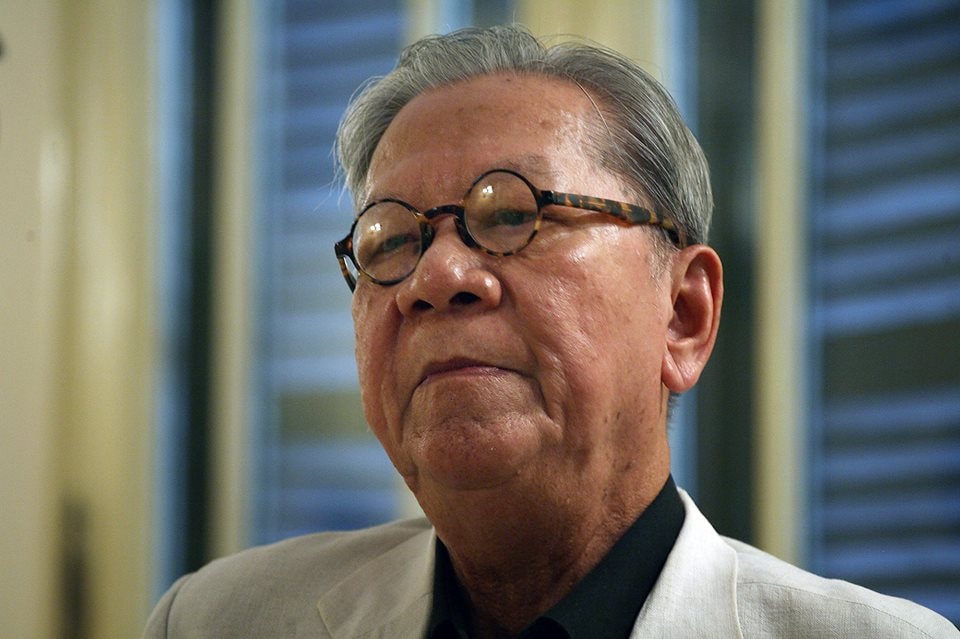
Besides his vast musical legacy, composer Hoang Van was also known for his innate talent in calligraphy. He used ordinary paper and ink, without any fuss, and only wrote calligraphy as gifts for fellow writers and musicians, depending on their personality, profession, and family circumstances. It is believed that Hoang Van's calligraphy skills were partly influenced by his Confucian background. He wrote for pleasure, not as a professional artist, and certainly never sold his calligraphy at the market. He didn't give away many pieces, but everyone who received them cherished them. There's a story that writer Nguyen Quang Sang once clutched a roll of calligraphy while drinking. Upon inquiry, he learned that it contained a few pieces of calligraphy handwritten by composer Hoang Van.
Evaluate
Meritorious Artist Bich Viet: “The song 'Ho Keo Phao' by composer Hoang Van evokes a wonderful sense of excitement in the hearts of the people, and in the hearts of anyone who hears it; it stirs up a fervent patriotic spirit. I enjoy singing all of his songs. However, in my archives, I have the song 'Hanoi, Hue, Saigon' which I sang when I graduated and on television many years ago. It's a song that all soprano voices must sing to be considered good.”
Le Nghiep (Member of the Executive Committee of the Vietnam Musicians Association, President of the Can Tho Musicians Association): “The musical legacy of composer Hoang Van is immense. I remember songs like 'That Soldier,' 'Quang Binh, My Homeland,' 'The Song of the Rice Plant,' 'The Artillery Pulling Song'... like a huge mountain of Vietnamese music. During the war, those songs encouraged us a great deal. Back then, there was no television; we only listened to them on a tiny radio, but they were incredibly inspiring. Composer Hoang Van is a towering figure in Vietnamese music.”
Dr. Nguyen Thieu Hoa, People's Artist: "Like other composers, composer Hoang Van wrote extensively on instrumental music and choral works. His first instrumental work, 'The Fatherland's Fortress,' was a major work, a significant academic achievement. Later, he wrote many choral pieces for club choirs, for children... In terms of volume, I can only say it was immense, monumental."