

How to prevent and treat 7 common diseases in freshwater fish farming.
(Baonghean.vn) - Freshwater fish farming often encounters several diseases that are difficult to detect and treat, affecting economic efficiency. Poor water and feed management can easily lead to outbreaks of disease in fish, resulting in mass mortality. Below are some common diseases and methods for prevention and treatment in freshwater fish farming.
1. Water mold disease (aquatic mold disease)
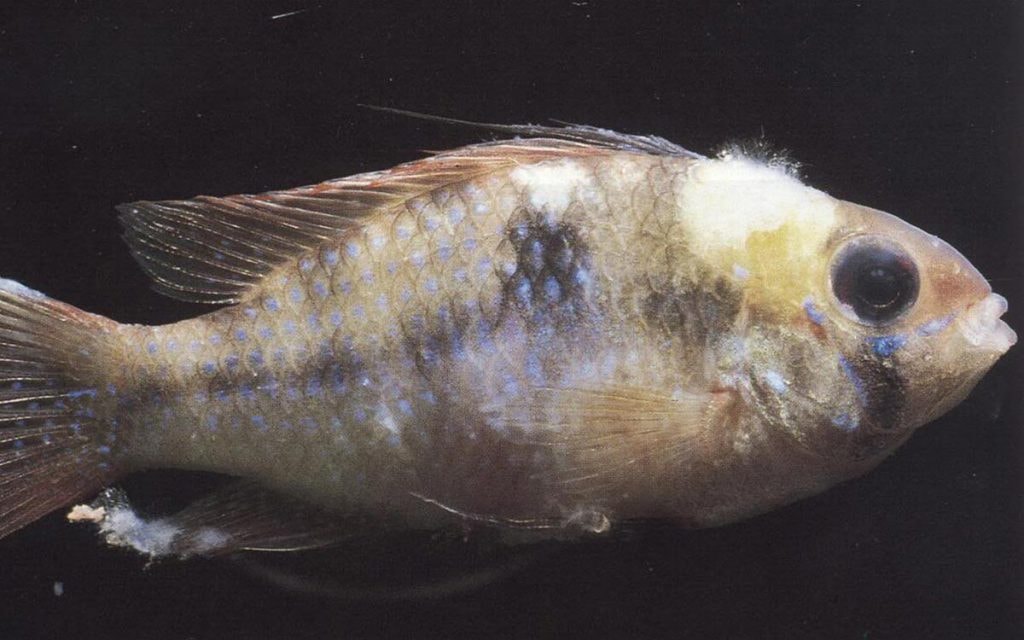 |
The disease occurs in most freshwater fish species such as carp, catfish, grass carp, snakehead, tilapia, and goby... The disease thrives in stagnant ponds with high organic matter content...
Causative agent:These include several genera of mushrooms such as: Leptolegnia, Aphanomices, Sarolegnia, and Achlya.
Symptoms:Initially, the fish's skin shows grayish-white patches, which are small, soft fungal filaments; later, the fungus develops into white, cotton-like clumps. Diseased fish swim abnormally, rubbing against objects in the water, causing scale loss and skin abrasions, creating conditions for bacteria to invade. In addition, parasitic infections can cause egg abscesses.
Disease prevention and treatment:Implement pond cleaning techniques before each farming season. Raise fish at an appropriate density, avoiding mechanical damage or parasitic infections that can harm the fish; maintain and stabilize the pond temperature in various ways such as maintaining a water level of 1.5m, covering 2/3 of the pond surface with water hyacinth, etc.
Use antifungal medication for the fish. Some chemicals that can be used to treat fungal infections include: Methylene blue 2-3g/m³, KMnO₄ 1-2g/m³ applied to the pond and repeated twice a week. Alternatively, use a 3% salt solution to bathe the fish for 15 minutes.
2. Streptocosis
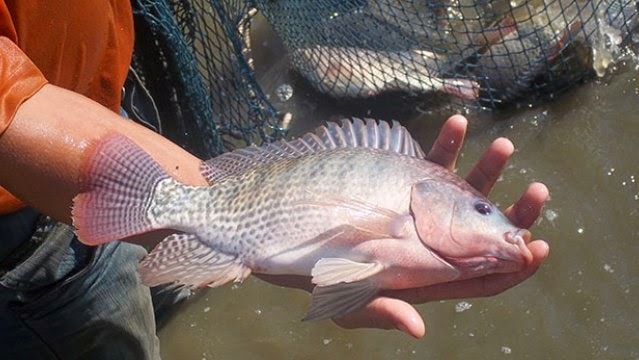 |
The disease occurs in some freshwater fish species such as tilapia and carp, and some marine fish species such as sea bass; it usually breaks out when the temperature is between 20 and 30 degrees Celsius.
Causative agent:It is caused by Streptococcus sp. bacteria (streptococci) at all stages of fish development.
Symptoms:The fish's coloration gradually darkens, they swim abnormally, their eyes bulge and become cloudy, and there are hemorrhages in the fins and gill cover bones. The hemorrhages spread into ulcers, but the ulcers are shallower than those of other ulcer diseases. Diseased fish swim in a spiral, erratically. The acute form of the disease causes a high mortality rate.
Disease prevention and treatment:Maintain a minimum water level of 1.2 m in the fish pond; increase water changes and use aerators at night and early morning to provide sufficient dissolved oxygen for the fish.
Regularly supplement feed with multivitamins for 7 consecutive days; kDisinfect the water with Vicato effervescent tablets every 20-30 days, following the dosage instructions.
Use antibiotics such as Erythromycin, Ciprofloxacin, and Enrofloxacin mixed into the feed; at a dose of 25-50mg/1kg of fish/day, fed for 4-7 days.
Using TD3 herbal supplement and multivitamins mixed into the fish's daily feed helps boost immunity and limit the spread and outbreak of bacterial infections in the pond.
3. Anchor worm disease
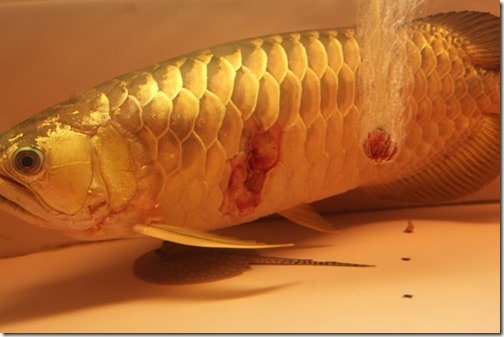 |
This disease is common in grass carp, silver carp, white carp, common carp, etc., parasitizing the skin, scales, gills, nasal cavities, eye sockets, and mouth. The disease develops strongly in late spring when temperatures are between 20 and 25 degrees Celsius.
Causative agent:It is an anchor worm belonging to the genus Leronaea.
Symptoms:Diseased fish swim abnormally, are sluggish, have poor appetite, and exhibit deformities. They have small red spots on their bodies, and some parasites in their mouths cause swelling, preventing them from closing properly and eating.
Disease prevention and treatment:Implement comprehensive disease prevention measures. Before stocking the pond with fish, apply neem leaves as a base fertilizer at a rate of 0.2 - 0.3 kg/m3 of water to kill anchor worm larvae present in the pond.
If possible, all the water in the pond should be replaced and the replacement water should be disinfected.
Applying 0.4-0.5 kg of neem leaves per cubic meter of water to fish ponds affected by disease can kill the Lernaea parasite. Because neem leaves decompose quickly, consuming a lot of oxygen and releasing toxic gases, especially in the summer with high temperatures, it is necessary to monitor and replenish water promptly when needed.
Bathe the fish in a potassium permanganate (KMnO4) solution at a concentration of 10-12g/m3 for 1-2 hours.
4. Ulcerative syndrome
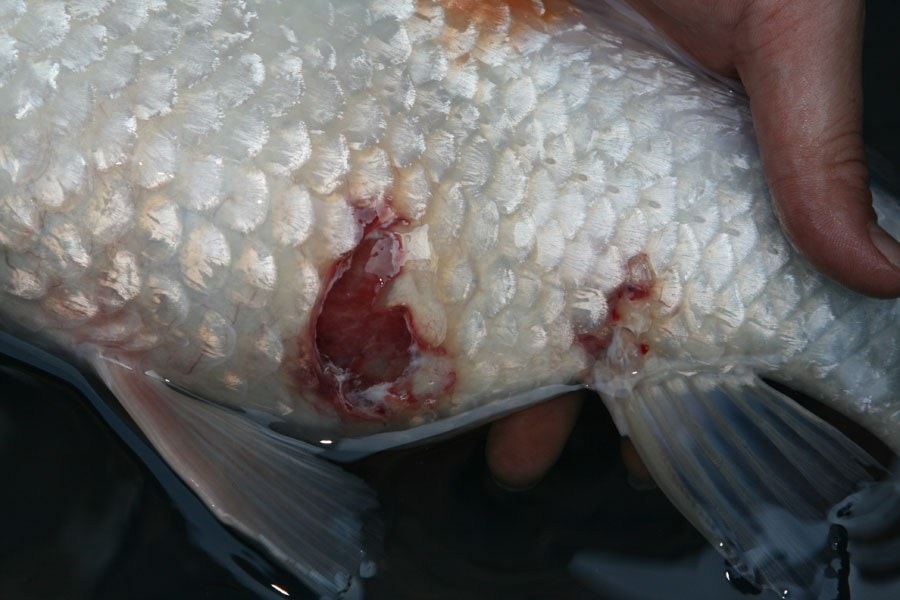 |
Many different fish species are affected by this disease, including some highly susceptible species such as snakehead fish, catfish, tilapia, and common carp. The disease spreads mainly through water currents and the movement of infected fish.
Causative agent:This is because the fungus Alphanomyces Invadan grows and penetrates deep into the fish meat. In addition, there are other opportunistic pathogens such as viruses, bacteria, and parasites.
Symptoms:Fish eat less, stop eating, and become sluggish; diseased fish have deep ulcers on their bodies, causing mass mortality. In large ulcers, the center is gray, where the fungus grows, and the edges are black.
Disease prevention and treatment:For ulcerative colitis, the most effective preventive measure is to select fish species with high disease resistance. In addition, there are measures to prevent fungi from entering the pond, such as: cleaning the pond before each farming season.
During the rearing process, every two weeks, mix lime (CaO) and spread it evenly across the pond surface at a dosage of 2 kg/100m3 of water.
Before stocking, the fish fry should be bathed in a 2-3% NaCl solution for 5-15 minutes to disinfect them from external agents.Avoid mechanical impacts that could injure the fish's body.
5. Aeromonas septicemia
Most freshwater farmed fish species can be affected by this disease; outbreaks typically occur in late spring or early summer. Juvenile fish are more susceptible than adult fish, and mortality rates can reach up to 80%.
Causative agent:This is due to bacteria belonging to the genus Aeromonas: A. hydrophila, A. caviae, A. sobria.
Symptoms:Diseased fish show dark patches on the belly, red patches on the body; tail and fin necrosis, wounds on the back, scales easily falling off; bulging, cloudy eyes.
Disease prevention and treatment:Avoid creating opportunistic factors such as parasitic infections; avoid injuring the fish, maintain proper hygiene, and avoid overcrowding...
Use potassium permanganate (KMnO4) to bathe the fish, at a dosage of 0.4g/100 liters of water, repeating the treatment after 3 days; periodically bathe the fish once a week, every two weeks, or once a month, depending on the fish's health condition.
Administer medications mixed into feed such as Oxytetracycline: 55-77 mg/kg body weight of farmed fish, fed for 7-10 days (use should be limited); Enrofloxacin: 20 mg/kg body weight of farmed fish, fed for 7-10 days; Streptomycin: 50-75 mg/kg body weight of farmed fish, fed for 5-7 days; Kanamycin: 50 mg/kg body weight of farmed fish, fed for 7 days...
6. Melon fluke disease (white spot disease)
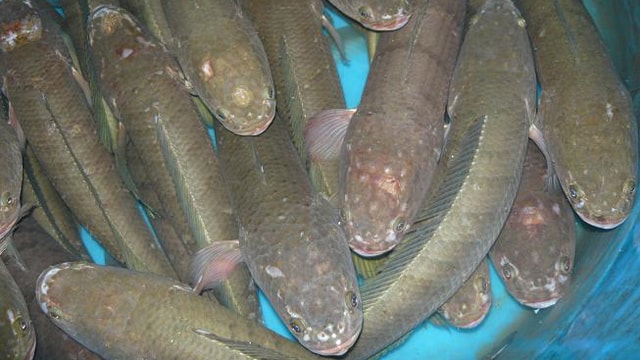 |
The disease commonly affects carp, catfish, grass carp, snakehead fish, and other similar species. It thrives during transitional periods between seasons – from late spring to early summer.
Causative agent:caused by the melon protozoan Ichthyophthirius multifiliis.
Symptoms: kWhen infected, the fish swim in schools on the water's surface, thrashing about due to itching; their skin, gills, and fins are covered with numerous tiny, opaque white parasites visible to the naked eye. The skin and gills of the diseased fish are pale and discolored. When too weak, the fish only surface to breathe, their tails motionless and their heads submerged in the water.
Disease prevention and treatment:Spray formalin into the pond twice a week at a concentration of 150-200 ml/m3, then change the water; or bathe the fish in formalin at a concentration of 200-250 ml/m3 for 30-60 minutes.
7. Bacterial Red Spot Disease
Many different species are affected by this disease, including some highly susceptible species such as tilapia, catfish, and common carp.
Symptoms:Fish show reduced or no appetite, develop red ulcerated spots on their bodies, scales fall off, lose their mucus coating, become dry and rough, fins hemorrhage, tear and gradually shorten; small hemorrhagic spots appear on the skin, around the mouth and gill cover, and on the ventral side.
Disease prevention and treatment:Use vaccines to prevent disease; reduce stocking density; provide good water quality; bathe the fish in KMnO4 solution at a dosage of 0.4g/100 liters of water, with no specified duration.
Antibiotics can be used to treat the condition, as in Aeromonas-induced septicemia. Treatment: Administer 100g of the recommended medicine per 50kg of fish daily, supplemented with Vitamin C.