

What are the advantages and disadvantages of a CVT (Continuously Variable Transmission) gearbox?
Unlike traditional gearboxes, continuously variable transmissions (CVTs) do not have gear pairs that create gear ratios.
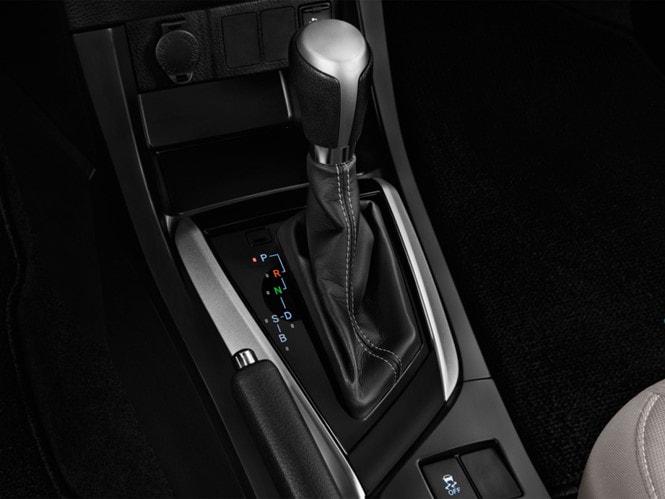 |
| Control levers for the CVT transmission on a Toyota Corolla. |
Over 500 years ago, Leonardo da Vinci conceived the idea for the CVT (Continuously Variable Transmission) gearbox.
Unlike traditional transmissions, continuously variable transmissions (CVTs) do not have gear pairs that create gear ratios. CVTs typically operate on a system of pulleys and belts that allows for stepless and continuous gear changes, without separate gear ratios.
Most CVT transmissions have three basic components: a high-strength metal or rubber drive belt, a variable-input pulley system connected to the engine shaft, and an output pulley system leading to the wheels.
CVTs also have a processor and sensors for monitoring and control, but these three main elements are the key factors that allow this idea to become a reality.
A CVT (Continuously Variable Transmission) offers drivers a driving experience similar to other automatic transmissions, but its operating principle is completely different. CVTs don't have gear ratios. Therefore, they shift very smoothly, significantly improving fuel efficiency.
The structure of the CVT continuously variable transmission in Subaru vehicles.Photo: Subaru |
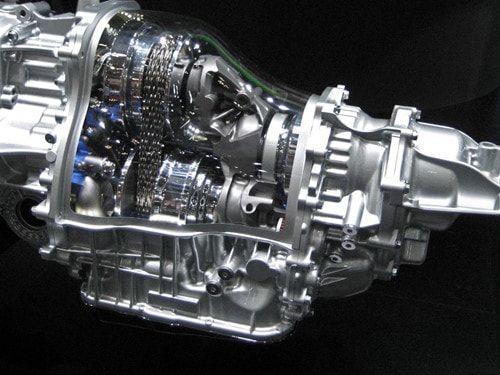
Theoretically, a car with a CVT can reach 100 km/h 25% faster than a car using the same engine but with a conventional transmission. This is because the CVT translates all points on the engine's operating characteristic curve into corresponding points on its own operating characteristic curve.
With its design and extremely simple operating principle, CVT transmissions rarely experience technical problems, repairs are simple, and repair costs are certainly lower compared to conventional automatic transmission technologies.
The most noticeable drawback of this type of car transmission is also its advantage. The driving feel, stemming from the principle of the transmission's operation, is that there are no gear changes, resulting in a smooth ride. This means that acceleration lacks the exhilarating feeling for the driver. This is why drivers often prefer the imagined driving experience to the actual "feel" of driving.
Additionally, CVT transmission belts can slip and stretch, reducing performance. The biggest weakness of CVTs is their inability to handle high torque, making them unsuitable for sports cars. However, their simplicity makes them ideal for motorcycles. CVT hybrids are also becoming popular, and this transmission is currently used in the Toyota Prius.