

Why doesn't Vietnam trace the origin of Chinese fruit?
China can trace the origin of Vietnamese fruits, but Vietnam finds it difficult to trace the origin of fruits from China.
Following the implementation of traceability requirements for many Vietnamese agricultural products, the Ministry of Industry and Trade recently announced that from April 1st, fruits (dragon fruit, mango, longan, durian, banana, etc.) exported from Vietnam to China will be subject to traceability. Specifically, the required information for exports from Vietnam to China includes: the name of the fruit product, its origin, and the name or code of the packaging factory in Chinese or English.
Conversely, Chinese fruits and vegetables without clear origin or source are still widely sold in the Vietnamese market.
Chinese fruits and vegetables survive by "hiding behind" the established system.
A survey of supermarkets and retail markets in Ho Chi Minh City revealed no trace of Chinese fruits and vegetables. Ms. Thuy Hien, a resident of Phu Nhuan District, Ho Chi Minh City, said that traders at the market often import apples and grapes from China through wholesale markets but advertise them as American products. This confuses buyers, making it difficult to distinguish between genuine and counterfeit goods, and to identify products of guaranteed quality.
"I understand that China has implemented traceability systems for our fruits and vegetables, so we should demand the same from them. That is, fruits and vegetables from China entering our country must also have clear traceability. They want their people to eat clean and safe food, so we must do the same to protect our people," said Ms. Hien.
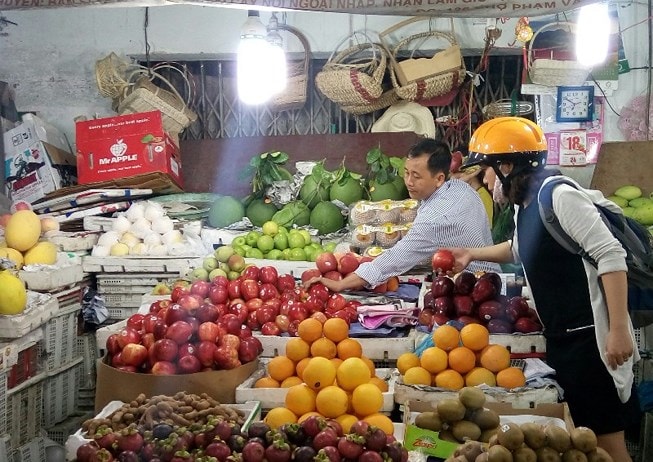 |
According to representatives from the Thu Duc wholesale agricultural market (Ho Chi Minh City), fruits and vegetables originating from China account for about 10%, or even more, of the total goods imported to the market. The most common are oranges, tangerines, apples, pears, grapes, pomegranates, persimmons, garlic, and onions. However, these Chinese agricultural products are often purchased by small traders and resold in smaller markets, informal markets, and on sidewalks without proper labeling.
Notably, fruits from European and American countries are mostly imported into Vietnam through official channels, so they have complete traceability documents and quality control. The biggest concern remains fruits from China because official imports are few, while unofficial imports are numerous, making quality control very difficult.
"Therefore, it is necessary to strictly control the input of Chinese agricultural products by tracing their origin at border gates. At the same time, information about Chinese vegetables and fruits found to contain harmful substances should be published so that consumers are aware," suggested a representative from the Thu Duc wholesale agricultural market.
Sharing the same view, Mr. Dinh Van Huong, Chairman of the Vietnam Fruit and Vegetable Association (Vina Fruit), said that Chinese fruits and vegetables still thrive thanks to their large influx into Vietnam through unregulated unofficial channels or by disguising themselves as imported fruits from the US, Australia, and New Zealand. Recently, many Chinese fruits have even been disguised as similar domestic fruits with similar appearances, such as mangoes, persimmons, and carrots.
"Currently, the amount of fruits and vegetables imported from China into Vietnam, when distributed to retail markets and reaching consumers, is loosely managed and not properly controlled. Therefore, there must be regulations requiring Vietnamese import and trading units to label the origin of fruits and vegetables when selling them on the market to protect food safety and hygiene for consumers," Mr. Huong said.
Fairness is essential to protect businesses and buyers.
Currently, exporting Vietnamese fruits like mangoes, rambutan, and star apples to other countries is very difficult. Not to mention that importers have to inspect the orchards themselves to ensure the produce meets international GlobalG.AP standards before they will buy. Even China, a market that has traditionally been quite lenient, now requires Vietnamese fruits to have clear origins and traceability.
Commenting on this latest move by China, Mr. Nguyen Lam Vien, General Director of Vinamit Company, said that China's actions...traceabilityIn the long run, Vietnamese agricultural products will be good for the market, limiting the number of Chinese traders coming to Vietnam to buy them.agricultural productsWithout any documentation, they are not complying with our country's laws. This also serves as a technical barrier to limit Chinese traders from acting independently, something that Vietnamese authorities are unable to prevent.
However, to ensure food safety and to be fair to Vietnamese goods, we should also have similar requirements for products imported from China. This includes standards for production, processing, and packaging procedures.
"Requiring traceability for imported Chinese goods ensures fairness for businesses and also provides peace of mind for consumers. It also helps us prevent the import of harmful Chinese products," stated the general director of Vinamit Company.
Responding to press inquiries on this issue, Mr. Hoang Trung, Director of the Plant Protection Department, Ministry of Agriculture and Rural Development, stated that applying traceability to fruits is necessary to ensure the quality and safety of exported goods, as well as the reputation of exporting countries. This is a stepping stone for Vietnamese products to gradually expand their access to demanding markets.
However, in Vietnam, the technical aspects of fruit quality control, from planting and cultivation to harvesting and preservation, are still not fully developed. This is one of the main reasons why Vietnam cannot yet require traceability of fruit imported from China.