

The new type of solar cell can generate electricity on both sides of the module.
With a simple trick, the solar power industry can increase the efficiency of solar power plants by up to 25%: the back of the solar panels can also capture sunlight.
Those who have skied know this well: If they don't apply sunscreen carefully on a Sunday, they'll find their skin is sunburned that very evening. This is more likely to happen because the white snow reflects sunlight. Therefore, the skin receives a much higher amount of ultraviolet (UV) radiation compared to sunbathing on a balcony in winter.
The photovoltaic industry wants to exploit this effect to increase the productivity of solar power plants. Conventional solar panels have a drawback: They can only generate electricity on the side facing the sun, meaning the front side of the panel cannot take advantage of reflected sunlight.
Therefore, research institutions and businesses alike are considering a type of solar cell capable of converting solar energy into electricity. Depending on its installation location and type, it could increase productivity by up to 25% compared to conventional solar panels.
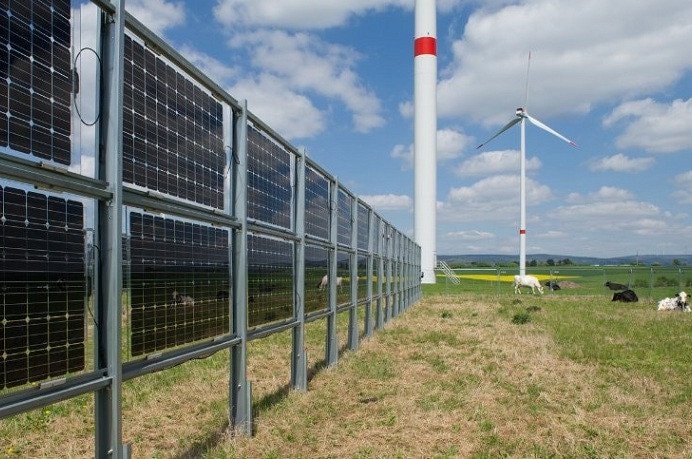
Major companies in the industry such as SolarWorld, Trina Solar, Yingli, and LG have launched the first modules of this type onto the market. The most noticeable difference compared to conventional solar panels is that these panels have a thin glass backing that protects against weathering but still allows reflected light to pass through. Conventional modules have a thin, opaque film covering the back.
The second difference: the metal contact points for conducting electricity – usually made of aluminum – behind the solar panel do not cover the entire surface as is typically the case."Instead, the contact points [in the new module type] made of aluminum or silver are as thin as a hair, no more than 100 micrometers thick. Therefore, the reflected light rays easily reach the solar panel without any obstruction.""This is what Dr. Thorsten Dullweber, at the Hameln Institute for Solar Energy Research (ISFH), explains."
The extent of the increase in efficiency depends primarily on the reflectivity of the back of the solar panel and the size of the space behind it. If installed on a dark-colored, saddle-shaped roof, these new types of panels are ineffective. However, if installed on a light-colored base or on a flat roof covered with white gravel, efficiency increases by 10% to 15% compared to conventional panels, according to Dr. Dullweber.
For solar power parks in deserts or other landscapes with a high sand content, the efficiency is comparable to that of light-colored or white gravel. Mounting the solar panels on frames facing the sun can increase productivity by up to 25%."This is mainly because the amount of sunlight hitting the front of the modules increases. The back of the modules also attracts more light.""Dr. Dullweber said."
Meanwhile, the cost of these new types of solar panels is not too high, only 4% to 7% higher than standard systems. Compared to the 10% to 15% increase in efficiency, this is already excellent, according to scientists at ISFH.
Furthermore, this new type of solar panel is attractive for another reason: the modules allow for electricity generation twice a day. A small field experiment conducted by the Berlin-based startup Next2Sun in Saarland, Germany, using a vertical east-west installation, showed that the front of the solar panels produced electricity in the morning, while the back supplied power in the afternoon.
However, compared to other wind farms or solar power plants, these new types of solar panel plants require more space – the rows of modules must be spaced far apart to avoid obstructing each other. However, this can also be an advantage, according to Heiko Hildebrand, CEO of Next2Sun: Because the rows of modules are spaced far apart and in an upright position, the area dedicated to these modules is not lost. Instead, they can serve ecological functions or support agricultural production. For example, these solar power parks could be used as grazing grounds for cattle or for growing fodder crops.
"For Germany, this option is actually very suitable.""Next2Sun is now preparing to continue building more solar power parks of this type. By this summer, the Saarland region will have another 2-megawatt solar power plant," said researcher Forscher Kopecek of the ISC Energy Research Center in Konstanz.