

Three women with extraordinary destinies in Vietnamese history.
From emperor to nun, from servant to empress, and from daughter to king, this is the story of Ly Chieu Hoang, the Le dynasty empress, Princess Ngoc Binh.
The history of feudal Vietnam has seen many women whose fates are considered unusual. Among them, the cases of Ly Chieu Hoang - the queen of the Ly dynasty, the Le consort of Le Uy Muc, and Princess Ngoc Binh of King Le Hien Tong are considered to have the most extraordinary destinies.
The tumultuous life of Ly Chieu Hoang
As the only female monarch in Vietnamese history, Ly Chieu Hoang neither protected the Ly dynasty's legacy nor determined her own future. Her life was filled with unpredictable hardships and challenges.
According to the Đại Việt Sử Ký Toàn Thư (Complete History of Đại Việt), Lý Chiêu Hoàng (1218-1278), whose real name was Lý Phật Kim, later changed her name to Lý Thiên Hinh, was the daughter of King Lý Huệ Tông and Queen Trần Thị Dung. At the age of 7, Lý Chiêu Hoàng inherited the throne from her father.
Having ascended the throne at a very young age, the power of the dynasty fell entirely into the hands of the Tran family. In 1225, at the behest of Tran Thu Do, Ly Chieu Hoang was forced to abdicate in favor of her husband, Tran Canh. The Ly dynasty declined, and the Tran dynasty took its place.
|
| Painting depicting Ly Chieu Hoang abdicating the throne in favor of her husband, Tran Canh. Source: Binh Phuoc Newspaper. |
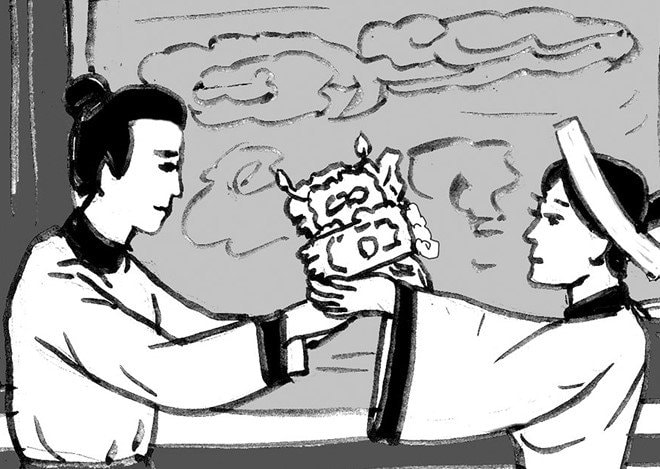
After abdicating the throne, Ly Chieu Hoang was bestowed the title of Empress Chieu Thanh. Seven years later, she gave birth to her first child, but the prince died shortly afterward. Fearing that Tran Thai Tong would have no male heir, Tran Thu Do forced the king to appoint a new empress, demoting Chieu Thanh to the rank of princess.
Overwhelmed by the continuous vicissitudes of life, she became so grief-stricken and disheartened that she shaved her head and became a nun. However, the destiny of the only female monarch in history was not yet over.
After the resistance against the Mongol army (1257-1258), she was restored to her princess title and married to Le Phu Tran, who had saved King Tran Thai Tong. During her 20 years of marriage, Chieu Thanh gave birth to two children.
In 1278, she passed away at the age of 60 while visiting her hometown in Co Phap (Tu Son, Bac Ninh). During her lifetime, Ly Chieu Hoang held seven titles: princess, crown prince, queen of the Ly dynasty, empress, princess, nun, and finally, lady of the household under the Tran dynasty.
From slave to imperial concubine
During the feudal era, slaves belonged to the lowest class in society. They had almost no basic human rights. Yet, some women from such a low status rose to become imperial consorts. This strange story took place during the reign of King Lê Uy Mục of the Later Lê Dynasty.
Among the concubines of Lê Uy Mục, the case of the imperial concubine surnamed Lê (some documents record her name as Lê Thị Thanh), originally from Vĩnh Linh district, Quảng Trị province today, is particularly noteworthy.
According to the Đại Việt Thông Sử (Comprehensive History of Đại Việt), because her family committed a crime, she was forced into servitude in the palace. Before Lê Uy Mục ascended the throne, he unexpectedly saw her and fell in love with her. After becoming king, Lê Uy Mục brought the slave girl into the palace and bestowed upon her the title of imperial consort.
According to the book "Ô Châu Cận Lục," thanks to being favored, the brother of the imperial concubine of the Lê family was also granted a title and entrusted with the important task of attracting people to reclaim land and establish many new villages in what is now Quảng Trị province.
After her death, the people, grateful for her brothers' contributions in reclaiming land and establishing settlements, erected temples in many places. Currently, most of these temples have fallen into disrepair, with only the main temple dedicated to her in Vinh Linh district, Quang Tri province, remaining intact. Every year, the people of the region hold a ceremony to honor the Le royal consort at her temple on the 27th day of the third lunar month.
The princess had a strange fate.
Like Ly Chieu Hoang, despite being born into a royal family and bearing the title of "precious gem and golden branch," Princess Ngoc Binh (1783-1810) of the Later Le Dynasty also experienced a life of ups and downs.
She was the 23rd daughter of King Lê Hiển Tông, and the younger sister of Princess Ngọc Hân, the famous wife of King Quang Trung. Renowned for her breathtaking beauty, in the year Ất Mão (1795), Princess Ngọc Bình was married to Nguyễn Quang Toản (later King Cảnh Thịnh).
|
| Illustration depicting Princess Ngoc Binh. Photo: Science and Life. |

After becoming the wife of the Tay Son king, Princess Ngoc Binh was appointed as the principal empress. Although she served as empress of the Tay Son dynasty for six years, she and King Canh Thinh, who was quite young at the time, did not have any children.
After the fall of the Tay Son dynasty in 1801, King Canh Thinh and Princess Ngoc Binh were both captured. King Gia Long decided to take Ngoc Binh as his wife, bestowing upon her the title of Third Consort Duc Phi.
According to the book "Nine Lords, Thirteen Kings of the Nguyen Dynasty," although Emperor Gia Long had many concubines at the time, Ngoc Binh was the one who was closest to him most often. During her nearly 10 years as Gia Long's concubine, Ngoc Binh gave birth to two princes and two princesses.
Her forced marriage to Nguyen Anh made Ngoc Binh one of the most extraordinary women in Vietnamese history. Born the daughter of a king, she ended up marrying two husbands who were kings of two opposing dynasties.
Because of Princess Ngoc Binh's extraordinary fate and tumultuous life, the folk song has been passed down ever since: "What a strange fate! The daughter of a king marries two kings."