

The prospect of North and South Korea unifying.
(Baonghean.vn) - In 2060, decades after South Korea and North Korea made history by unifying the two Koreas.
It has been a long and difficult process, but the Korean Peninsula is now home to the world's 10th-largest economy, with a Gross National Product (GDP) of $5.5 trillion, significantly higher than South Korea's GDP in 2016 ($1.4 trillion).
The KTX bullet train, which originally served only South Koreans when it was built in 2004, now travels across Eurasia, connecting Seoul with Paris.
The unification of two vastly different nations – a technological and manufacturing powerhouse with an isolated country mired in poverty – cost trillions of dollars but has truly paid off. The economic benefits of this integration now outweigh the costs.
That is the hopeful vision of North Korea's future that is mentioned at the Unification Tower museum, near the Demilitarized Zone at the 38th parallel that divided the two Koreas in 1953.
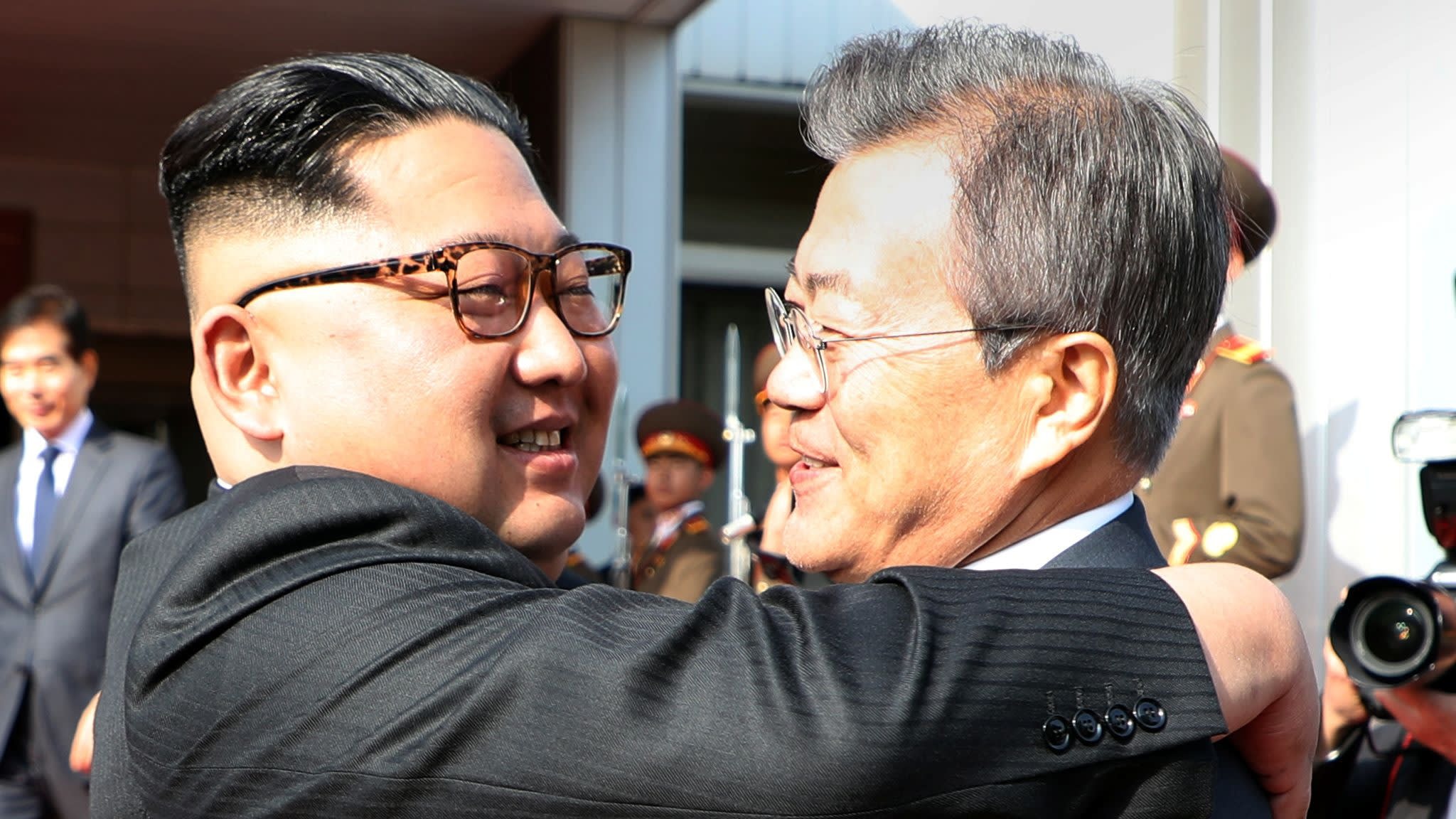 |
| The North Korean leader embraces the South Korean president during the inter-Korean summit on May 26. Photo: Getty |
The warming relationship between the two countries following North Korean leader Kim Jong-un's New Year's address has sparked hopes for the possibility of peaceful reunification. The summit between Kim Jong-un and US President Donald Trump on June 12th further fueled this cautious optimism.
However, people on the Korean Peninsula have experienced this feeling many times before.
Cheon Seong Whun, a former national security advisor to the South Korean president, said: “We too have often had hopes and excitement about a future of reunification like this… When I was in high school in the mid-1970s, a North Korean delegation came to Seoul and we waved flags to welcome them. However, those excitements didn’t last long; the promises crumbled in less than a year.”
Nevertheless, Cheon and many other experienced experts still believe that the peninsula will be unified one day. The Nikkei Asian Review recently interviewed experts from various countries around the world about the prospect of a unified Korea and a series of questions that need answering.
Is the reunification of North and South Korea a reality?
The reunification of North and South Korea is considered far more complex than what happened between East and West Germany after the fall of the Berlin Wall in 1989. The question is, what is needed for the reunification process to succeed?
Cheon Seong Whun, currently working at the Institute for Policy Studies in Seoul, argues that before the fall of the Berlin Wall, people in both parts of Germany maintained basic exchanges and cooperation, possessing certain foundations, whereas South Korea and North Korea are "two completely separate societies."
According to him, after reunification, the daily lives of Koreans should be maintained, and South Korea should only gradually change this society. He said, "That could be seen as the Korean version of the Marshall Plan. A massive amount of work that could take decades."
Meanwhile, Kathryn Weathersby, a historian at Korea University in Seoul, argues that the concerns and grievances of the North Korean people need to be taken into account. She says, “They have legitimate concerns about their very existence. They don’t want to become another Iraq or Libya, or the next Romania and East Germany.”
This historian emphasized the importance of treating the Korean people with respect.
According to Cheon Seong Whun, the North Korean defectors are evidence that reunification is unlikely to happen quickly.
He explained: “North Koreans are used to having their basic needs subsidized by the government. They are not used to a competitive society… South Korea has preferential programs for employment and education. Non-governmental organizations can support families and young children. But it’s very possible they would feel like they’ve fallen from heaven to reality.”
Furthermore, according to this expert, one issue to consider is discrimination, because North Koreans have a distinct accent and their origins can be immediately identified, whether they are North Korean or from a specific border region.
 |
| The prospect of a unified Korea. Photo: AP |
Concerns arise after the unification process takes place.
If the unification process takes place, the major issue of concern will be the "fate" of Kim Jong-un and the ruling regime in Pyongyang.
Bong Young-shik, a North Korea expert at Yonsei University in Seoul, commented: “Kim Jong-un wants a big deal. He doesn’t want to spend 40 years as a dictator leading a poor country. He doesn’t want to live like his father… Kim also doesn’t want to end up like Gadhafi.”
Kim Jong-un has carried out a large-scale purge of opponents, so "if he changes policy (and abandons nuclear weapons), Kim will become the target of the same criticism. The regime will be severely damaged."
According to Weathersby, another concern among North Koreans is what legal issues those who manage prison camps or develop ballistic missile programs will face. With fears of conviction, they will undoubtedly seek to ensure the independence of their government system.
She added: “As for Kim, will he be brought before the International Criminal Court in The Hague? If the answer is yes, then he must have reason to defend his regime.”
A denuclearized North Korea that collapses economically certainly cannot be the foundation for guaranteeing peace. However, integrating the North Korean economy into the global economy in the 21st century is by no means a simple task.
Stephen Jen and Joana Freire, analysts at Eurizon SLJ Capital, estimate that the cost of reunifying the two Koreas would be around $2 trillion over 10 years, based on the results of the reunification of East and West Germany.
Even with North Korea's backwardness and its agricultural-dependent economy, compared to pre-unification East Germany, it may have required even more money to rebuild and stabilize the country.
The political landscape of Asia after the reunification of the Korean Peninsula.
A unified Korean Peninsula would reshape Asia's political landscape. The question is whether this would signify the end of U.S. military hegemony in the Pacific or solidify China's influence? And how would other U.S. allies in the region react?
Associate Professor Ji-Young Lee, a specialist in international relations at American University, argues that to consolidate autonomy and limit outside interference, a unified Korea might decide to end its alliance with the United States, even viewing the presence of the US military as a destructive factor to its identity and unity.
If things unfold in this way, a unified Korea would adopt a more pro-China approach to its security policy, a sign of the end of the American era of dominance in Asia.
According to him, the geopolitical position of a unified Korean Peninsula would certainly force Beijing and Tokyo to closely monitor the new nation's relations with the outside world, especially in military and political terms.
He said, "In my opinion, if the prospect of Korean reunification becomes a reality, both Japan and China will certainly make greater efforts to strengthen bilateral relations and deepen Sino-Japanese-Korean relations."
Meanwhile, Bruce Jones, Deputy Director of Policy at the Brookings Institute, commented that any wise leader would surely steer the country toward strategic independence, maintaining close but somewhat distant relationships with both Washington and Beijing.
Bong Young-shik emphasized: “A unified Korean Peninsula can only be created through a peace process and by the will of the people. There are three pillars that are needed to ensure this goal: liberal democracy, an open market economy, and a peninsula completely free of nuclear weapons.”
These are challenges that are not easy to overcome, but not impossible. Everything ultimately depends on Kim Jong-un's decisions regarding his arsenal of weapons and missiles.