

Russian Air Force takes a shortcut in developing 6th-generation UAVs.
The Russian Aerospace Forces are actively researching and developing a sixth-generation unmanned aerial vehicle (UAV) capable of combat operations comparable to its manned counterpart.
Recently, the Russian Aerospace Forces (VKS) have been equipped with new fighter jets, bombers, and unmanned aerial vehicles (UAVs).
Therefore, the establishment of this force on August 12th promises to attract the attention of the world's media.
|
| The Su-57 is currently the most modern fifth-generation fighter jet in the Russian Aerospace Forces. |
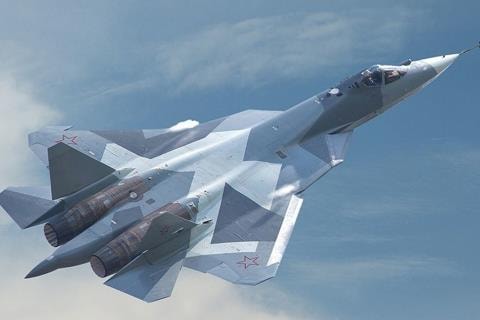
Regarding this force, in an interview with TASS news agency, renowned Russian test pilot Anatoly Kvochur stated that Russia is currently actively developing unmanned aerial vehicles (UAVs), for example, robots capable of replacing pilots to help aircraft land, "blind" enemies, and developing sixth-generation UAVs.
Anatoly Kvochur believes that, with its current capabilities, the Russian Air Force is fully capable of countering any enemy and fulfilling any mission.
Their fighter jets are almost brand new and possess considerable power. However, their capabilities will be further enhanced after being upgraded to subsequent versions in the future.
He added that in combat, a pilot's skill is crucial, but it depends on many factors, including external information support. If a pilot is sitting in the cockpit like in a tank and can't see anything, they will become a target for the enemy.
Therefore, understanding what is happening around the aircraft is crucial; it helps the pilot determine whether to attack or defend.
To solve this problem, Russian experts designed numerous sensors and special devices around the aircraft's fuselage, combined with cockpit displays, to allow the pilot to observe everything as clearly as possible.
For example, thanks to these devices along with satellite navigation systems, pilots will be able to land more accurately at all times, including at night.
He argued that in modern warfare, air forces need to coordinate seamlessly with ground forces, but in worst-case scenarios, such as partially destroyed airfields or severely damaged radio systems...
In this case, the aircraft's observation and navigation systems play a crucial role; the pilot uses them and determines the landing plan themselves.
While pilots played a crucial role in fourth and fifth-generation aircraft, the sixth generation will see the emergence of unmanned aircraft. These will operate like smaller UAVs.
The sixth-generation fighter jet will have both manned and unmanned versions, but their combat effectiveness will be the same.
One essential requirement is that unmanned aircraft need to be controlled; in this case, manned fighters such as the Su-57 or 6th-generation fighters will be responsible for maintaining a control distance from the unmanned aircraft, even allowing multiple aircraft to perform their missions simultaneously.
This means that in the future, the role of pilots will gradually diminish, and instead, newer aircraft will be equipped with even more modern technology to replace their duties.
This is the future direction of development not only for the Russian Prosecutor's Office but also for many other countries around the world.