

Another amazing fact about ancient Egyptian civilization.
The Egyptians didn't just learn about mummification during the time of the Pharaohs. The formula for preserving mummies existed 1,500 years earlier.
Dr. Jana Jones, from the Department of Ancient History at Macquarie University, Australia, and her colleagues have just published the results of their team's analysis of a prehistoric Egyptian human remains.
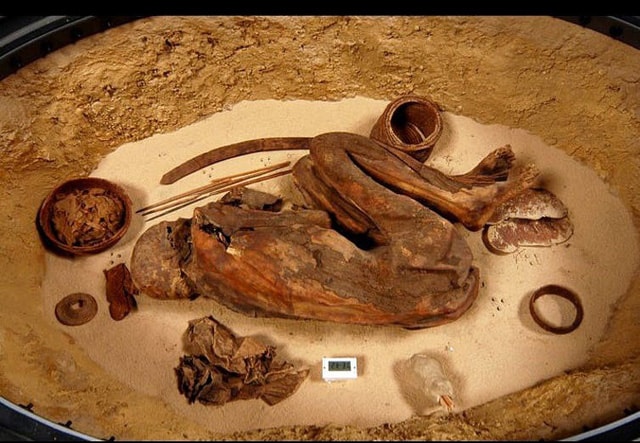
The mummy is stored in a museum in Turin, Italy.
The mummy, dating from approximately 3,700 to 3,500 BC, has been housed in a museum in Turin, Italy, since 1901 and remains in pristine condition. Until now, it was thought that mummification was a practice only practiced during the time of the Pharaohs. However, analysis has provided compelling evidence that the Egyptians had been mummifying bodies as early as 1,500 years prior.
Previously, it was believed that the man's body had naturally dried out due to being buried in the hot, dry desert sand, but now we can confirm that the body was preserved.
Along with other research, this information tells us that ancient Egyptians, living approximately 1,500 years or more before the time of the Pharaohs, had knowledge of body preservation procedures and performed religious rituals related to their belief in the afterlife.
A few old clues
Previous studies by the group have also analyzed the practice of embalming before funeral rites among prehistoric people in some parts of central Egypt, who lived long before the time of the Pharaohs and were familiar with some techniques for preserving corpses.
Reports from these studies indicate that many prehistoric corpses (dating back to approximately 4,500–3,350 BC) unearthed in Badari and Mostagedda were buried with small bags containing resinous seeds.
This suggests that people at that time used tree resin as a rudimentary method of embalming. The resin here is extracted from certain tree species, specifically pine resin, and is a preservative ingredient mixed into the embalming mixture.
Previous studies did not obtain complete bodies for experimentation, but only fragments of linen used for embalming, which are stored in museums in England. These fragments were gifts from the excavators to the museums and are the only surviving evidence proving that the corpses were wrapped.
The research team found tree resin in those pieces of cloth. However, they did not have any more samples to expand their research until today, when they studied the human remains found in Turin.
Preparing for the afterlife
The basic principle of mummification in ancient Egypt was to preserve the body intact so that the deceased could be reincarnated in the afterlife. If, unfortunately, a person lost a leg to a crocodile, a wooden prosthetic leg would be fitted to complete the body.
Bodies wrapped in cloth at prehistoric sites were often not examined with the utmost care during excavations, as in the 19th and early 20th centuries people were only interested in the artifacts buried with the corpses. Furthermore, there is no reason to believe that prehistoric Egyptians used wax to preserve the dead.
Like the British, the Italians also conducted excavations to obtain artifacts for display in their Museo Egizio museum. Perhaps the most famous archaeologist was Ernesto Schiaparelli, director of the museum from 1895 to 1928.
Schiaparelli continued to make several trips to Egypt to excavate and purchase mummies and burial artifacts from antiquities dealers, including the prehistoric mummy that Dr. Jones's research team recently gained access to.
Embalming formula
In 2014, Dr. Jones' research team, along with a group of international experts, conducted research on this mummy. They took small samples of the fabric and skin for biochemical analysis, radiocarbon dating, analysis of the weaving technique, and DNA analysis of pathogenic bacteria.
Since arriving at the museum in 1901, the mummy has not been preserved with any chemicals, meaning it has been virtually unaffected by or subjected to any chemical influences, making it an ideal specimen for scientific study. Chemical analysis of the shroud samples taken from the body and wrists revealed vegetable or animal oils, resin, and plant-based fragrances.
Pine resin and aromatics are the two main antimicrobial agents used to deter insects and preserve soft tissues. The cloth was dipped into a mixture of melted resin and aromatics before being used to wrap the body.
Special skills of the Egyptians
Radiocarbon dating of the linen burial samples indicated the mummy's age to approximately 3,700–3,500 BC. The fabric was spun using traditional Egyptian linen weaving techniques dating from around 5,000–3,600 BC.
Microbiological analysis found no pathogenic DNA, possibly because the bacteria that cause the disease could not survive in the environmental conditions of Egypt or the museum. Therefore, we do not know whether this person died from an illness. In addition, the extremely fragile condition of the mummy did not allow for movement for X-ray analysis.
Combining previous research, these new findings from the fully preserved mummy reveal that prehistoric Egyptians possessed knowledge of body preservation techniques as well as a belief system developed to the point of having a theory of reincarnation.
They were known to find and extract pine resin from the Eastern Mediterranean, suggesting that long-distance trade may have developed. Some burial sites located 200 km from the mummy's discovery also contained similar materials in their embalming wax.
These materials continued to be used until the time of the pharaohs, when mummification techniques reached their peak, about 2,500 years later. This truly demonstrates the enduring talent of the ancient Egyptians, preserved despite the ravages of time and nature.