

Does the giant Megalodon shark still exist?
(Baonghean.vn) - Could the Megalodon, the giant sea bream that lived in the oceans millions of years ago, measuring over 20 meters in length, still exist somewhere in the deep waters unexplored by humans? This is a question many people ask after watching films about this creature that once dominated the oceans.
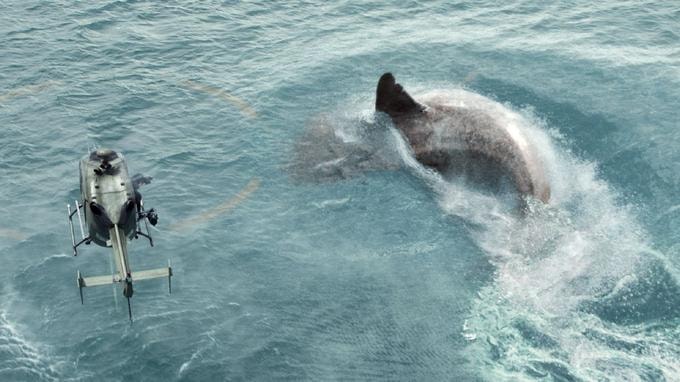 |
| Does the giant Megalodon shark, as depicted in the movies, still exist? Photo: Warner Bros. |
Megalodon teeth, some measuring over 15 cm in length and once mistaken for those of medieval dragons, are still being found on some beaches in Victoria, South Australia.
Scientists say that the jaws of a megalodon, when open, were larger than a man's. Weighing between 50 and 100 tons, megalodons lived in oceans worldwide 25 million years ago before disappearing around 1.5 million years ago.
However, many still question whether humans can be completely certain that this most fearsome predator has truly disappeared from the oceans.
Back in the 17th century, humankind first realized the existence of a giant shark in the oceans by comparing teeth believed to belong to dragons with those of modern-day sharks. Since then, further discoveries and hypotheses about the megalodon's survival have been put forward to this day.
In 1918, a megalodon was reportedly sighted off the coast of Port Stephens, Australia. These rumors caused panic among shrimp fishermen, who decided not to go out to sea for weeks. In the 2000s, Bernard Seurat, a shark expert, discovered a megalodon tooth while dredging sediment off the coast of New Caledonia.
He then handed it over to Philippe Hanvier, a CNRS prospector. Notably, Bernard stated, “It (the megalodon tooth) is perfectly preserved and genuinely new, not at all like a fossil. Even more surprising is that this tooth is embedded in a modern animal.” In 2014, a film about “Megalodon, the living monster” presented evidence (including some fabricated evidence) to prove its existence.
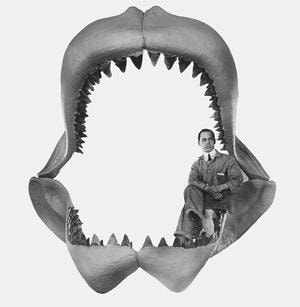 |
| This image depicts the size of the Megalodon's jawbone, taken by Bashford Dean in 1909. |
Some surprising discoveries, such as the finding of coelacanths and megamouth sharks (with their enormous mouths) still existing, have led many to believe that the megalodon may also still exist somewhere in the ocean. Coelacanths are known to be extremely ancient fish, thought to have become extinct at the end of the Cretaceous period, about 65 million years ago. However, a specimen of this species was captured in 1938, and another in 1952. Since then, several other coelacanth specimens have been discovered around the world. As for the megamouth shark – a plankton-eating species – it was only discovered in 1976.
It's worth noting that coelacanths typically live in very deep waters and spend most of their time in caves. Megamouth sharks, reaching lengths of up to 4.5 meters, also live in very deep water. Therefore, it's not unusual for them to go undetected for extended periods. This is quite different from the Megalodon. Many scientists believe that a large predator like the Megalodon couldn't possibly remain undisturbed.
Fossils found on beaches are considered the best evidence of the megalodon's extinction. Scientists have shown that megalodon preferred warm, shallow waters where there was more prey to satisfy its enormous size. And if it had survived, a predator like the megalodon would certainly have left its mark. Its impact on the food chain was enormous. It would have eaten sharks and whales in all oceans, and bite marks and scars exceeding the size of a typical shark attack would have been found. Therefore, for scientists, it is certain that the megalodon is extinct and could not have survived to this day.