

Should parents read their children's text messages?
Do parents, relatives, teachers, etc., have the right to monitor and view children's text messages, Facebook accounts, and other confidential correspondence? If so, how should they act appropriately?
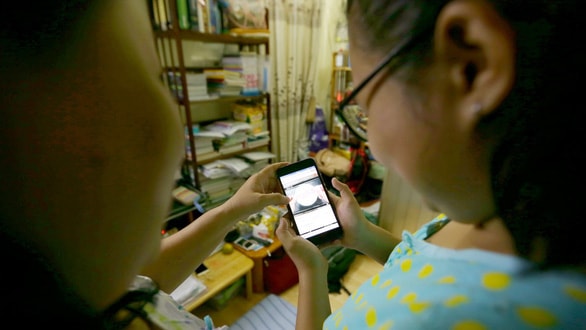
This has been a subject of debate in recent days, following an incident in Thanh Hoa where 10th-grade students had their negative comments about the school and teachers read by their homeroom teacher in a Facebook group.
* Ms. TO THI DIEM QUYENMicrosoft's global education expert):
Don't add fuel to the fire.
When students speak ill of their teachers on social media, it's important to consider what kind of teachers they might actually be, given the students' underlying dissatisfaction. Students who feel oppressed often react in one of two ways: they might bravely resist, or they might withdraw and harbor resentment, sharing this frustration with friends to relieve their stress.
The key to dealing with students on Facebook is to avoid adding fuel to the fire. Therefore, managing students' online behavior on social media can be done by understanding their preferences, because people do things based on three factors: coercion, understanding, or liking.
Students love using social media, so why don't adults support this interest by organizing projects for them or promoting their group's products on Facebook? Schools and parents shouldn't forbid it, but rather guide students, so that they use social media in a beneficial and civilized way.
* M.Sc., Lawyer PHAM VAN CHUNGKon Tum Department of Justice):
Disrespecting teachers will lead to disrespecting the law later on.
It can be affirmed that speaking ill of teachers will negatively affect the reputation and honor of the teacher, as well as the educational work of the school. Therefore, in my opinion, the school's decision to temporarily expel these students is reasonable and necessary. Because students who come to school must abide by the school's rules and regulations. In this case, they are high school students, and they are old enough to understand the consequences of their actions.
Conversely, if students violate regulations and speak ill of teachers without being punished, will teachers still be able to educate them? If they are not punished, other students will assume that speaking ill of teachers is acceptable, and thus violations of regulations will become widespread.
More dangerously, this will foster a mindset among students of disrespecting and challenging teachers, and disregarding school rules and regulations. Later in life, they will disregard and violate the law, becoming criminals.
Students speaking ill of their teachers goes against the beautiful tradition of respecting and honoring teachers that our nation cherishes. Regardless of the circumstances, we absolutely should not tolerate behavior that contradicts our nation's tradition of valuing and respecting teachers.
* Lawyer HUA THI THAOHo Chi Minh City Bar Association):
We need to cultivate good manners.
Children are a special group that needs the attention, care, and education of their families, schools, and society... and children also have all their civil rights. Unfortunately, the general situation is that our society has not yet developed the habit of respecting the privacy of individuals.
It is also regrettable that in the educational environment in general, and in schools in particular, the habit of respecting privacy and confidentiality of correspondence among teachers is not yet complete or adequate. While schools should ideally be the place where the most exemplary conduct regarding respect for children's civil rights is demonstrated.
In the past, only a few cases of child abuse and violence (with sufficient evidence) from schools or childcare facilities have been prosecuted and appropriately deterred. Furthermore, due to competitive pressures and academic achievement, schools often create significant academic stress and psychological abuse for children, making it difficult to address these issues.
Monitoring or detecting children speaking ill of their teachers cannot be a valid reason for a teacher's violation of the law. The law only permits such checks on children in certain cases, and only certain authorized agencies are allowed to do so in the presence of the child's parents or guardians.
* Lawyer NGUYEN THI BICH TRAMHo Chi Minh City Bar Association):
Balancing educational responsibilities with privacy rights.
Decree 56 stipulates that the disclosure or publication of images, information, and secrets of children must have the consent of the child (at least 7 years old) and of their parents or guardians.
The draft decree on administrative penalties for social protection, relief, and child protection and care also stipulates fines of up to 50 million VND for the act of "Publishing or disclosing information about the private life and personal secrets of children without the consent of their parents or guardians...". Many violations of the responsibility to protect children in the online environment are also subject to fines of up to 30 million VND and revocation of operating licenses.
Even parents or guardians who are directly responsible for raising, caring for, and educating children are not allowed to arbitrarily access their children's phones, emails, etc. In reality, children are exposed to the online environment quite early, so parents must also have technical solutions to protect their children online.
Parents who want to understand their children's thoughts and desires in order to help and guide them must be tactful. They shouldn't peek or spy, but must ask for the child's permission. To do this, they need to show love and build trust so that the child will give permission.
* Lawyer TRAN THI NGOC NUHead of the Lawyers' Branch - Ho Chi Minh City Association for the Protection of Children's Rights):
Checking children's phones and expelling them from school are both wrong.
The right to privacy, including the confidentiality of correspondence, telephone calls, and telegrams, is one of the most fundamental rights of all citizens, recognized by most countries around the world. This right is stipulated in the Constitution of Vietnam.
The Civil Code and the Criminal Code throughout history have both included provisions protecting this right. The 2016 Children's Law (Article 21) also stipulates: Children have the inviolable right to privacy, personal secrets, and family secrets. They are protected by law regarding their honor, dignity, reputation, confidentiality of correspondence, telephone calls, telegrams, and other forms of private communication...
Tenth-grade students, who are under 16 years old, are considered children according to the Law on Children. The teacher's act of taking their phones to view their information is wrong in two ways. Firstly, phones are children's property; if there is a regulation prohibiting bringing phones to school, teachers can remind or correct them, but they cannot confiscate the phones. Secondly, taking the phones to view their contents (images, private information, messages, etc.) violates the Constitution as well as criminal law.
The second mistake is the disciplinary action of expelling the children. Regardless of whether the children actually spoke ill of the teacher (whether they spoke ill or truthfully about something bad), applying the penalty of expulsion violates the principles of the Law on Children. Clause 3, Article 5 of the Law on Children states the principle: "Ensuring the best interests of the child in all decisions concerning the child." This doesn't even consider the educational aspect; expelling children simply for speaking ill of a teacher is counterproductive.
Dr. Vo Van Nam, an education expert from Ho Chi Minh City University of Education, believes that students are heavily influenced by emotions, easily swayed by feelings, and act and speak based on emotions. Therefore, their use of Facebook, within the limits of immature thinking, and their desire to stand out from the crowd through sensationalism and prominence, is understandable. Correcting and preventing this is the responsibility of adults.
Parents must guide their children through self-awareness so that they understand what constitutes freedom and how to speak in a way that doesn't harm or offend others. Schools and teachers must understand the psychology of the students; otherwise, it will lead to a mindset of intimidation and coercion, easily resulting in violence, even psychological violence. From there, students will try to belittle and slander those who cause them stress.
Mr. Nam emphasized that above all, it is necessary to understand the psychology of students in order to guide their actions and thoughts, so that even with hundreds of social media platforms available, they will still use them appropriately.