

Suspension system - a cushion for car passengers.
The suspension system is a crucial component of a car, contributing to a smooth ride and improved driving support.
The suspension system is a crucial component of a car, acting as a bridge between the chassis and the four wheels. Its primary function is to absorb shocks and minimize vertical oscillations, resulting in a smoother ride and preventing jolting or bouncing when driving on rough roads. Additionally, the suspension system ensures the car's stability and agility during steering, cornering, acceleration, and deceleration.
A basic suspension system consists of three main parts:elasticity, damping, and guidance.
|
The structure of the suspension system on the Ford Transit. |
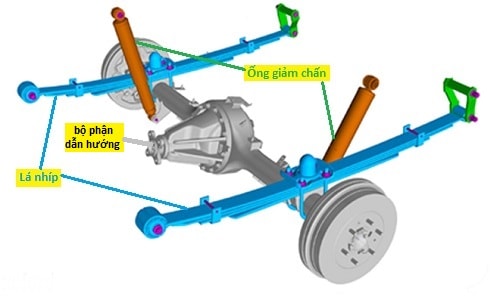
Modern car suspension systems typically come in various forms such as leaf springs, coil springs, torsion bars, or compressed air in luxury models. Their function is to facilitate vertical wheel oscillations, ensuring a smooth ride.
|
The suspension system uses leaf springs. |
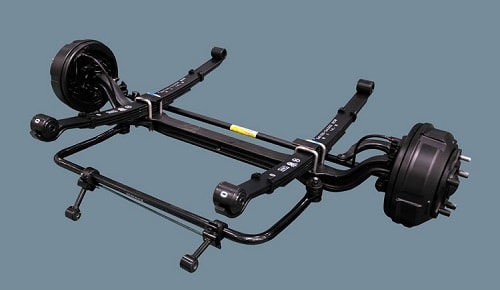
The second component is the shock absorber. Most modern vehicles primarily use hydraulic shock absorbers, consisting of a piston and cylinder system. A small number of vehicles also use mechanical shock absorbers, which are leaf springs. This component helps to dampen the vibrations of the wheels and body, ensuring better traction and preventing excessive shaking.
This type of shock absorber is often referred to by the more common and easily understood name: shock absorber or fork. Nowadays, many people are familiar with leaf spring shock absorbers, which are suspension systems that use leaf springs. A spring shock absorber system uses a spring as the damping element. In addition, oil shock absorbers, gas shock absorbers, or air shock absorbers are different types classified according to the structure of the hydraulic damping element.
|
Structure of the oil reservoir in the hydraulic shock absorber system. |
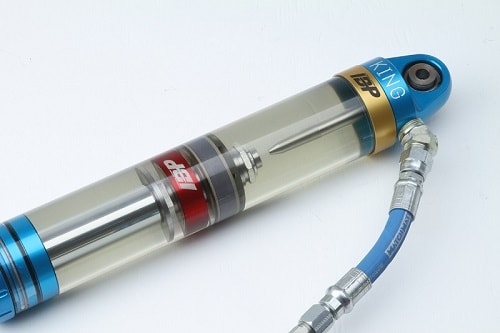
Finally, the guiding component is responsible for receiving and transmitting force and torque between the wheels and the chassis. Based on this, suspension systems are generally divided into two main types: independent suspension and dependent suspension. Dependent suspension systems are commonly found on trucks or pickup trucks. Two wheels are attached to either end of an axle, and the leaf spring suspension system acts as a bridge between the axle system and the chassis and body of the vehicle.
Besides trucks, most body-on-frame SUVs and pickup trucks in Vietnam use this type of suspension system, such as the Toyota Fortuner - Hilux, Ford Everest - Ranger, Chevrolet Trailblazer - Colorado, Isuzu Mu-X - D-Max, and Nissan Terra - Navara.
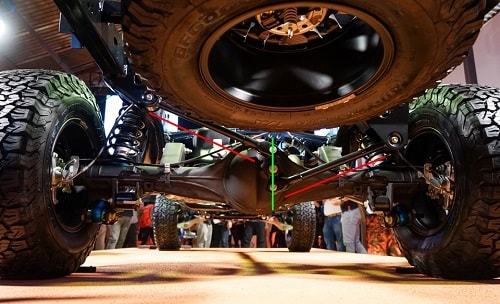
However, to increase the value of the vehicle, manufacturers offer special editions with slightly different suspension systems. The Ford Ranger Raptor uses a Watt linkage, which is also a type of dependent suspension system, with the dampers being hydraulic shock absorbers from the renowned Fox company. In addition, the Nissan Navara EL version also uses a multi-link suspension system, not the conventional leaf springs.
|
Connecting Watt on the Ford Ranger Raptor.Photo: OTV News. |
The advantage of a dependent suspension system is its simple structure and few components. Therefore, maintenance and disassembly for repair are simpler, and maintenance costs are also lower. Despite its simple structure, the materials used in this system are usually hard and capable of bearing heavy loads. This is why this suspension system is commonly used on trucks, pickup trucks, and large SUVs in Vietnam.
However, this suspension system still has inherent drawbacks. Because it is constructed from relatively stiff materials, the ride is not smooth, and passengers will experience jolting. Furthermore, at high speeds, sharp turns by the driver can cause wheel slippage, leading to loss of control and potentially an accident.