

US F-35 fighter jets showcase "Beast Mode" over the Pacific Ocean.
The American F-35B was flying a training mission in a ground attack configuration, carrying four smart bombs mounted under its wings to increase its firepower.
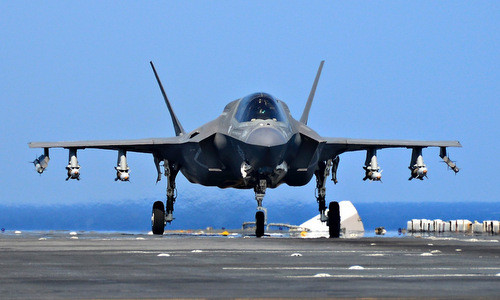 |
| A US F-35B with four bombs and two air-to-air missiles under its wings. Photo:US Navy. |
On February 3rd, a US Marine Corps F-35B stealth fighter took off from the amphibious assault ship USS Wasp operating in the Pacific Ocean, carrying four GBU-12 guided bombs and two AIM-9X short-range air-to-air missiles. This marks the first time a US F-35 fighter has used its "Beast" mode in combat.AviationistReport the news.
According to manufacturer Lockheed Martin, the F-35 fighter jet can engage in combat in two modes: "Stealth" and "Beast". Stealth mode is typically used in the early stages of a war, where all weapons are concealed in the aircraft's internal bays, ensuring maximum stealth capabilities for the F-35.
However, in the later stages, when the enemy's air defense and air force systems have been suppressed, the F-35 can switch to "Beast" mode, utilizing its underwing weapon pylons, sacrificing stealth capabilities to increase ground attack firepower.
In its "Beast" configuration, the F-35 can carry up to six GBU-31 smart bombs, each weighing 907 kg, for ground attack missions, along with two AIM-120 AMRAAM medium-range air-to-air missiles and two AIM-9X Sidewinder missiles for self-defense. For air superiority missions, each F-35 can carry up to 14 AMRAAM missiles and two Sidewinder missiles.
However, analysts remain skeptical of the "Beast" mode, considering it a marketing gimmick with little practicality. The US F-35B fighter jet itself only carries four GBU-12 bombs weighing 226 kg each, significantly smaller than the six GBU-31 bombs advertised by Lockheed Martin.