

Learn about the basic parts of a car.
The hood, grille, steering wheel, or gear shifter… these are basic parts of a car that almost everyone has heard of, but how many people truly understand their functions?
The basic parts of a car. |
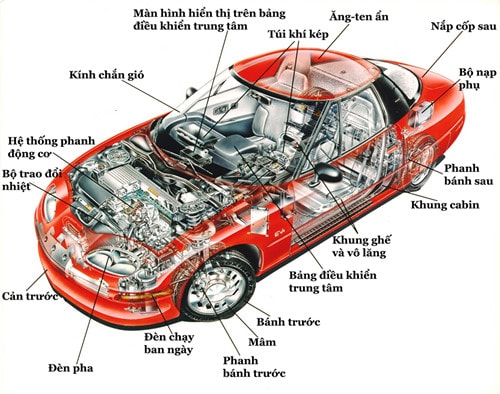
In reality, many car owners only focus on more complex aspects such as design, equipment, performance, or safety features. However, most forget the importance of understanding the basic structure of the exterior and interior, while this information is extremely useful for operating the vehicle smoothly and efficiently.
1. Exterior
Hood:It is the metal frame at the front of the vehicle that protects the engine compartment and can be opened and closed for maintenance and repair of the internal components.
Grille:Most cars are equipped with a radiator grille at the front to protect the radiator and engine, while also allowing air to flow inside. Additionally, radiator grilles can be located in several positions, such as in front of the wheels (to cool the braking system) or on the rear of the vehicle, for cars with rear-mounted engines.
The exterior parts of the car. |
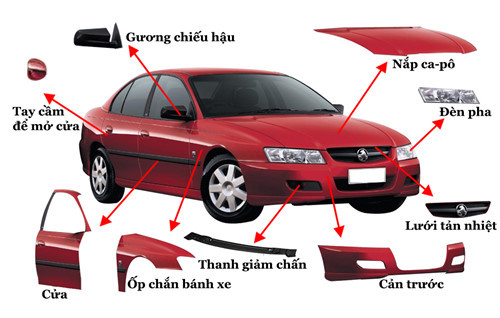
Headlight:Headlights are lighting devices typically located at the left and right corners, connecting the hood and the front of the vehicle. They produce a strong, focused beam of light that illuminates the road horizontally and can reach a distance of approximately 100 meters. Headlights can be used in conjunction with low beam lights (fog lights) in the same housing, or installed as supplementary lights for optimal illumination.
Obstruction:These are structures attached to or integrated into the front and rear of a car to absorb the impact force during a collision, helping to minimize injuries to occupants and damage to other parts of the vehicle.
Windshield:As a type of glass window located at the front of a car, it not only serves to block wind, dust, rain, etc., from entering the vehicle, but also contributes to increasing the structural rigidity of the car and protecting passengers in certain collision situations.
Rearview mirror:These are mirrors mounted in the corners of the two front doors to help the driver see the area behind and to the sides of the vehicle.
2. Interior
Steering wheel:As part of the steering system, it is controlled by the driver. The rest of the system responds to driver input on the steering wheel through the coordination of two pairs of steering mechanisms: rack and pinion and worm gear, and may also be assisted by a hydraulic pump.
The interior components of a car. |
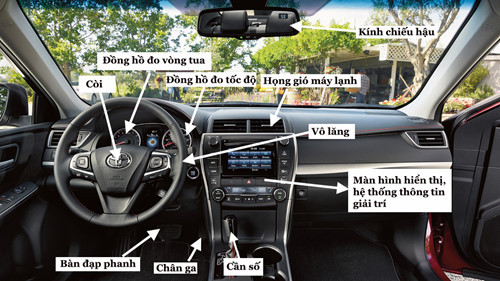
Dashboard:An information system, comprising gauges, displays, and indicator lights, provides the driver with information about the operational status of several key systems in the vehicle. This information is displayed in two forms: analog or digital.
Speedometer:Used to measure and display the instantaneous speed of a vehicle, it has been standard equipment on motor vehicles since 1910, often combined with an odometer to indicate the distance the vehicle has traveled since starting and a tripmeter to measure short distances.
Tachometer:The engine crankshaft rotation speed gauge displays revolutions per minute (RPM). For manual transmission vehicles, this parameter is crucial, indicating whether the engine is operating within its optimal torque range and whether the idle speed is within the standard range. For automatic transmission vehicles, drivers monitor the gauge to maintain the engine's operating speed within a reasonable range and to save fuel.
Gas pedal:The accelerator pedal is a part of a car that, when applied, makes the car go faster. Operated by the right foot, it controls the amount of fuel injected into the engine. The harder the driver presses the accelerator, the more fuel is injected into the engine, making the car go faster. When the accelerator is released, the car slows down. The accelerator pedal is highly responsive even with minimal pressure applied.
Brake pedal:This part is also controlled by the right foot and used to slow down or bring the vehicle to a complete stop. When the driver presses the brake pedal, the brake fluid in the system flows through the pipes to the wheel cylinders. Under the force generated by the brake fluid pressure acting on the pistons, the braking mechanism performs the task of slowing down or stopping the vehicle. The time and distance for the vehicle to brake depend on the force applied to the pedal. However, it is best for the driver to gradually increase the pressure until the vehicle comes to a gentle stop, avoiding sudden braking.
Clutch pedal (only available on manual transmission vehicles):This pedal is controlled by the driver's left foot and is used to move the vehicle from a stationary position, shift gears, and stop the vehicle without causing the engine to suddenly stall. To ensure smooth movement, the clutch pedal should be released in the following sequence: Release the first 2/3 of its travel quickly to allow the clutch disc to make contact with the flywheel, then release slowly for the remaining 1/3 to gradually increase the torque transmitted from the engine to the drivetrain. When the clutch pedal is fully released, the driver should place their foot on the floor to prevent clutch slippage.
Gear shift:It operates in conjunction with the clutch. Shifting the gear lever affects the engagement of the gears in the gearbox, changing the traction and speed of the car.
The design, equipment, and technical specifications of an engine are fixed elements according to manufacturer standards, and even if the owner understands them, they cannot be fully applied to the vehicle's operation. However, once the driver masters the operating principles of these components, they can flexibly control the vehicle according to different conditions, thereby optimizing its performance. Therefore, no basic detail should be underestimated, because even a simple mechanism can have a significant impact.