

The enduring value of the Declaration of Independence
Seventy-four years after President Ho Chi Minh read the Declaration of Independence, and especially after more than 30 years of national renewal, every Vietnamese citizen has come to appreciate even more the value of independence and freedom; the great and profound significance of Ho Chi Minh's thought on human rights and the rights of each nation.
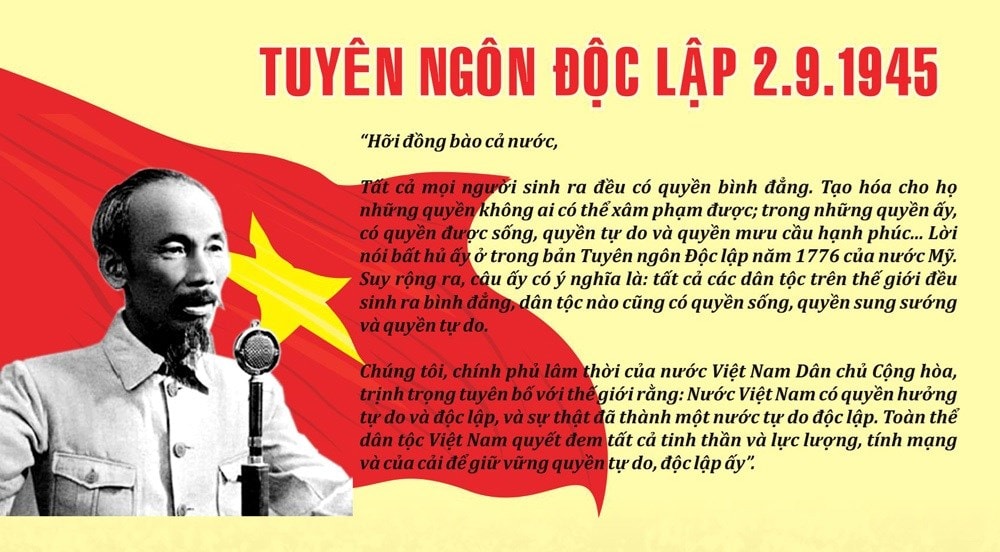 |
Immediately after the success of the August Revolution in 1945, President Ho Chi Minh, on behalf of the Provisional Government, read the Declaration of Independence on September 2, 1945, at Ba Dinh Square (Hanoi), declaring to the nation and the world: "Vietnam has the right to enjoy freedom and independence, and in fact has become a free and independent nation."
HUMAN RIGHTS ARE DIALECTICALLY UNIFIED WITH NATIONAL RIGHTS
The Declaration of Independence, read by President Ho Chi Minh on behalf of the Provisional Government on September 2, 1945, not only gave birth to the Democratic Republic of Vietnam, ushering the Vietnamese nation into a new era – the era of independence, freedom, and socialism – but also holds profound historical significance. Its ideology, encompassing the right to freedom and the pursuit of happiness for every citizen, is linked to the sacred right to equality among nations; and it reflects the spirit and will of the Vietnamese people in their struggle for independence and freedom in their journey to regain that right.
Affirming the legitimacy of human rights and the rights of each nation, at the beginning of the Declaration of Independence, President Ho Chi Minh demonstrated profound and far-reaching thinking by quoting the American Declaration of Independence of 1776 and the Declaration of Human Rights and Citizen Rights of the French Revolution of 1791, stating: “All men are created equal. They are endowed by their Creator with certain unalienable rights, among which are the right to life, liberty, and the pursuit of happiness.”"People are born free and equal in rights, and must always remain free and equal in rights."With this argument, he affirmed: “Broadly speaking, that statement means: all nations in the world are born equal, every nation has the right to live, the right to happiness, and the right to freedom,” and “These are undeniable truths.” And therefore, every Vietnamese citizen and the Vietnamese nation have these legitimate rights; no one can take them away; and if they are taken away, the entire nation will be strong, united, and persistent in fighting to regain them and resolutely defend them.
Following this, President Ho Chi Minh denounced the French colonialists: “For over 80 years, the French colonialists, under the banner of freedom, equality, and fraternity, have seized our country and oppressed our people. Their actions are completely contrary to humanity and justice. Politically, they absolutely deny our people any freedom or democracy… They established three different regimes in the Central, Southern, and Northern regions to prevent national reunification and to prevent our people from uniting. They built more prisons than schools. They ruthlessly murdered patriots and national heroes… They suppressed public opinion and implemented a policy of deliberate ignorance. They used opium and alcohol to weaken our race… They exploited our people to the bone… They imposed hundreds of unreasonable taxes… They prevented our capitalists from becoming wealthy. They exploited our workers with extreme cruelty.” Not only that, in the autumn of 1940, when the Japanese fascists arrived in Indochina, the French colonialists again knelt down and surrendered, and "thus, not only did they fail to 'protect' us, but on the contrary, in five years, they sold our country to Japan twice," causing our people even more suffering, resulting in "more than two million of our compatriots dying of starvation."
Resolutely fighting for independence and freedom, the truth is: 1) “From the autumn of 1940, our country became a colony of Japan, not a colony of France anymore”; 2) “When Japan surrendered to the Allies, the people of our entire country rose up to seize power and establish the Democratic Republic of Vietnam”; 3) “Our people reclaimed Vietnam from the hands of the Japanese, not from the hands of the French”; 4) “The French fled, the Japanese surrendered, and Emperor Bao Dai abdicated. Our people overthrew the colonial shackles of nearly 100 years to create an independent Vietnam. Our people also overthrew the monarchy of several centuries to establish a Democratic Republic,” and Vietnam was an independent nation.
Therefore, President Ho Chi Minh declared "a complete break with France, the abolition of all treaties that France had signed concerning Vietnam, and the elimination of all French privileges in Vietnam"; at the same time, he emphasized, "The Allied countries, having recognized the principles of national equality at the Tehran and Yalta Conferences, cannot fail to recognize the right to independence of the Vietnamese people." Because, "A nation that has bravely resisted French enslavement for more than 80 years, a nation that has bravely stood with the Allies against fascism for several years, that nation must be free! That nation must be independent!", therefore, "Vietnam has the right to enjoy freedom and independence, and in fact has become a free and independent nation. The entire Vietnamese nation is determined to dedicate all its spirit and strength, its life and property, to uphold that right to freedom and independence." The oath of independence – the sacred oath to defend the nation and the immortal spirit of the August 1945 Revolution – has resonated throughout the country for generations to come.
President Ho Chi Minh's declaration in the Declaration of Independence, regarding the inevitable right to independence and freedom of the Vietnamese nation in its struggle for independence and freedom, was not only a preemptive strike against the French colonialists' plot to reoccupy Indochina and the imperialist powers' intentions to intervene in Vietnam, but also affirmed before the public: Any act infringing upon the independence and sovereignty of independent Vietnam violates international law and goes against the trend of progressive human development.
As Professor Singo Sibata said in his research on the Declaration of Independence, "Ho Chi Minh's famous contribution lies in the fact that he developed human rights into national rights. Thus, all nations have the right to self-determination." Therefore, it can be said that the 1945 Declaration of Independence is not only the declaration of independence of the Vietnamese nation but also a declaration of human rights, the rights of colonial peoples in the struggle against colonialism and imperialism. History shows that freedom and equality are the humanistic ideals of human society since the emergence of classes. The struggle for freedom and equality for individuals in particular, and for each nation in particular, is a humanistic goal, an ideal of progressive humanity. Therefore, President Ho Chi Minh's quotation of the American and French Declarations of Independence shows that human rights and national rights are an objective reality of the understanding of truth. President Ho Chi Minh started from the perspective of human rights, using human rights to establish national rights and fight for national rights, because human rights are the fundamental basis for establishing national rights. Therefore, when expanding and developing from human rights to the right to national independence and freedom; affirming that human rights and national rights are always closely linked and dialectically unified, the lofty ideology and thoroughly revolutionary humanism of Ho Chi Minh were crystallized in the Declaration of Independence of the Democratic Republic of Vietnam.
The Declaration of Independence, embodying the spirit, will, and aspirations for independence and freedom; and the persistent struggle for independence and freedom of the Vietnamese people, affirmed the sacred and inviolable rights of the Vietnamese nation, and the unwavering will of the Vietnamese people and nation in the struggle to win and defend national independence.
HISTORICAL VALUE AND CONTEMPORARY SIGNIFICANCE
The Declaration of Independence was drafted by President Ho Chi Minh right in the heart of Hanoi, at house number 48, Hang Ngang Street, belonging to the patriotic capitalist Trinh Van Bo. This important document was discussed and reviewed by President Ho Chi Minh with input from members of the Central Party Standing Committee, members of the Provisional Government, the general public, and with input from A. Patti, a representative of the Allied forces. The Declaration of Independence contains 1,120 words, arranged in 49 sentences. This is a historical document, a concise, rigorous, and sharp legal text containing core content and a solid legal basis to not only affirm the national sovereignty of the Vietnamese people before the world but also to usher in a new era for our nation and people on the path of building and developing, enhancing Vietnam's position on the international stage.
The Declaration of Independence not only encapsulates the heroic and indomitable traditional values, the spirit and will to fight for an independent and free Vietnam, but also affirms that the Vietnamese revolution is a part of the world revolutionary movement; at the same time, it encourages the people of colonial and dependent countries to rise up against colonialism and win national independence. Therefore, the Declaration of Independence is not only associated with Ho Chi Minh but also opens up the historical Ho Chi Minh era, linked to the journey of the Vietnamese people steadfastly pursuing the path of national independence linked with socialism.
The Declaration of Independence also clearly affirms the role and strength of the united people in the struggle for independence and freedom. In that arduous journey, with the leadership of the Party, with a correct and creative revolutionary line, with the strength of national unity, and by leveraging and developing the strength of the nation and the times, our nation completely eliminated the colonial and feudal regimes, "reclaiming its name on the world map." Therefore, the Declaration of Independence is not only a glorious milestone, contributing to the brilliance of our nation's history of nation-building and national defense, but also affirms and spreads the Vietnamese civilization: "Standing firm for four thousand years / With swords on our backs, pens in our hands / Pure and true, bright on both sides of thought / Living proudly yet compassionately and harmoniously."
With the Declaration of Independence, a reborn Vietnam, after countless losses and sacrifices, continues to move towards a bright future, fighting for peace, independence, freedom, democracy, and social progress. Throughout this journey, imbued with Ho Chi Minh's thought that "all nations in the world are born equal" as stated in the Declaration of Independence, and linked to "ensuring the supreme interests of the nation," always considering national interests as paramount, the highest and most important goal—meaning the guiding principle of foreign policy in all fields—Vietnam has consistently remained steadfast and ready to cooperate with all countries, including those with a hostile past but who recognize Vietnam's independence, sovereignty, and territorial integrity. This is the tradition of Vietnamese tolerance and compassion, of erasing hatred and setting aside the past to move together towards the future.
History records that President Ho Chi Minh declared "a complete break from colonial relations with France" in the Declaration of Independence, but he also simultaneously emphasized that Vietnam was ready and proactive in building a friendship with France, sincerely cooperating and collaborating comprehensively with the French government and people, and "welcomes those French who want to bring capital into our country to exploit untapped resources... we can invite French, American, Russian, or Chinese experts to come here to help us in national reconstruction. But, it must be reiterated that the main condition is that they must recognize the independence of this country. Otherwise, nothing can be discussed at all"...
This vivid example not only demonstrates President Ho Chi Minh's "unchanging" principle of independence, self-reliance, and prioritizing the interests of the nation and people in response to the ever-changing and unpredictable circumstances, but also reflects his flexible and adaptable foreign policy thinking. It also shows that a consistent and pervasive theme in Ho Chi Minh's thought is that to achieve "equality" and "equal rights" in international relations, the country must build a strong and comprehensive national power base in politics, economics, culture, diplomacy, defense, and security. At the same time, it must be proactive, insightful, and vigilant in devising appropriate countermeasures against any foreign aggressor; especially when national sovereignty is threatened or violated, it is necessary to secure international support while remaining persistent, resolute, and decisive, but not rigid or mechanical; and flexible but not yielding or weak in decision-making and action.
From affirming the values of a nation—the right to equality, the right to life, the right to happiness, and the right to freedom—in the Declaration of Independence, President Ho Chi Minh asserted that human rights are only truly guaranteed when linked to the independence and freedom of the nation. Imbued with his ideology, for nearly 90 years, under the leadership of the Party, our people have persistently fought to protect the achievements of the August Revolution of 1945, successfully waged the resistance war against French colonialism and against American imperialism, liberated the South, and unified the country, etc., steadfastly pursuing the goal of national independence linked with socialism.
In particular, over the past 30 years of reform and international integration, along with achievements in all aspects, human rights have been implemented and enshrined in the Constitution. Through numerous revisions and amendments to the Constitution, human rights and citizens' rights have always been a fundamental issue in the Constitutions of 1946, 1959, 1980, 1992, and 2013. In the 2013 Constitution, for the first time, human rights and citizens' rights and obligations were stipulated in Chapter II. Subsequently, to institutionalize the 2013 Constitution, the National Assembly also amended and enacted many laws on the basis of ensuring human rights while protecting the social system, such as the Penal Code (2015) and the Press Law (2016). Law on Access to Information (2016)… In particular, it can be said that the goal of building a socialist Vietnam that is “prosperous, strong, democratic, just, and civilized” is the realization of the “right to happiness”/“prosperous people” and the “right to freedom”/“democracy”, the right to be masters, the right of the people to be masters/human rights affirmed by President Ho Chi Minh in the Declaration of Independence in 1945.
Seventy-four years after President Ho Chi Minh read the Declaration of Independence, and especially after more than 30 years of national renewal, every Vietnamese citizen has come to appreciate even more the value of independence and freedom; the great and profound significance of Ho Chi Minh's thought on human rights and the rights of each nation. This is also the goal and ideal that all nations and countries in the world strive for.
The Declaration of Independence is the ideology, the aspiration, and the result of President Ho Chi Minh's journey to find a way to save the nation, the reality of revolutionary struggle, and his sharp, unique scientific thinking; at the same time, it is also a vivid embodiment of the historical encounter between the Vietnamese nation, rich in tradition and culture, always yearning for independence, freedom, peace, and friendship, and an era of peace, cooperation, friendliness, and development, always respecting international law.
In the context of globalization, the world and regional situation remains highly complex and unpredictable. International relations present both opportunities and challenges. Based on the ultimate goal of protecting independence, sovereignty, and territorial integrity, including maritime sovereignty and islands, while simultaneously ensuring human rights and a peaceful, prosperous, and happy life for the people, the entire Party, people, and army of Vietnam continue to steadfastly pursue the independent, self-reliant, peaceful, and friendly policies with other countries to build and protect the socialist Vietnamese Fatherland – a nation that is "rich, strong, democratic, just, and civilized."