

Disagreements between Japan and South Korea have temporarily cooled down!
(Baonghean) - Last week, public opinion witnessed unexpected ups and downs in the relationship between the two allies, Japan and South Korea, related to the General Security of Military Information Agreement (GSOMIA) between the two sides aimed at responding to the common threat of North Korea's missile tests.
Prior to the agreement's expiration date of November 23rd, many were certain that South Korea would terminate and not renew the agreement due to the deep trade tensions between the two countries in recent times. However, at the last minute, South Korea made a surprising decision to extend the agreement, saving the Japan-South Korea alliance from imminent collapse!
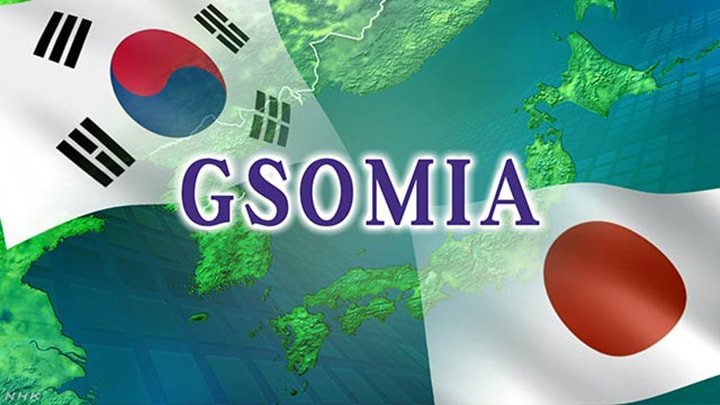 |
| On November 22, South Korea decided to extend the General Security of Military Information Agreement (GSOMIA) with Japan. (Photo: Teller Report) |
Military or economic?
In fact, the possibility of South Korea not renewing the General Security of Military Information Agreement (GSOMIA) has been raised since August of this year. At that time, the country threatened to terminate the agreement in response to Japan's decision to restrict exports of high-tech materials to South Korea stemming from historical disputes, and to remove Seoul from the list of trusted trading partners.
Specifically, Japan-South Korea relations had already deteriorated rapidly since the South Korean Supreme Court ruled that Japanese companies must compensate South Korean forced laborers during World War II. Tensions further escalated when South Korea subsequently announced plans to remove Japan from its list of countries enjoying special trade privileges. In September, Seoul also filed a complaint with the World Trade Organization (WTO) regarding a trade dispute with Tokyo over export restrictions.
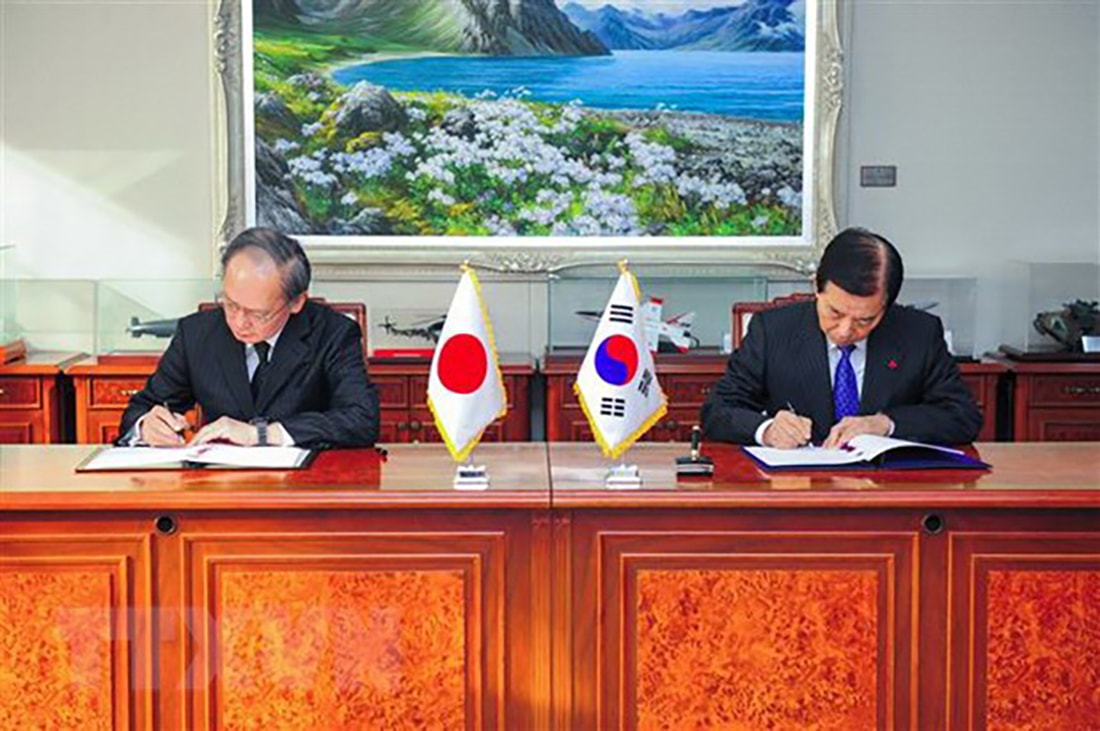 |
| South Korean Defense Minister Han Min-Koo (right) and Japanese Ambassador to South Korea Yasumasa Nagamine at the signing ceremony of the General Security of Military Information Agreement (GSOMIA) in Seoul on November 23, 2016 (Photo provided by the South Korean Ministry of Defense). Photo: AFP/VNA |
It should be recalled that Japan and South Korea signed the GSOMIA agreement on November 23, 2016, with the primary purpose of responding to North Korea's nuclear and missile tests.
This agreement is crucial because it helps overcome the weaknesses of both countries in dealing with Pyongyang's missile launches. It also allows the two countries to share sensitive military information instead of through their common ally, the United States. The agreement is automatically renewed annually, but either side can terminate or withdraw from it with prior notice. Despite Prime Minister Shinzo Abe's administration asserting that the GSOMIA agreement and the disputed trade issues are entirely separate and should not be combined for negotiation or have any impact on each other, the Seoul government has repeatedly urged Tokyo to lift the trade restrictions imposed on South Korea before renewing the agreement.
From Japan's perspective, it's clear they are concerned that disrupting the GSOMIA agreement would create difficulties and risks in monitoring North Korean missile launches. Furthermore, if South Korea were to actually withdraw from the agreement, the trilateral alliance between Japan, the US, and South Korea would plummet. This would also mean that important security structures and axes in the region would shift in a way that is unfavorable to Tokyo. Of course, for its part, the missile threat from North Korea remains a constant concern for South Korea. However, gaining an advantage with voters is a greater priority for President Moon Jae-in ahead of the April election. According to a recent opinion poll, South Koreans strongly support terminating the GSOMIA agreement with Japan, given the rapidly deteriorating bilateral relations.
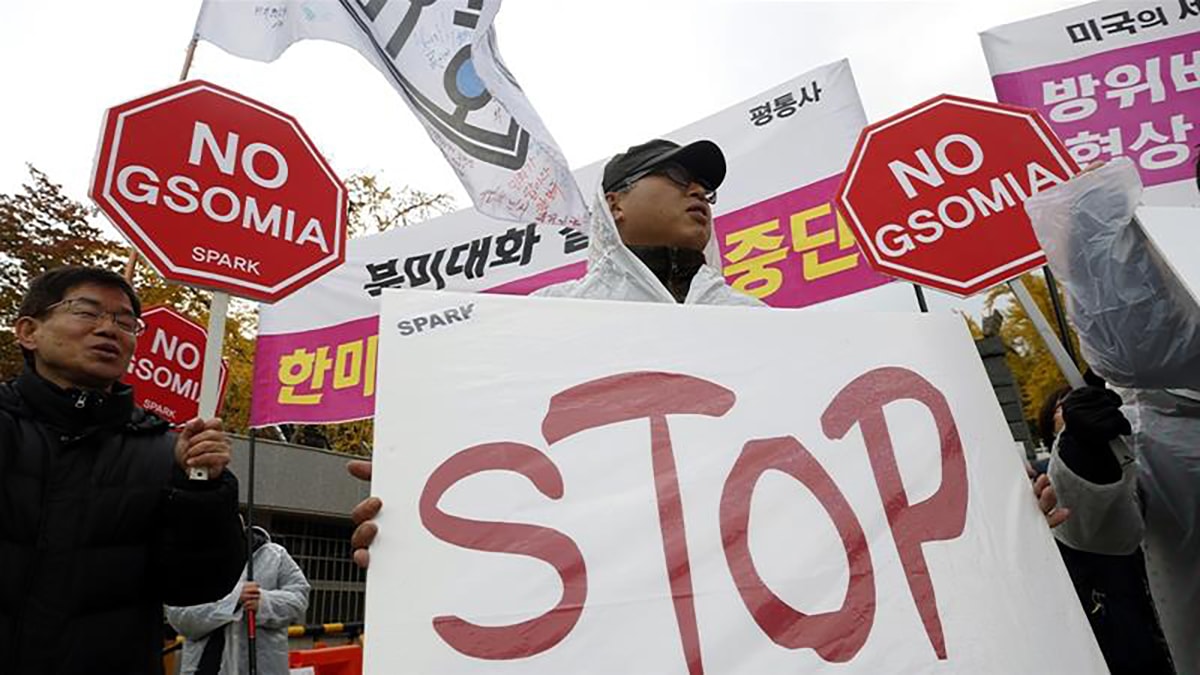 |
| South Korean protesters demonstrate against the extension of the GSOMIA agreement with Japan. Photo: EPA |
Pressure from the US
It seemed as though the November 23rd deadline had marked the end of the General Security of Military Information Agreement (GSOMIA) between the two allies, Japan and South Korea. However, unexpectedly at the last minute, President Moon Jae-in's administration agreed to extend the agreement, albeit with conditions attached. This was surprising because, over the past few months, efforts by both Japan and the US to persuade South Korea to extend GSOMIA had been unsuccessful. These included a meeting between the Japanese and South Korean defense ministers at the ASEAN Expanded Defence Ministers' Meeting in Bangkok, Thailand, as well as a trilateral meeting attended by US Defense Secretary Mark Esper. Esper's earlier visit to South Korea also showed no signs of progress.
Having failed to persuade them, the US will certainly not stand idly by while the US-Japan-South Korea alliance deteriorates, impacting its Indo-Pacific strategy.
Looking back to November 19th, the US abruptly abandoned the latest round of negotiations with South Korea on military cost-sharing. Furthermore, the US is demanding that its ally, South Korea, significantly increase its contributions to maintaining the 28,500 US troops stationed there. Reports indicate that the US has requested nearly $5 billion next year to cover costs related to joint military exercises and the operational needs of this large troop presence. Faced with this considerable pressure, South Korea likely has no choice but to agree with Japan to extend the GSOMIA agreement.
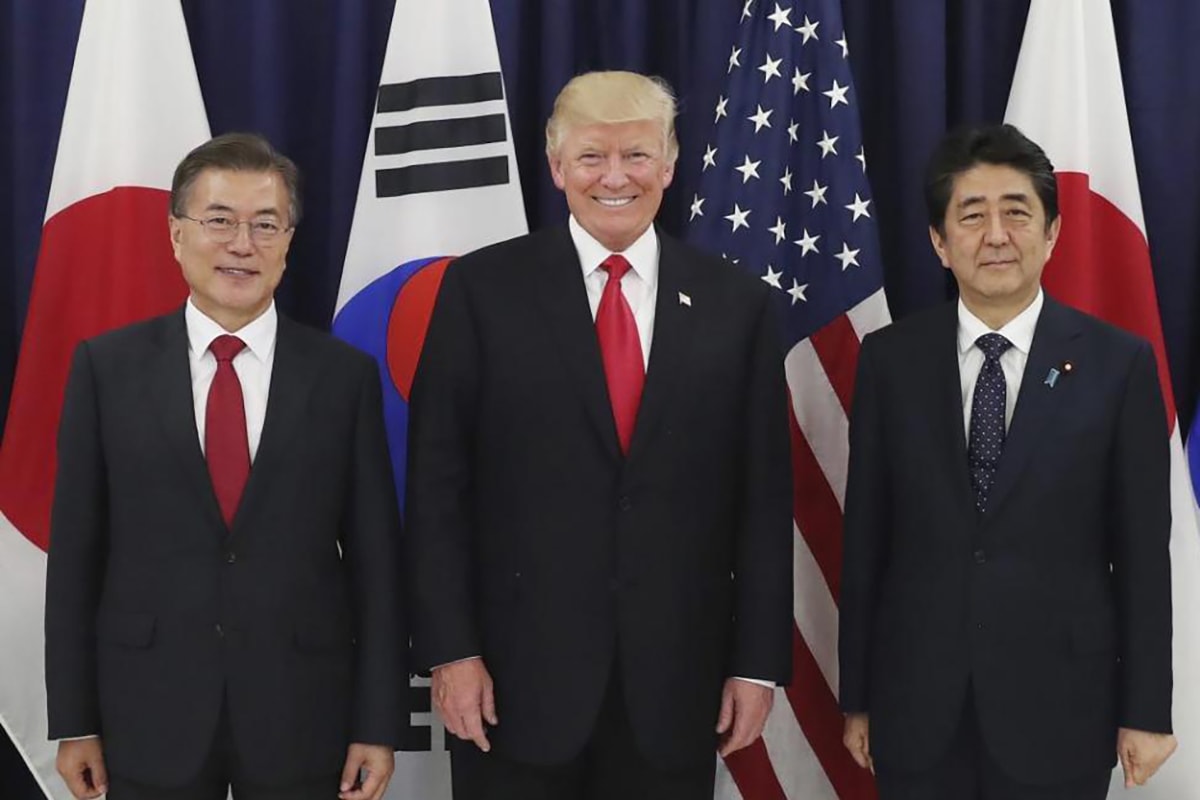 |
| The US-Japan-South Korea axis remains a central focus of the foreign and security policies of all three countries. (Photos: Yonhap, EPA) |
According to observers, at first glance, the recent situation seems like a "last resort" for South Korean President Moon Jae-in, having to agree with Japan under pressure from the US. However, few realize that Moon Jae-in actually has certain advantages. The GSOMIA agreement remains crucial not only for Japan but also for South Korea, given North Korea's recent missile tests. Furthermore, the US-Japan-South Korea relationship undeniably plays a vital role in Seoul's foreign and security policy. In the eyes of voters, Moon Jae-in was simply forced to extend the agreement under US pressure in exchange for sharing defense costs!
To date, the bilateral relationship has shown some improvement, with the two countries' foreign ministers agreeing on the sidelines of the recent G20 Foreign Ministers' Meeting to work towards organizing a summit between the two leaders next month. Of course, the long-term future of the GSOMIA agreement remains uncertain! South Korea, in its statement, still maintains that it can terminate the agreement at any time if negotiations on export control measures for high-tech materials with Japan fail. Conversely, the Tokyo government still wants to maintain these measures to pressure Seoul to change the court's ruling on forced labor. Therefore, South Korea's recent decision can be considered a temporary "untanglement" of Japan-South Korea tensions. However, this does not mean that conflicts and disagreements will not flare up again at any time!