

Are the actual number of Covid-19 cases in the US, Italy, and China 10 times higher?
There are many reasons why the world may never know the true scale of the Covid-19 pandemic.
Researchers generally agree that the true number of Covid-19 cases is much higher than the officially reported figures globally, especially in countries experiencing large-scale outbreaks such as China, Italy, and the United States.
|
Healthcare workers in Ottawa, Canada, on March 13, 2020. Photo: Reuters |
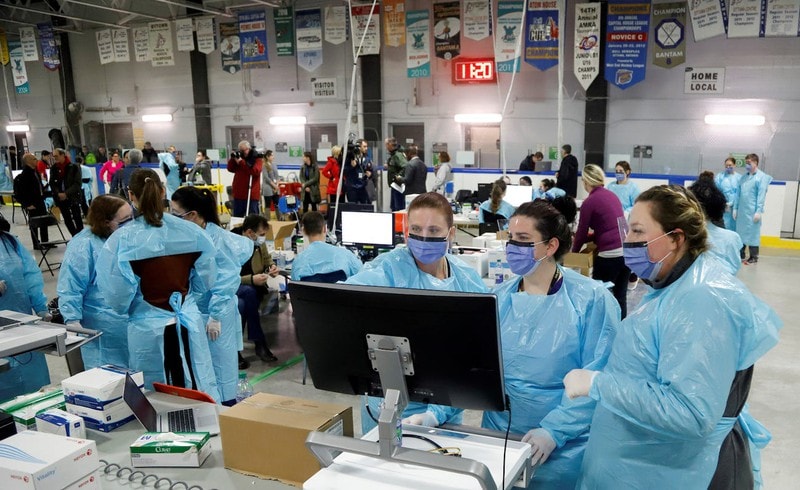
In these countries, limited testing capacity due to the overwhelming number of cases and the difficulty in finding and detecting asymptomatic cases may lead to many patients going undiagnosed. Covid-19 tests can also produce false negative results if not performed correctly or if the disease does not have enough virus to be detected in the samples.
The actual number is at least 10 times higher.
Some public health experts believe the true total number of Covid-19 cases in China, Italy, and the United States could be at least 10 times higher than current figures.
"Nobody really knows. There are so many people with the disease who have been overlooked," Elizabeth Halloran, a biostatistician at the Fred Hutchinson Cancer Research Center and the University of Washington, told Business Insider.
According to expert Hallorran, based on recent models, the actual number of Covid-19 cases in any region of the US could be 5 to 20 times higher than the current figures. However, she also noted that any calculation or statistical model is inevitably subject to some margin of error.
Neil Ferguson, a professor of epidemiology at Imperial College London, estimated in February that China had identified only about 10% or less of its Covid-19 cases.
Similarly, the head of Italy's Civil Protection Agency told La Repubblica in March 2020 that the ratio of 1 confirmed case per 10 people with Covid-19 in Italy was "credible".
Trevor Bedford, an epidemiologist at Fred Hutchinson, estimated last weekend that for every 10 or 20 people infected, the US only confirms one case. This means the actual number of Covid-19 cases in the country could be as high as 5-10 million.
A study published in Science in March 2020 showed that the COVID-19 outbreak in the US was 5 to 10 times larger than the reported numbers.
"Many models using different methods are producing similar results," Halloran said, but also acknowledged that "there is still a lot of uncertainty."
Asymptomatic cases
One of the biggest obstacles to accurately identifying Covid-19 cases lies in the fact that some infected individuals may be asymptomatic.
"We don't know how many asymptomatic cases there are. We suspect these people are the source of infection for many others in the community," expert Halloran said.
Anthony Fauci, director of the National Institute of Infectious Diseases and Allergies, recently estimated that approximately 25-50% of people with Covid-19 are asymptomatic but still capable of transmitting the virus.
Some other calculations are even higher. A study of 3,000 people in Vo'Euganeo, a village in northern Italy, showed that 50-70% of Covid-19 cases were asymptomatic.
Meanwhile, a February 2020 report from the World Health Organization (WHO) indicated that asymptomatic cases were "relatively rare" in China, but the country's National Health Commission later confirmed that 78% of new Covid-19 cases since April 1st were asymptomatic.
Test errors and limited testing capacity
The more tests a country conducts, the closer it gets to the true number of Covid-19 cases. However, many countries are still struggling to conduct enough tests for patients at risk. In Italy, a country with one-fifth the population of the US and 23 times the population of China, there is also insufficient capacity to test all citizens.
Although Italy initially conducted widespread testing, including that of asymptomatic individuals, the country later changed its policy to test only those with severe symptoms.
Meanwhile, in New York City, the epicenter of the Covid-19 outbreak in the US, hospitals are still struggling to test patients with severe symptoms. States with high numbers of cases, such as California and Washington, have yet to conduct enough tests.
In addition, testing can also have certain errors. A study of over 1,000 patients admitted to hospitals in Wuhan showed that 75% of those who tested negative may have had Covid-19 based on their CT scans.
"There are many things that can affect whether a test actually detects the virus," Priya Sampathkumar, an infectious disease expert at the Mayo Clinic, told AFP.
In addition, limitations in the process of statistically recording Covid-19 cases have also resulted in the actual number being higher than the current official figures.
Expert Halloran also assessed that current tests for patients "need to be faster, cheaper, more reliable, and more readily available on the market in larger quantities."
Many deaths go unrecorded.
Public health experts are still debating the total number of deaths from the 1918 Spanish flu pandemic more than a century later. Some researchers estimate around 20 million people died, while others suggest the number could be as high as 100 million.
Regarding the Covid-19 pandemic, we can cite New York City, USA, where from March 4th to April 4th, the city recorded twice the monthly death toll. Of the 5,330 deaths that month, only 3,350 were confirmed as deaths due to Covid-19.
"We will never know whether any of those 2,000 deaths were due to Covid-19 or some other cause. This is just the report from one city for one month, where they may have delayed reporting deaths by two weeks. The actual number is probably much higher," Halloran said.
As of the morning of April 21st, Vietnam has gone five consecutive days without reporting any new COVID-19 cases.
The 6:00 AM news bulletin on April 21st from the National Steering Committee for COVID-19 Prevention and Control reported no new COVID-19 cases. This marks the fifth consecutive day that Vietnam has recorded no new cases.