

Two years since the inter-Korean summit: Quiet, with few significant events!
(Baonghean) - April 27th marks the second anniversary of the first inter-Korean summit between South Korean President Moon Jae-in and North Korean leader Kim Jong-un. Since that historic handshake between the two leaders, countless hopes have been raised with promises and commitments from both sides for a peaceful and stable future, and denuclearization on the Korean Peninsula.
Looking back over the past two years, while acknowledging the achievements, it's also necessary to recognize the reality that the denuclearization dialogue on the Korean Peninsula, as committed by the two leaders, still faces numerous obstacles. And that, even after this two-year milestone, there is still much work to be done!
From the Joint Statement…
Looking back to the end of April 2018, South Korean President Moon Jae-in and North Korean leader Kim Jong-un, following their historic meeting, jointly issued a statement. Most notably, the two leaders agreed to cooperate towards the denuclearization of the Korean Peninsula. The statement also pledged to continue dialogue to formally declare an end to the war and establish a lasting and sustainable peace treaty.
Both sides also agreed to urgently address the humanitarian issues of separated families. In addition, they pledged to cooperate in reducing military tensions on the Korean Peninsula, cease all propaganda activities such as loudspeaker broadcasts and leaflets, and agreed to establish a joint liaison office in the city bordering Kaesong…
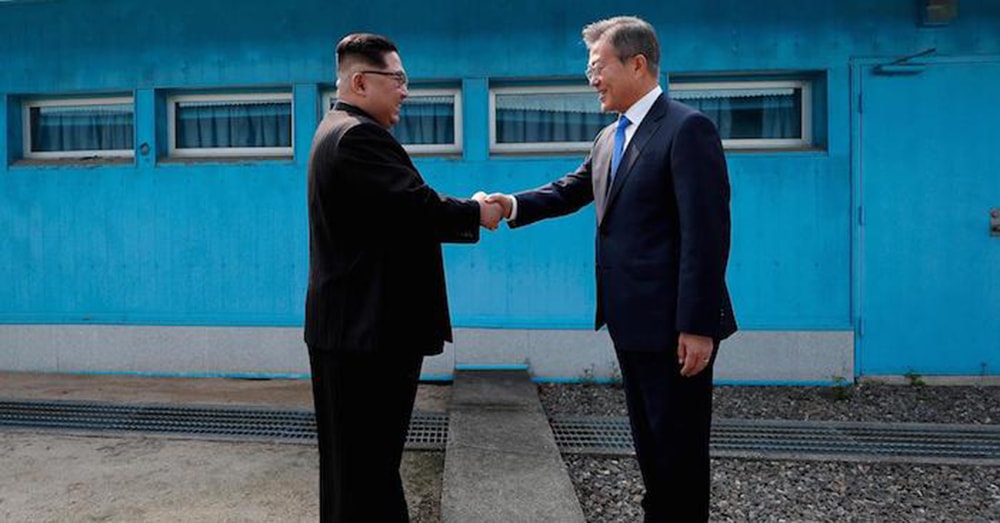 |
| The historic handshake between South Korean President Moon Jae-in and North Korean leader Kim Jong-un. Photo: Getty |
To realize the commitments made, over the past two years, 36 rounds of bilateral talks at various levels have been held, including the second and third inter-Korean summits; 7,500 people from both sides have been reunited… The military hotline between South Korea and North Korea has been restored after years of being cut off. For the past two years, military officials from both Koreas have regularly spoken by phone twice a day, at 9:00 AM and 4:00 PM, through the eastern and western communication lines of both sides.
Furthermore, following the success of the historic inter-Korean summit, another historic event, the first US-North Korea summit, also took place amidst the excitement and expectations of the people of both Koreas. However, since the second US-North Korea summit failed to produce a joint declaration, things have become far from easy!
Reconnecting road and rail links between the two Koreas was one of the key agreements of the summit two years ago.
Yesterday, April 27th, South Korea held a small, rather quiet ceremony at Jejin Station in the border town of Goseong, in the far north of South Korea on the East Coast. The ceremony aimed to reiterate Seoul's commitment to promoting rail connectivity and other inter-Korean exchanges agreed upon at the summit two years ago. Reconnecting road and rail links between the two Koreas is one of the key agreements. South Korea plans to invest 2.85 trillion won (approximately $2.3 billion USD) to build a railway line over 110 km long from the coastal city of Gangneung to the border town of Jejin.
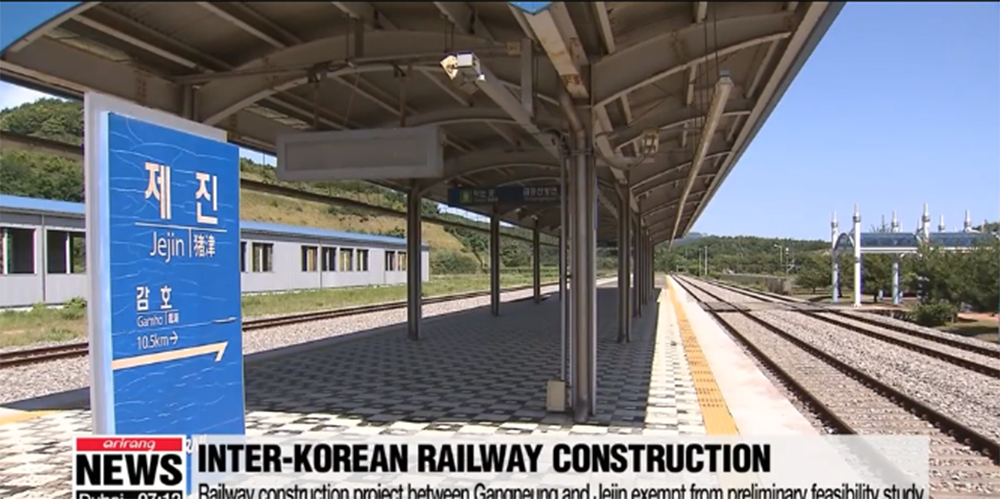 |
| South Korea has begun construction on a 110.9-kilometer railway line from the coastal city of Gangneung to the border town of Jejin. (Photo: Arirang) |
It should be recalled that the two sides held a groundbreaking ceremony for the project in the border town of Kaesong in December 2018, but in reality, the project has not yet commenced due to obstacles related to international sanctions against North Korea.
Although just last week, South Korea declared the Gangneung-Jejin railway line a crucial inter-Korean cooperation project, and would expedite construction without a feasibility study, the reality is that as long as North Korea remains subject to US sanctions, cooperation projects, including this railway project, are unlikely to become feasible anytime soon!
…to an uncertain future!
Just before the second anniversary of the inter-Korean summit, South Korean media reported that the US appeared to have detected signs that North Korea was preparing for a missile launch. Prior to that, in March, Pyongyang had also made a series of military moves, including a large-scale test firing of short-range missiles. Even at the end of March, the country confirmed the successful testing of a "super-large multi-barreled" rocket launcher.
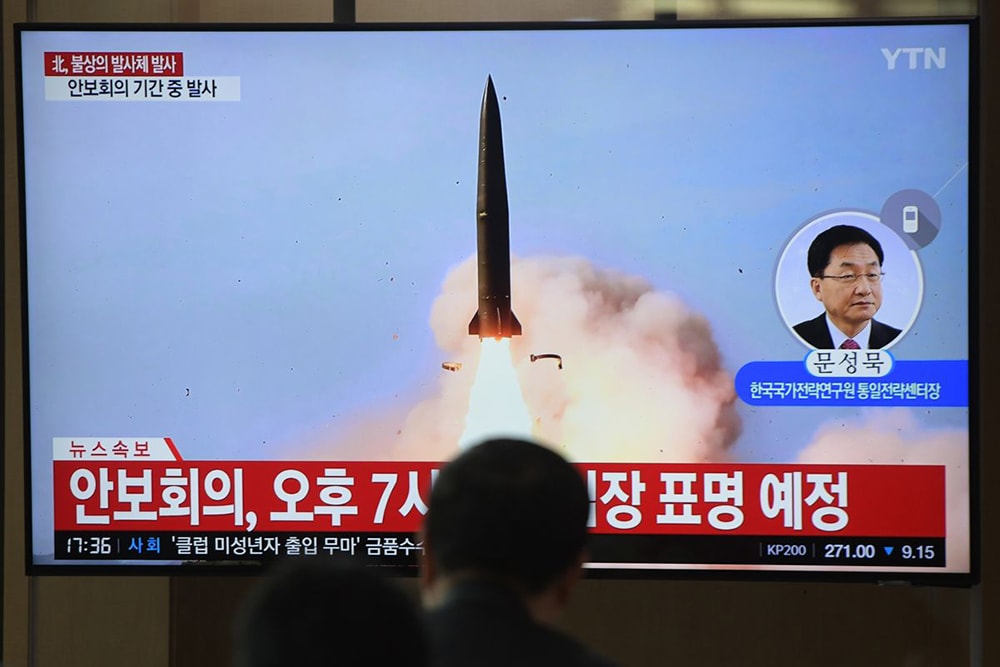 |
| North Korea repeatedly test-fired short-range missiles in March. (Photos: AFP, Getty) |
Clearly, Pyongyang's repeated military maneuvers are no accident. Observers believe these steps raise concerns that North Korea may be returning to a hardline policy, determined to pursue its missile and nuclear weapons programs despite international opposition.
The vast differences have prevented both sides from making any further progress in the dialogue.
This is also because, despite three direct meetings between US President Donald Trump and North Korean leader Kim Jong-un, denuclearization negotiations between the two sides have remained deadlocked for over a year due to unresolved disagreements over the scope of North Korea's denuclearization and concessions from the US. While Pyongyang wants a gradual reduction in scale corresponding to Washington's sanctions lifting, the US insists on immediate denuclearization of the Korean Peninsula. This vast difference has prevented any further progress in dialogue over the past year.
Furthermore, the "South Korean" catalyst has not been effective recently, as President Moon Jae-in has had to focus his efforts on the general election in his country. Although his ruling party won, the 2022 South Korean presidential election is still ahead. Therefore, while public opinion hopes that the ruling party's victory will be a stepping stone, giving President Moon Jae-in the impetus to "rekindle" his role as a mediator between the US and North Korea, the reality is that the chances are slim!
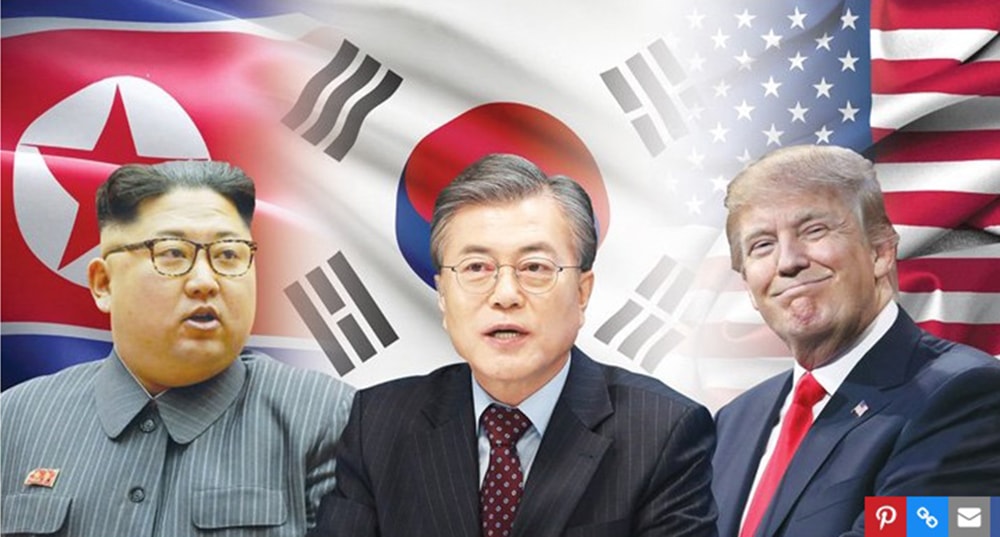 |
| The three countries with a long and complicated history: the US, South Korea, and North Korea. Photo: Korea Times |
Meanwhile, on the US side, President Donald Trump has recently adopted a strategy of "silence" and "ignorance" regarding all moves from North Korea. However, this does not mean that the US will take new steps to break the deadlock in nuclear negotiations. Simply put, Trump is only interested in dedicating his time to the presidential race and combating the Covid-19 pandemic domestically. And, no matter how impatient Pyongyang may be, any new moves by the US will only be made after the end of this year!